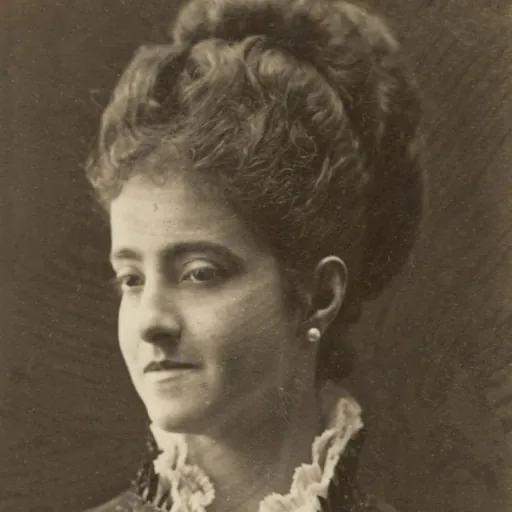
About Adelina Patti
Lived 1843 – 1919 (aged 76). Adelina Patti was a Spanish opera singer, composer and lyric coloratura soprano.
Adela Juana Maria Patti (19 February 184327 September 1919), commonly known as Adelina Patti, was a Spanish-Italian opera singer. At the height of her career, she was earning huge fees performing in the music capitals of Europe and America. She first sang in public as a child in 1851, and gave her last performance before an audience in 1914. Along with her near contemporaries Jenny Lind and Christina Nilsson, Patti remains one of the most famous sopranos in history, owing to the purity and beauty of her lyrical voice and the unmatched quality of her bel canto technique.
The composer Giuseppe Verdi, writing in 1877, described her as being perhaps the finest singer who had ever lived and a "stupendous artist". Verdi's admiration for Patti's talent was shared by numerous music critics and social commentators of her era.
Biography
She was born Adela Juana Maria Patti, in Madrid, the youngest child of tenor Salvatore Patti (1800–1869) and soprano Caterina Barilli (died 1870). Patti sang professionally from childhood, and developed into a coloratura soprano with perfectly equalized vocal registers and a surprisingly warm, satiny tone. Patti learned how to sing and gained understanding of voice technique from her brother-in-law Maurice Strakosch, who was a musician and impresario.
Vocal development
Adelina Patti made her operatic debut at age 16 on 24 November 1859 in the title role of Donizetti's Lucia di Lammermoor at the Academy of Music, New York. On 24 August 1860, she and Emma Albani were soloists in the world premiere of Charles Wugk Sabatier's Cantata in Montreal which was performed in honour of the visit of the Prince of Wales. In 1861, at the age of 18, she was invited to Covent Garden, to perform the role of Amina in Bellini's La sonnambula.
Financial acumen and retirement In her prime, Patti commanded a payment of $5,000 per night, in gold. Her contracts stipulated that her name be top-billed and printed larger than any other name in the cast.
In his memoirs, the famous opera promoter "Colonel" Mapleson recalled Patti's stubborn personality and sharp business sense. She reportedly had a parrot whom she had trained to shriek, "CASH! CASH!" whenever Mapleson walked in the room. Jerome K. Jerome wrote in 1926:
Patti enjoyed the trappings of fame and wealth, but she was not profligate with her earnings, especially after losing a large proportion of her assets as a result of the break-up of her first marriage (see below). She invested wisely large sums of money, and unlike some of her extravagant former colleagues, such as the star tenor Giovanni Mario, who died in poverty, she saw out her days amid luxurious surroundings.
In 1893, Patti created the title role of Gabriella in a now-forgotten opera by Emilio Pizzi at its world premiere in Boston. Patti had commissioned Pizzi to write the opera for her.
Ten years later, she undertook one final singing tour of the United States; however, it turned out to be a critical, financial and personal failure, owing to the deterioration of her voice through age and wear-and-tear. From then on she restricted herself to the occasional concert here or there, or to private performances mounted at a little theatre she had built in her impressive residence, Craig-y-Nos Castle in Wales. She last sang in public on 24 October 1914, taking part in a Red Cross concert at London's Royal Albert Hall that had been organised to aid victims of World War I. She lived long enough to see the war end, dying in 1919 of natural causes.
Recordings
The first recordings of her voice were made ca. 1890 on phonograph cylinders for Thomas Marshall in New York. Neither the recorded titles, nor their numbers are known. All but one of these cylinders have been lost. The sole surviving cylinder remains at Syracuse University in New York. Due to its fragility it is unable to be played without the risk of damage.
Patti cut more than 30 disc gramophone recordings of songs and operatic arias (some of them duplicates) — plus one spoken voice recording (a New Year's greeting to her third husband, which she intended him to keep as a memento) — at her Welsh home in 1905 and 1906 for the Gramophone & Typewriter Company. By then she was aged in her 60s, with her voice well past its prime after a busy operatic career stretching all the way back to 1859.
Nonetheless, her tone and legato line remained strong, compensating for her overall breath control. The records also display chest voice, mellow timbre, and trill.
Patti's recorded legacy included a number of songs and arias from the following operas: Le Nozze di Figaro, Don Giovanni, Faust, Martha, Norma, Mignon and La sonnambula.
The records were produced by the Gramophone & Typewriter Company, forerunner of EMI Records, and were issued in the United States by the Victor Talking Machine Company. Patti's piano accompanist, Landon Ronald, wrote of his first recording session with the diva, "When the little (gramophone) trumpet gave forth the beautiful tones, she went into ecstasies! She threw kisses into the trumpet and kept on saying, 'Ah! Mon Dieu! Maintenant je comprends pourquoi je suis Patti! Oh oui! Quelle voix! Quelle artiste! Je comprends tout!' [Ah! My Lord! Now I understand why I am Patti! Oh yes! What a voice! What an artist! I understand everything!] Her enthusiasm was so naïve and genuine that the fact that she was praising her own voice seemed to us all to be right and proper."
Thirty-two Patti recordings were reissued on CD in 1998 by Marston Records (catalogue number 52011-2).
Personal life
Engaged as a minor to Henri de Lossy, Baron of Ville, Patti wed three times: first, in 1868, to Henri de Roger de Cahusac, Marquess of Caux (1826–1889). The marriage soon collapsed; both had affairs and de Caux was granted a legal separation in 1877 and divorced in 1885. The union was dissolved with bitterness and cost her half her fortune.
She then lived with the French tenor Ernesto Nicolini for many years until, following her divorce from Caux, she was able to marry him in 1886. That marriage lasted until his death and was seemingly happy, but Nicolini disinherited Patti, suggesting some tension in the last years.
Patti's last marriage, in 1899, was to Baron Rolf Cederström (1870–1947), a priggish, but handsome, Swedish aristocrat many years her junior. The Baron severely curtailed Patti's social life. He cut down her domestic staff from 40 to 18, but gave her the devotion and flattery that she needed, becoming her sole legatee. After her death, he married a much younger woman. Their only daughter, Brita Yvonne Cederström (born 1924), ended up as Patti's sole heir. Patti had no children, but was close to her nieces and nephews. The three-time Tony Award-winning Broadway actress and singer Patti LuPone is a great-grandniece and namesake. Drummer Scott Devours is her third great nephew.
Patti developed a love for billiards and became a reputable player, making guest appearances at many major billiard events for exhibition matches and fancy shot displays.
In her retirement, Patti, now officially Baroness Cederström, settled in the Swansea Valley in Wales, where she purchased Craig-y-Nos Castle. There she had a $2000 billiard table installed, and her own private theatre, a miniature version of the one at Bayreuth, and made her gramophone recordings.
Patti also funded Craig-y-nos railway station on the Neath and Brecon Railway. In 1918, she presented the Winter Garden building from her Craig-y-Nos estate to the city of Swansea. It was re-erected and renamed the Patti Pavilion. She died at Craig-y-Nos and eight months later was buried at the Père Lachaise Cemetery in Paris to be close to her father and favourite composer, Rossini, in accordance with the wishes in her will.
Voice Adelina Patti had a high soprano voice. Her vocal emission was of perfect equality and her vocal range was wide, from low C to high F (C4 – F6).
Accolades and homages La Vie parisienne by Jacques Offenbach, with book by Henri Meilhac and Ludovic Halévy (1866), mentions Adelina Patti: "Je veux, moi, dans la capitale Voir les divas qui font fureur Voir la Patti dans Don Pasquale Et Thérésa dans le Sapeur"
Other works of literature and music evoking Patti include: Anna Karenina by Leo Tolstoy The Picture of Dorian Gray by Oscar Wilde The Age of Innocence by Edith Wharton Nana by Émile Zola Boroña by Leopoldo Alas Sherlock Holmes by Arthur Conan Doyle The Village in the Treetops by Jules Verne Hitty, Her First Hundred Years by Rachel Field The song "The Deadwood Stage (Whip-Crack-Away!)" featured in both Calamity Jane film and Calamity Jane stage musical mentions a hat that Patti wore as part of the contents for sale in the stagecoach's offerings. In the 1890s, African-American singer Sissieretta Jones adopted the stage name "Black Patti," and called her company "Black Patti's Troubadours." The Ballad of Baby Doe by Douglas Moore
Don’t just read it —
keep it.
Full-length biographies made to live with: read them, listen on the way to work, watch them tonight.
- E-book
- Audio
- Video
Instant download · yours to keep · every purchase keeps this site free
Important facts
Family & relationships
People in Adelina Patti's life
Named in this biography and alive at the same time



Related people
Same field, nearest in time

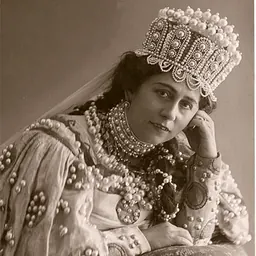
Contemporaries
People whose lives overlapped Adelina Patti's
Frequently asked questions
Who was Adelina Patti?
Spanish opera singer (1843–1919)
When was Adelina Patti born?
Adelina Patti was born on 10 February 1843 in Madrid.
When did Adelina Patti die?
Adelina Patti died on 27 September 1919 in Brecon.
What was Adelina Patti's occupation?
Adelina Patti was an opera singer, composer and lyric coloratura soprano.
What nationality was Adelina Patti?
Adelina Patti was Spanish.
Sources & further reading
Cite this page
APA: Biography.guide. (2026). Adelina Patti. https://biography.guide/adelina-patti/
MLA: "Adelina Patti." Biography.guide, https://biography.guide/adelina-patti/.
Chicago: "Adelina Patti." Biography.guide. https://biography.guide/adelina-patti/.
Data last updated: 2026-09-22 · Spot an error? Report a correction.
Portrait: Wikimedia Commons · author & licence
Page generated 2026-09-27 04:59 UTC