
About Adam Stegerwald
Lived 1874 – 1945 (aged 70). Adam Stegerwald was a German politician, joiner, minister and union member.
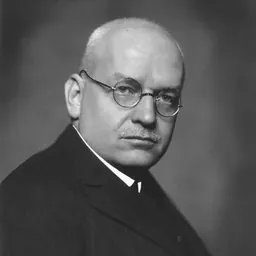
Adam Stegerwald (14 December 1874 – 3 December 1945) was a German politician and union leader who served as chairman of the German Trade Union Federation (DGB), the Catholic trade union association, during the Weimar Republic. He was also a prominent member of the Catholic Centre Party and served briefly as Minister-President of Prussia in 1921. After the Second World War, he was a co-founder of the Christian Social Union in Bavaria.
Early life and Imperial period Stegerwald was born the son of a farmer in Greußenheim in Lower Franconia and attended primary school there between 1881 and 1888 before completing an apprenticeship as a carpenter in Würzburg. From 1900 to 1902, Stegerwald studied economics under Lujo Brentano at the Ludwig-Maximilians-Universität München. He began his engagement with the labour movement in 1893, when he joined the Catholic Gesellenverein, a non-union Catholic labour society, in Günzburg. From 1896, he was part of the workers' electoral association of the Centre Party in Munich, where he was committed to building the burgeoning Catholic trade union movement. He advanced quickly, becoming honorary chairman of the Central Union of Christian Woodworkers in 1899 and, in 1903, general-secretary of the General Association of German Christian Trade Unions, a position he retained until 1929.
In his political role, he steered a conservative course, supporting the Empire and its colonial ambitions. He attempted to unify the non-socialist unions, such as the Protestant DHV and the Catholic Gesellvereine, into a unified organisation to create a counterweight to the socialist free trade unions, though he was unsuccessful. He supported the German war effort in the First World War and served on the board of the Wartime Food Office from 1916 to 1919, as well as in the Prussian House of Lords during the final year of the war.
Weimar Republic Union leader In the aftermath of the November Revolution, Stegerwald represented the Catholic trade unions in co-signing the 15 November working agreement between the unions and employers' associations. The working agreement set out a common understanding between labour and capital, acknowledging unions as the legitimate representatives of the workers and setting out the basis for collective bargaining agreements and the eight-hour day.
Throughout the following year Stegerwald called for the end to the workers' council movement which was popular among many radical workers, mostly in the socialist unions. In 1919, he became head of the German Trade Union Federation (DGB), the reorganised Christian trade union federation. Initially, it bore a close resemblance to Stegerwald's prewar proposal of a broad non-socialist union federation, including the Catholic unions as well as the liberal and the Protestant white-collar associations. However, the more secular Hirsch-Duncker unions departed in November, leaving the DGB largely dominated by the Catholic unions with a deeply conservative Protestant minority in the German National Association of Commercial Employees (DHV).
As leader of the DGB, Stegerwald struggled to maintain the unity of the federation's conflicting parts. Left-wing elements such as the Catholic miners' and industrial unions resented Stegerwald's conservative orientation and his continuous attempts to find common cause with conservative Protestants rather than seek better conditions for workers. At the same time, he sought constantly to appease the ultraconservative white-collar DHV. In 1927, he sided with the DGB's industrial unions in opposing a widely-agreed wage increase for civil servants. This effort failed and alienated him from the white-collar elements of the DGB, to whom he had previously been a stalwart ally.
Stegerwald strongly advocated for the Centre to form part of a conservative government in the Reich under Hans Luther, using his role as head of the DGB to claim widespread union support. For this he received a cold reception at the October 1924 congress of the DGB's industrial unions and was attacked by Heinrich Imbusch, head of the miners' union. Ultimately the unions passed a resolution declaring neutrality in political affairs and Stegerwald was forced to walk back his previous statements. When the first Luther cabinet was invested the following January, the majority of the labour representatives among the Centre's Reichstag delegation did not support it. The following month, he helped lead negotiations with the Nazi Party to secure the Centre's support for the Enabling Act of 1933 which handed de facto dictatorial power to Hitler.
From 1933 to 1934 he was indicted, along with Wilhelm Marx and Heinrich Brauns, in the trial of the Cologne Volksverein Verlag in his capacity as board member of the National Association for Catholic Germany. He was on the list of politicians to be purged during the Night of the Long Knives, but received warning and disappeared into exile for three months. He retired to Franconia during the regime, and in letters to former colleagues urged church leaders to appease the government for fear of the churches' dissolution.
Following the 20 July plot, he was temporarily arrested under the Aktion Gitter. From August to October 1944 he was detained by the Gestapo in Würzburg prison before being released.
Post-war Following the end of the Second World War, the American occupation authority appointed the 71-year-old Stegerwald administrator of the Lower Franconia district. He became leader of the "Würzburg group" which proved instrumental in the foundation of the Christian Social Union in Bavaria in the late summer and autumn of 1945. In Stegerwald's speeches and writing it was clear he considered the new party the fulfillment of his "People's Party" concept of 1920, serving as a "bridge" between denominations, classes, and generations; he coined the name "Christian Social Union". Despite the desire of some Catholic labour leaders to found a united labour party with the socialist unions, and of other Catholic leaders to re-found the Centre Party, Stegerwald's model was ultimately taken up nationwide in the form of the Christian Democratic Union of Germany.
Adam Stegerwald died of pneumonia in December 1945. He has been honoured extensively, with streets named after him in numerous towns and cities across Germany. Two political education foundations, the Adam Stegerwald Circle and Stegerwald Foundation, are named in his honour. A neighbourhood in Cologne, Stegerwaldsiedlung, is also named for him. Two buildings in Würzburg are named Adam-Stegerwald-Haus: the office of the regional CSU branch as well as a student accommodation building. Another building in Königswinter, originally acquired by Jakob Kaiser and used by Catholic welfare and political associations in the Weimar period, was renamed Adam-Stegerwald-Haus in 1948 after its acquisition by the new German Trade Union Confederation. After housing a number of different organisations over the decades, the building was sold in 2015 and converted into a nursing home, retaining its name.
Don’t just read it —
keep it.
Full-length biographies made to live with: read them, listen on the way to work, watch them tonight.
- E-book
- Audio
- Video
Instant download · yours to keep · every purchase keeps this site free
Important facts
People in Adam Stegerwald's life
Named in this biography and alive at the same time



Related people
Same field, nearest in time





Contemporaries
People whose lives overlapped Adam Stegerwald's

Frequently asked questions
Who was Adam Stegerwald?
German politician (1874-1945)
When was Adam Stegerwald born?
Adam Stegerwald was born on 14 December 1874 in Greußenheim.
When did Adam Stegerwald die?
Adam Stegerwald died on 3 December 1945 in Würzburg.
What was Adam Stegerwald's occupation?
Adam Stegerwald was a politician, joiner, minister and union member.
What nationality was Adam Stegerwald?
Adam Stegerwald was German.
Sources & further reading
Cite this page
APA: Biography.guide. (2026). Adam Stegerwald. https://biography.guide/adam-stegerwald/
MLA: "Adam Stegerwald." Biography.guide, https://biography.guide/adam-stegerwald/.
Chicago: "Adam Stegerwald." Biography.guide. https://biography.guide/adam-stegerwald/.
Data last updated: 2026-09-20 · Spot an error? Report a correction.
Page generated 2026-09-27 05:28 UTC