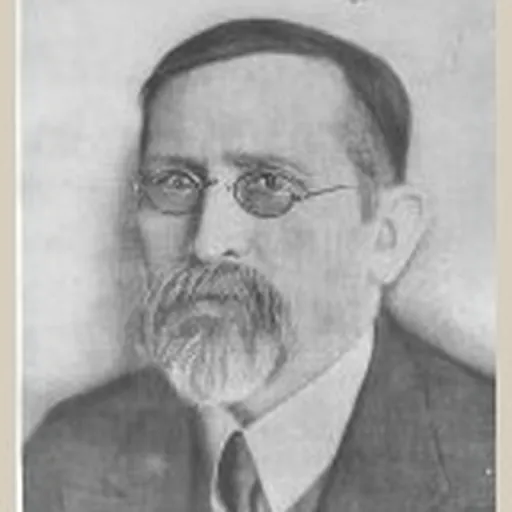
About Adam Rakovsky
Lived 1879 – 1941 (aged 61). Adam Rakovsky was a Russian chemist and chemistry.
Adam Vladislavovich Rakovsky (; 1879–1941) was a Soviet physical chemist specializing in chemical thermodynamics ; Doctor of Chemical Sciences (1935, awarded without dissertation defense), Professor, and Corresponding Member of the USSR Academy of Sciences (1933).
Biography
Adam Vladislavovich Rakovsky was born on December 12 (December 24, N.S.), 1879, in Mezhyrich, Siedlce Governorate (later part of the Warsaw Voivodeship, Poland), into a family of a schoolteacher.
In 1898, he graduated from the classical gymnasium in Biała, Siedlce Governorate, and from that year onward lived in Moscow. In 1903, he graduated from the natural sciences department of the Faculty of Physics and Mathematics at Moscow University, having studied under N. D. Zelinsky and V. F. Luginin. After graduation, he worked at the Moscow Central Chemical Laboratory of the Ministry of Finance (renamed in 1919 as the Institute of Pure Chemical Reagents): he worked as its director from 1917 to 1919 and as head of the Inorganic Chemistry Laboratory from 1919 to 1941. In 1914, he defended his master's thesis at St. Vladimir University in Kyiv on the topic “On the Theory of Adsorption”.
From 1915, Rakovsky taught at Moscow University: as a private docent (1915–1918), then as a professor (from 1918), and worked as chairman of the University’s Chemistry Department and of the Subject Chemistry Commission (1922–1928). Concurrently, from 1920 to 1922, he was a member of the management board of Moscow chemical plants under the Chemical Department of the Supreme Council of National Economy and a member of the Collegium of Chemistry at the Pharmaceutical Laboratory of the Chemical Department; he also worked as a consultant for Tsentrospirt, MinTsvetZolota and Giredmet. Upon the establishment of the Faculty of Chemistry at Moscow University in 1929, Adam Vladislavovich was appointed head of the Department of Inorganic Chemistry and, from 1930 onward, headed the Department of Physical Chemistry until his death. In 1933, he was elected Corresponding Member of the Department of Mathematical and Natural Sciences (Physical Chemistry) of the USSR Academy of Sciences. From 1933 to 1937, he worked as Dean of the Faculty of Chemistry and Director of the Research Institute of Chemistry at Moscow University.
He lived in Moscow at 29 Nikoloyamskaya Street and 4 Samokatnaya Street. He died on June 7, 1941, in Moscow and was buried at Vvedenskoye Cemetery (section 19).
Scientific research
Adam Vladislavovich Rakovsky began his scientific career while working at the Central Chemical Laboratory of the Ministry of Finance (later renamed the Institute of Pure Chemical Reagents in 1919). During this period, he published a series of articles on rectification of alcohol, the kinetics of aqueous-alcoholic solutions, and the kinetics of consecutive first-order reactions. Additionally, he collaborated with other scientists on various research projects: with A. V. Frost on quantitative determination of trace chlorine in pharmaceuticals; with D. N. Tarasenkov on determination of sulfuric acid in the presence of chromic acid; and with Reichshtein on detection of selenium in sulfuric acid. These works were published in 1927.
During his master’s thesis research, Rakovsky conducted extensive investigations into the adsorption of water and aqueous solutions by starch. In particular, he carried out numerous experiments with starch and other adsorbents and demonstrated that in these cases the process is described by a complex sinusoidal equation. He also showed that adsorption of alkali and alkaline earth metal hydroxides follows a hydrolysis equation. In total, the solubility of 27 ternary systems and one quaternary system was experimentally investigated.
Rakovsky also conducted research on heteropoly compounds and the electronic theory of valence. and conducted supplementary sessions for senior students.
Rakovsky also taught courses in colloid chemistry. Between 1926 and 1931, he published several of his own courses, translated books, and textbooks on inorganic and physical chemistry. Around 1934, he began delivering lectures on physical chemistry. He was among the first educators to establish a coherent, systematic approach to its instruction. A notable innovation he introduced into his physical chemistry lectures was the study of the structure of matter. In 1938, his book “Introduction to Physical Chemistry” was published followed in 1939 by “Course of Physical Chemistry”.
A. V. Rakovsky’s views on chemistry education
Rakovsky advocated the lecture method of teaching but viewed lectures primarily as a means to motivate students toward independent study of scientific subjects through books. He rejected the practice of combining lectures with seminar sessions, believing they consumed too much time and offered students minimal benefit. Regarding laboratory classes, Rakovsky pointed out that strict time limits imposed on practical sessions negatively affected the quality of chemistry education.
Works
Раковский А.В. К учению об адсорбции (To the doctrine of adsorption). М.: печатня А.И. Снегиревой, 1913. – 194 с. Раковский А.В. Термодинамика химических процессов (записки студ. лекций, читанных в 1 МГУ – 1926-1927 г.) (Thermodynamics of Chemical Processes (Student Lecture Notes from Moscow State University, 1926–1927). М.: б.и., 1926-1927. – 270 с. Раковский А.В. Химическая кинетика и катализ. Доп. выпуск к основным началам физической химии А. Эйкена. Руководство для высш. учеб. заведений (Chemical Kinetics and Catalysis. Supplementary Volume to the Fundamentals of Physical Chemistry by A. Eucken. A Textbook for Higher Educational Institutions). М.-Л.: Гос. науч.-тех. изд., 1931. – 84 с. Партингтон Дж. Р., Раковский А.В. Курс химической термодинамики: Пер. с англ. с дополнениями (A Course in Chemical Thermodynamics: Translated from the English with Additions). М. ; Л. : Гос. научно-техн. изд-во, 1932. - 382 с. Раковский, А.В., Краузе Э.Ф., Богомолов А.Е. Курс общей и неорганической химии. Т. 1. (Course in General and Inorganic Chemistry. Vol. 1). М. ; Л. : НКТП СССР, Гос. химико-техн. изд-во, 1933. - 420 с. Раковский, А.В. Курс физической химии : Учеб. для хим. ВТУЗов (Course in Physical Chemistry: A Textbook for Chemical Engineering Institutes). М. : НКХП СССР, Гос. НТИ хим. лит., 1939. - 544 с.
Don’t just read it —
keep it.
Full-length biographies made to live with: read them, listen on the way to work, watch them tonight.
- E-book
- Audio
- Video
Instant download · yours to keep · every purchase keeps this site free
Important facts
Related people
Same field, nearest in time




Contemporaries
People whose lives overlapped Adam Rakovsky's


Frequently asked questions
Who was Adam Rakovsky?
Academician, Professor
When was Adam Rakovsky born?
Adam Rakovsky was born on 24 December 1879 in Siedlce Governorate.
When did Adam Rakovsky die?
Adam Rakovsky died on 7 June 1941 in Moscow.
What was Adam Rakovsky's occupation?
Adam Rakovsky was a chemist and chemistry.
What nationality was Adam Rakovsky?
Adam Rakovsky was Russian.
Sources & further reading
Cite this page
APA: Biography.guide. (2026). Adam Rakovsky. https://biography.guide/adam-rakovsky/
MLA: "Adam Rakovsky." Biography.guide, https://biography.guide/adam-rakovsky/.
Chicago: "Adam Rakovsky." Biography.guide. https://biography.guide/adam-rakovsky/.
Data last updated: 2026-09-22 · Spot an error? Report a correction.
Portrait: Wikimedia Commons · author & licence
Page generated 2026-09-27 05:04 UTC