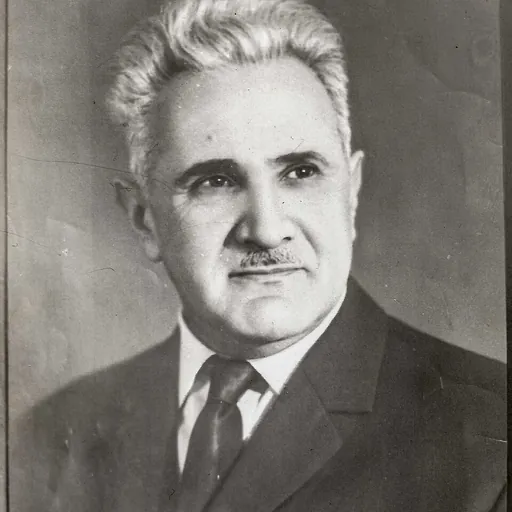
About Abdulkarim Alizadeh
Lived 1906 – 1979 (aged 73). Abdulkarim Alizadeh was a Russian scientist.
Abdulkerim Alizada (in Azerbaijani – Əbdülkərim Əlizadə; in English sometimes spelled as Alizadeh or Alizade; 1906–1979), was an Azerbaijani historian, writer, and orientalist and a member of the Azerbaijan National Academy of Sciences. His works spans the medieval history of Azerbaijan and the countries of the Near and Middle East. Because of his contributions and researches, Alizada was awarded the USSR State Prize in Science, the Mirza Fatali Akhundov State Prize of the Azerbaijan SSR (1978), the Order of the Red Banner of Labour (1966), Medal "For the Defence of the Caucasus", Medal "For Valiant Labour in the Great Patriotic War 1941–1945", and the Order of the Badge of Honour.
Biography Alizada was born on 11 January 1906 into the family of a religious community leader, Sheikh Ali, in the village of Bilgah, north of Baku. In 1908 the family moved to Tehran, where Alizada spent his childhood years, received his primary education, and mastered Persian and Arabic. Upon returning to Baku in 1917, he continued his studies at a special secondary school. In 1922 he enrolled in the Rabfak (workers' faculty), from which he graduated in 1926. In the same year, Abdulkerim was assigned to the Leningrad Institute of Oriental Studies. Upon graduation from the Institute in 1930, he was admitted to the postgraduate course of the State Academy of the History of Material Culture. The academic environment of Leningrad was crucial to Alizada's development as a scientist, determining the main directions of his future scientific research. His teachers were leading lights of Russian and international Oriental studies such as Vasily Bartold, Nikolai Marr, Ignaty Krachkovsky, Ivan Meshchaninov, Aleksandr Romaskevich, Alexander Samoylovich, Vasily Struve, and others. After defending his PhD thesis in 1935, Alizada took a position as a research fellow at the Museum of Asia (currently known as the Institute of Oriental Manuscripts of the Russian Academy of Sciences) in Leningrad. During the same period, he taught Persian at the Leningrad Institute of Oriental Studies (1936–1938) and at the Faculty of Oriental Studies of the Leningrad State University (1938–1939).
Alizada was a member of the Academy of Sciences of the Azerbaijan SSR since 1955. He was awarded the degree of the Honoured Scientist of the Azerbaijan SSR in 1960. He was the first director of the Institute of Oriental Studies of the Academy of Sciences of the Azerbaijan SSR (1958–1963). He also actively participated in the Ladoga Archaeological Expedition and maintained his passion for archaeology throughout his entire life. Soon, he established himself as a brilliant expert in medieval Persian literature. For this reason, he was appointed to prepare a scholarly edition of Jami al-tawarikh (The Collection of Chronicles), the monumental work of the medieval historian and scholar Rashid al-Din. Alizada completed this challenging task with the utmost care and The Collection of Chronicles was published as a monograph. In 1938, Alizada, together with Evgenii Bertels, A.A. Aleskerzada, F. Babaev, L.A. Khetagurov, and O.I. Smirnova, began preparing a scholarly-critical edition of the "Khamsa" ("Quintet"). The work was completed in 1940. At the outbreak of World War II, Alizada returned to Baku and took the position of senior researcher at the Institute of History of the Azerbaijani branch of the USSR Academy of Sciences. He was appointed director of the Institute in 1944.
In 1948, Abdulkerim Alizada and Evgenii Eduardovich Bertels were awarded the State Stalin Prize in Science for the publication of their scholarly edition of the Sharafnama of Nizami. Alizada defended his doctoral thesis, "Social, Economic, and Political History of Azerbaijan in the 13th–14th centuries", in Moscow in 1954. It was subsequently published as a separate monograph. From 1963 until the end of his life, Abdulkerim Alizada headed the Department of Textology and Publishing of the Institute of Oriental Studies of the Azerbaijan Academy of Sciences. During the last two decades of his life, Alizada focused his efforts on publishing historical sources covering the history of Iran and Azerbaijan during the Mongol rule. In particular, he meticulously revisited the two volumes of Jami al-tawarikh (the "Collection of Chronicles") by Rashid al-Din, which had been compiled before the war but had remained unpublished. He also edited and published Gulistan-i Iram by Abbasgulu Bakikhanov and three volumes of Dastur al-Katib fi-Tayin al-Maratib by Muhammad ibn Hendushah Nakhjavani. These studies represented a significant contribution to the development of science in Azerbaijan. In recognition of his achievements, Abdulkerim Alizada was awarded the State Prize of the Azerbaijan SSR in 1978. His work has been published in English, German, Persian, Arabic, and Turkish.
Legacy
Alizada published more than a hundred scientific works in his lifetime. He was the pioneering researcher of the forms of medieval land ownership and tax systems in Azerbaijan. He established a scientific field of textologists-medievalists in the Azerbaijan SSR. His research in this field, along with his other publications, marked a crucial stage in the development of medieval studies in Azerbaijan. As Azerbaijan's first prominent medievalist, he played an outstanding role in laying the foundations of this science in Azerbaijan and contributed to the training of an entire generation of researchers. As a result of many years of work, he created his original concept of the history of Azerbaijan in the thirteenth and fourteenth centuries. He participated in international congresses in Warsaw (1955), Munich (1957), Ankara (1961, 1970), Tehran (1966, 1969), Tabriz (1969), and other cities.
Abdulkerim Alizada died on 3 December 1979. The street where he lived in central Baku has been renamed in his honour.
Don’t just read it —
keep it.
Full-length biographies made to live with: read them, listen on the way to work, watch them tonight.
- E-book
- Audio
- Video
Instant download · yours to keep · every purchase keeps this site free
Important facts
People in Abdulkarim Alizadeh's life
Named in this biography and alive at the same time



Related people
Same field, nearest in time

Contemporaries
People whose lives overlapped Abdulkarim Alizadeh's
Frequently asked questions
Who was Abdulkarim Alizadeh?
Azerbaijani Soviet historian
When was Abdulkarim Alizadeh born?
Abdulkarim Alizadeh was born on 11 January 1906 in Bilgəh.
When did Abdulkarim Alizadeh die?
Abdulkarim Alizadeh died on 3 December 1979 in Baku.
What was Abdulkarim Alizadeh's occupation?
Abdulkarim Alizadeh was a scientist.
What nationality was Abdulkarim Alizadeh?
Abdulkarim Alizadeh was Russian.
Sources & further reading
· Wikipedia: Abdulkarim Alizadeh
Cite this page
APA: Biography.guide. (2026). Abdulkarim Alizadeh. https://biography.guide/abdulkarim-alizadeh/
MLA: "Abdulkarim Alizadeh." Biography.guide, https://biography.guide/abdulkarim-alizadeh/.
Chicago: "Abdulkarim Alizadeh." Biography.guide. https://biography.guide/abdulkarim-alizadeh/.
Data last updated: 2026-09-20 · Spot an error? Report a correction.
Page generated 2026-09-27 05:09 UTC