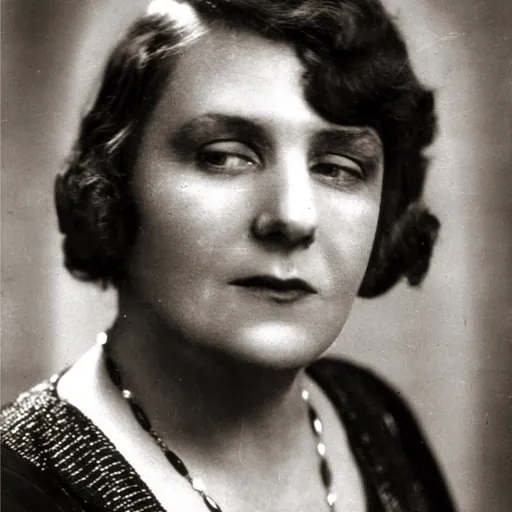
About Zofia Nałkowska
Lived 1884 – 1954 (aged 70). Zofia Nałkowska was a Russian and Polish writer, playwright, journalist, poet, essayist and politician.
Zofia Nałkowska (, 10 November 1884 – 17 December 1954) was a Polish prose writer, dramatist, and prolific essayist. She served as the executive member of the prestigious Polish Academy of Literature (1933–1939) during the interwar period.
Biography
Nałkowska was born into a family of intellectuals dedicated to issues of social justice. She was the sister of the sculptor Hanna Nałkowska. She studied at the clandestine Flying University under the Russian partition. Upon Poland's return to independence and the establishment of the Second Polish Republic she became one of the country's most distinguished feminist writers of novels, novellas and stage-plays characterized by socio-realism and psychological depth.
From 1928, she was vice-president of the Polish PEN Club. In the 1930s, she took an active part in speeches against the Sanation regime. She was one of the organizers of protests against political persecution in Poland. From 1933, she has been a member of the Polish Academy of Literature.
During the German occupation, she was engaged in underground literary activities and after participated in the work of the International Commission for the Investigation of Hitler's Crimes in Poland. A supporter of the new communist authorities in Poland, Nałkowska became a deputy of the State National Council and later a deputy of the National Assembly of the Polish People's Republic.
Nałkowska died of a cerebral hemorrhage and was buried at the Powązki Military Cemetery with full state honours.
Literary output Nałkowska's first literary success was the Romans Teresy Hennert (The Romance of Teresa Hennert, 1923) followed by a slew of popular novels. She is best known for her books Granica (Boundary, 1935), the Węzły życia (Bonds of Life, 1948) and Medaliony (Medallions, 1947).
In her writing, Nałkowska boldly tackled difficult and controversial subjects, professing in her 1932 article "Organizacja erotyzmu" (Structure of Eroticism) published in the Wiadomości Literackie magazine – the premier literary periodical in Poland at the time – that: ...a rational, nay, intellectual approach to eroticism must be encouraged and strengthened, to allow for a consideration of eroticism in conjunction with other aspects of the life of the human community. Eroticism is not a private matter of the individual. It has its ramifications within all domains of human life and it is not possible to separate it from them by way of contemptuous disparagement in the name of morality, discretion, or yet by a demotion on the hierarchy of subjects worthy of intellectual attention: it cannot be isolated by prudery or relegated to science for its purely biological dimension."
Tribute
On 10 November 2014 Google celebrated her 130th birthday with a Google Doodle.
From May 2024, a manuscript Nałkowska's Diary is presented at a permanent exhibition in the Palace of the Commonwealth in Warsaw.
Works Novels Kobiety (Women, 1906), translated by Michael Henry Dziewicki, 1920 Książę (The Prince, 1907) Rówieśnice (Contemporaries, 1909) Narcyza (1911) Noc podniebna (Heavenly night, novella, 1911) Węże i róże (Snakes and roses, 1914) Hrabia Emil (Count Emil, 1920) Na torfowiskach (At the bogs, 1922) Romans Teresy Hennert (The Romance of Teresa Hennert, 1923), translated by Megan Thomas and Ewa Malachowska-Pasek, 2014 Dom nad łąkami (House upon the meadows, autobiography, 1925) Choucas (1927), translated by Ursula Phillips, 2014 (winner of the Found in Translation Award 2015) Niedobra miłość (Bad love, 1928) Granica (Boundary, 1935), translated by Ursula Phillips, 2016 Niecierpliwi (Anxious,1938) Węzły życia (Living ties, 1948) Mój ojciec (My father, 1953)
Short stories Medaliony (Medallions, 1946), a collection of 8 short stories about German World War II atrocities in occupied Poland, translated by Diana Kuprel, 2000
Stage plays Dom kobiet (1930) Dzień jego powrotu (1931) (The Day of his Return, translated by Marja Slomczanka, performed 1931) Renata Słuczańska (1935)
Don’t just read it —
keep it.
Full-length biographies made to live with: read them, listen on the way to work, watch them tonight.
- E-book
- Audio
- Video
Instant download · yours to keep · every purchase keeps this site free
Important facts
People in Zofia Nałkowska's life
Named in this biography and alive at the same time
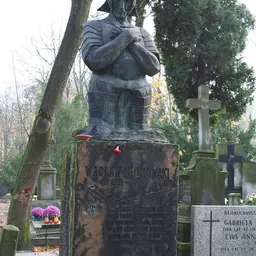

Related people
Same field, nearest in time


Contemporaries
People whose lives overlapped Zofia Nałkowska's

Frequently asked questions
Who was Zofia Nałkowska?
Polish prose writer, journalist & dramatist (1884-1954)
When was Zofia Nałkowska born?
Zofia Nałkowska was born on 10 November 1884 in Warsaw.
When did Zofia Nałkowska die?
Zofia Nałkowska died on 17 December 1954 in Warsaw.
What was Zofia Nałkowska's occupation?
Zofia Nałkowska was a writer, playwright, journalist, poet, essayist and politician.
What nationality was Zofia Nałkowska?
Zofia Nałkowska was Russian and Polish.
Sources & further reading
Cite this page
APA: Biography.guide. (2026). Zofia Nałkowska. https://biography.guide/zofia-nalkowska/
MLA: "Zofia Nałkowska." Biography.guide, https://biography.guide/zofia-nalkowska/.
Chicago: "Zofia Nałkowska." Biography.guide. https://biography.guide/zofia-nalkowska/.
Data last updated: 2026-09-22 · Spot an error? Report a correction.
Portrait: Wikimedia Commons · author & licence
Page generated 2026-09-27 05:02 UTC