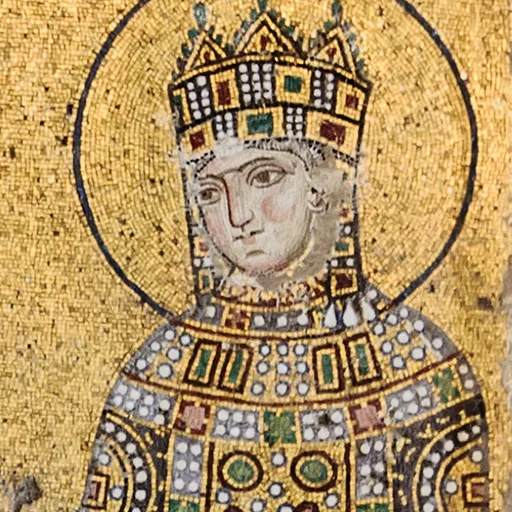
About Zoe Porphyrogenita
Lived 978 – 1050 (aged 71–72). Zoe Porphyrogenita was a Byzantine sovereign.
Ruling with Theodora and Constantine IX: 1042–1050 Zoe immediately assumed power and tried to force Theodora back to her monastery, but the Senate and the people demanded that the sisters should jointly reign. As her first act, Theodora was called upon to deal with Michael V. Zoe wanted to pardon and free Michael, but Theodora was clear and adamant. She initially guaranteed Michael's safety, but then ordered him to be blinded and to spend the rest of his life as a monk.
Officially Zoe was the senior empress, and her throne was situated slightly in front of Theodora's on all public occasions. In practice, Theodora was the driving force behind the joint administration. The sisters proceeded to administer the empire, focusing on curbing the sale of public offices and on the administration of justice. Although contemporary historian Michael Psellus claimed the joint reign was a complete failure, John Scylitzes stated that they were very conscientious in rectifying the abuses of the previous reigns.
Theodora and Zoe appeared together at meetings of the Senate and gave public audiences, but it was soon apparent that their joint reign was under strain. Zoe was still jealous of Theodora and had no desire to administer the empire; but she would not allow Theodora to conduct public business alone. The court began to split, with factions forming behind each empress. After two months of increasing acrimony, Zoe decided to search for a new husbandthereby denying Theodora the opportunity to increase her influence. By the rules of the Orthodox Church her next marriage, her third, was the last she was permitted.
Her preference was for Constantine Dalassenos, who had been her father's first choice as her husband back in 1028. He was brought for an audience before the Empress, but during their conversation his independent and forceful manner displeased Zoe, and he was dismissed from her presence. Her next choice was the married Constantine Atroklines, a court official with whom it was rumoured that she had had an affair during the reign of Romanos III. He died under mysterious circumstances a few days before the wedding was to take place, possibly poisoned by his own soon to be ex-wife.
Zoe then remembered the handsome and urbane Constantine Monomachos, another former lover. The pair were married on 11 June 1042, without the participation of Patriarch Alexios, who refused to officiate over a third marriage (for both spouses). Constantine was crowned by the patriarch the next day.
Zoe got more than she bargained for when Constantine decided to bring with him to his new station his long-standing mistress Maria Skleraina. Not content with bringing her to court, he insisted that he be allowed to publicly share his life with her, and that she obtain some official recognition. The 64-year-old Zoe did not object to sharing her bed and her throne with Skleraina. Skleraina was given the title of sebaste, ranking behind Zoe and Theodora, and was addressed as mistress or empress, like them. At official events Skleraina took position immediately behind the sisters.
In the eyes of the public, however, Constantine IX's preferential treatment of Skleraina was a scandal, and eventually rumours began to spread that Skleraina was planning to murder Zoe, and possibly Theodora. This led to a popular uprising by the citizens of Constantinople in 1044, which came dangerously close to actually harming Constantine, who was participating in a religious procession along the streets of Constantinople. The mob was only quieted by the appearance on a balcony of Zoe and Theodora, who reassured the people that they were not in any danger of assassination.
It is said that Zoe was stunningly beautiful, and Michael Psellos in his Chronographia commented that "every part of her was firm and in good condition". Recognising her own beauty and its use as a tool of statecraft, Zoe attempted to maximise and prolong its effect with a variety of treatments. She operated a cosmetics laboratory in the gynaeceum, and was said to have carried out experiments to improve the efficacy of the perfumes and unguents prepared there. Psellos reports that her face looked youthful into her sixties.
Psellos noted changes in Zoe's personality in her later years; she became deeply pious, and kept a bejeweled statue of Christ in her quarters that she would consult for omens, often passing them on to Constantine. He also claims that she became more extravagant and indolent, and that she developed vindictive tendencies and would order people to be blinded for trivial offenses or none at all, which often compelled Emperor Constantine to intercede on behalf of those condemned.
Zoe died in 1050, aged 72. She was buried in Constantinople. Constantine attempted to have Zoe canonised as a saint, but his efforts foundered on her history of affairs.
Don’t just read it —
keep it.
Full-length biographies made to live with: read them, listen on the way to work, watch them tonight.
- E-book
- Audio
- Video
Instant download · yours to keep · every purchase keeps this site free
Important facts
People in Zoe Porphyrogenita's life
Named in this biography and alive at the same time

Related people
Same field, nearest in time




Contemporaries
People whose lives overlapped Zoe Porphyrogenita's




Frequently asked questions
Who was Zoe Porphyrogenita?
Byzantine Empress
When was Zoe Porphyrogenita born?
Zoe Porphyrogenita was born in 978 in Constantinople.
When did Zoe Porphyrogenita die?
Zoe Porphyrogenita died in 1050 in Constantinople.
What was Zoe Porphyrogenita's occupation?
Zoe Porphyrogenita was a sovereign.
What nationality was Zoe Porphyrogenita?
Zoe Porphyrogenita was Byzantine.
Sources & further reading
· Wikipedia: Zoe Porphyrogenita
Cite this page
APA: Biography.guide. (2026). Zoe Porphyrogenita. https://biography.guide/zoe-porphyrogenita/
MLA: "Zoe Porphyrogenita." Biography.guide, https://biography.guide/zoe-porphyrogenita/.
Chicago: "Zoe Porphyrogenita." Biography.guide. https://biography.guide/zoe-porphyrogenita/.
Data last updated: 2026-09-21 · Spot an error? Report a correction.
Portrait: Wikimedia Commons · author & licence
Page generated 2026-09-27 05:00 UTC