
About Gisela of Swabia
Lived 990 – 1043 (aged 52). Gisela of Swabia was a German sovereign.
Gisela of Swabia ( 990 – 15 February 1043), She reigned as regent for her absent husband in 1037.
Early life Gisela was the daughter of Duke Herman II of Swabia and Gerberga of Burgundy, daughter of King Conrad the Peaceful. Both her parents were descendants of Charlemagne. According to a plate found when her tomb was unearthed, she was born on 11 November 999, but that date cannot be reconciled with the records of her marriages.
Gisela first married the Saxon count Brun I of Brunswick, about 1002. Upon Brun's death, her second marriage was c. 1012 with the Babenberg scion Ernest, who had been enfeoffed with the Duchy of Swabia by King Henry II of Germany at the death of Gisela's brother, Duke Herman III and aimed at legitimising himself as his heir. After Ernest's early death in 1015, Gisela became regent for their minor son Duke Ernest II of Swabia.
Queen and empress Hair of Conrad and Gisela, preserved in the Speyer Cathedral. The strand of blond hair belongs to Gisela.
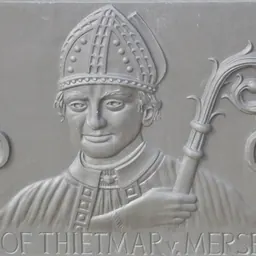
Gisela's third marriage, which took place before January 1017, was to Conrad II, who was elected king of Germany in 1024 and became emperor of the Holy Roman Empire in 1027. According to Thietmar of Merseburg, Archbishop Aribo of Mainz refused to crown her as queen because Gisela and Conrad were too closely related, the couple both descending from King Henry the Fowler. For the same reason, Henry II replaced her as her son's regent with Poppo of Trier, which became the source of conflict between Conrad and Henry.
Gisela played an active part in politics, attending Imperial councils. Also, she participated in several synods of the church. She took care of her sister Matilda's daughters Sophie and Beatrice, who later ruled Bar and Tuscany, respectively.
In 1027, she mediated between Conrad and King Rudolph III of Burgundy, her uncle, leading to a peace agreement in Mutten, near Basel. Rudolph recognized her husband's right of succession in Burgundy.
She tried to mediate between Conrad and her son Ernest II, Duke of Swabia, who repeatedly rebelled against his stepfather. All her efforts broke down though, when in 1030, Ernest refused to act against his friend and vassal Werner of Kyburg and impose peace. She had to give up and swear a public oath not to take revenge should any measure be taken against her son, who had received an imperial ban. In the end, Ernest lost his life fighting against Count Manegold, who was charged by Bishop Warmann of Constance (the guardian of Hermann, her younger son who had become the new duke by then) to reestablish the peace breached by Ernest, Werner and their men.
In 1032, she interceded successfully on the behalf of King Mieszko II Lambert, who regained the favour of Conrad.
She was a long-time donor and patron of the Speyer Cathedral, paying close attention to the development of her family's memorial culture there.
After Conrad's death in 1039, she and her son Henry III led the mourning progression.
During the 1030s, she played an important role as the patron of the new church reform movement. In 1037, she ruled as regent on behalf of Conrad who returned to Italy to deal with a new crisis.
The empress died of dysentery at the Imperial Palace of Goslar in 1043. Gisela's tomb in Speyer was opened in 1900 and her mummified body was found to be tall, with long blond hair.
Gisela was ambitious, intelligent and energetic. As "necessary companion" (necessaria comes) to her husband, she often acted authoritative and decisive in his small circle of advisors. Unlike Conrad, she was educated, thus he often entrusted her with affairs of the Church.
Marriages and children Privately, the imperial pair's relationship was also considered harmonious,
Huschner opines that she must have loved Conrad, with whom she shared what was probably the best years of her life, ruling together at the top. The young Henry's education and development were also in accordance with her wishes. After Conrad's death, she tried to continue her previous role together with Henry III (because Henry's wife, Gunhilda of Denmark, had died), but the new emperor was vehemently against this idea, which led to conflicts between mother and son. Before 1041, she still frequented the court. After this year though, she retired to Goslar.
Conrad II brought back to his wife Gisela the corpse of her son Herman (Conrad II. bringt seiner Frau Gisela die Leiche ihres Sohnes Hermann zurück, Wilhelm Zimmermann's Illustrirte geschichte des deutschen volkes, 1875) Gisela and Brun I, Count of Brunswick had: Liudolf, Margrave of Frisia (c. 1003 – 24 January 1038) Daughter (c. 1004 – ?), married Count Thiemo II of Formbach Gisela (c. 1005 – c. 1052), married Count Berthold of Sangerhausen
Gisela and Ernest I, Duke of Swabia had: Ernest II, Duke of Swabia (c. 1013 – 17 August 1030) Herman IV, Duke of Swabia (c. 1015 – 28 July 1038)
Gisela and Conrad II, Holy Roman Emperor had: Henry III, Holy Roman Emperor (28 October 1017 – 5 October 1056) Matilda (1027 – January 1034), betrothed to Henry I of France Beatrix (c. 1030 – 26 September 1036)
Cultural depictions
In Germany, new studies and exhibitions on Gisela, once almost forgotten together with her husband and their family, have arisen together with the recent interest in the Salians as well as imperial women Gisela is often depicted as an ambitious, intelligent and strong-minded woman who nevertheless, was also a loyal partner to her husband, with whom she formed a harmonious team, instead of pursuing "one's own politics".
Gisela's intercession shows the central role of herself as well as imperial consorts in general in the government. Among 191 (out of 248 diplomata, thus representing 78 percent) in which intercessors appeared, she intervened in 155 cases (85 percent), many of which together with her son, the future Henry III. Gisela was the sole intercessor in 33 diplomata. Of these, 12 of the last 14 times (issued after the couple's stay in Verona) were for Italian recipients.
Huschner opines that although she never had the chance to bear sole responsibility for the highest decisions in the government, Gisela had a significant share in royal-imperial rule and greatly contributed to the consolidation of central government, thus shaping the new dynasty. As imperatrix augusta and consors regni, she was considered co-ruler by her contemporaries (although in documents, the latter title was only used sporadically, and almost exclusively in diplomata granted to Italians—the reason for this rare use was that the previous empress, Cunigunde of Luxembourg, had failed to assert herself in the Chancellery of her husband, Henry II. Zey comments that this also shows how this title is a useful measure for gauging the influence of a queen in the government).
Depictions in arts Contemporary arts
See also:
In 1880, a treasure of golden jewellery of 25 pieces was discovered by building workers. In 1913, Otto von Falke published this discovery and attributed it to Gisela. Since then, it has often been called "Gisela's jewels" or "Gisela's treasure". According to the Frankfurter Rundschau, the treasure is considered "the most important testimony of medieval gold jewellery". There are a lot of debates about the dates, the true origin place of the treasure and the owner though. It is generally agreed that the pieces come from different eras. In a 2017 exhibition Hessisches Landesmuseum Darmstadt, it was argued that the jewels were found in a field near Wiesbaden, with some pieces being nineteenth-century forgeries created to persuade Emperor Wilhelm II to buy them for an excessive price. Mechthild Schulze-Dörrlamm refutes these theories, claiming that the treasure is genuine and the place where they were found is Mainz, but opines that the treasure, with most of the pieces created in the eleventh century, should be associated with Agnes of Poitou, Gisela's daughter-in-law. Charles T. Little from the Metropolitan Museum of Art, relying on the date identified as late tenth century by Hiltrud Westermann-Angerhausen and Hermann Fillitz as well as Byzantine influence, linked the treasure to Theophanu. Peter Lasko suggests a date of Late Carolingian. The most notable piece was the fibula with the eagle (or peacock) shape. Its authenticity has never been doubted, but the latest investigations have also failed to establish a clear date. Birgit Heide opines that the date was either much earlier than the assumed date of the second half of the ninth century (thus Late Carolingian), or between 975 and 1025.
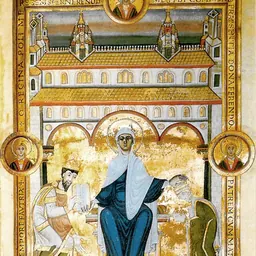
The Golden Gospels of Henry III, commissioned by Henry III, honours himself as well as his mother. An image showing Gisela and Conrad before Christ (fol. 2v) is noted. The couple is depicted as ruling partners, both with crowns, receiving divine blessings and associated with divine figures through adornment, and the colours of their clothing matched (these characteristics are also applied in the portrayal of Henry III and Agnes of Poitou. The tears of Conrad are shown, reminding of a previous argument between father and son, in which Conrad is said to have wept and collapsed (Henry III considered his behaviour justified, and this image seems to show this too).
Later depictions Sculpture
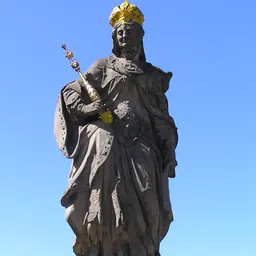
In Speyer, there are a group of statues representing the Salians (Gisela, Conrad II, Henry III, Henry IV, Henry V and secondary figures, created around 1930–1940 by Ludwig Cauer (sculptor, born 1866 in Bad Kreuznach, died 1947 in Bad Kreuznach) and commissioned by Wilhelm Frick, Reich Minister of the Interior.
There are also statues of Conrad, Gisela, Henry III, Henry IV and Bertha in the Kaiser-Halle of the cathedral, erected in the nineteenth century.
Prose Gottlob Heinrich Heinse (1766–1853) wrote the two-volume Ida von Schwaben. Enkelin der Kaiserin Gisela about Ida von Elsdorf, here Ernest II's daughter. Ida was a possible granddaughter to Gisela through Ernest or through Liudolf, Margrave of Frisia. Die Herrin der Kathedrale is a 2013 novel by Claudia and Nadja Beinert about Uta von Naumburg, who was educated in the Gernrode convent before becoming a lady-in-waiting to Empress Gisela, who became her role model as a strong woman. She had to leave the imperial couple to marry Ekkehard von Meißen, whom she did not love. Despite this, she found consolation in a platonic relationship with her brother-in-law Hermann and their common project to build a cathedral in Naumburg.
Theater Ernest II, Gisela and Conrad II in Ingelheim. Engraving by Wilhelm Camphausen (MeisterDrucke-467217) In 1818, August von Kotzebue wrote the four-act Gisela. The main characters included Gisela, her husband Conrad the Older, and Conrad the Younger. The 1818 trauerspiel Ernst, Herzog von Schwaben, written by Ludwig Uhland is the first work exploring Gisela's inner conflict between motherly love towards Ernest and her roles as Conrad's wife and ruler. In 1867, Albert Dulk published the six-act Konrad der Zweite, which describes the story of Conrad, Gisela, her sons Ernest and Henry, Ernest's wife Agnes.
Commemoration Gisela is one of the five empresses (together with Adelaide of Italy, Theophanu, Cunigunde of Luxembourg and Agnes of Poitou), presented as Säulen der Macht (pillars of power), commemorated by the city of Ingelheim am Rhein. There are six stelae at the Heidesheim Gate (Heidesheimer Tor) displaying their lives and work. All five empresses once stayed at the Kaiserpfalz (imperial residence) in Ingelheim.
Don’t just read it —
keep it.
Full-length biographies made to live with: read them, listen on the way to work, watch them tonight.
- E-book
- Audio
- Video
Instant download · yours to keep · every purchase keeps this site free
Important facts
Family & relationships
People in Gisela of Swabia's life
Named in this biography and alive at the same time


Related people
Same field, nearest in time


Contemporaries
People whose lives overlapped Gisela of Swabia's



Frequently asked questions
Who was Gisela of Swabia?
11th century empress of the Holy Roman Empire
When was Gisela of Swabia born?
Gisela of Swabia was born on 11 November 990 in Swabia.
When did Gisela of Swabia die?
Gisela of Swabia died on 14 February 1043 in Goslar.
What was Gisela of Swabia's occupation?
Gisela of Swabia was a sovereign.
What nationality was Gisela of Swabia?
Gisela of Swabia was German.
Sources & further reading
Cite this page
APA: Biography.guide. (2026). Gisela of Swabia. https://biography.guide/gisela-of-swabia/
MLA: "Gisela of Swabia." Biography.guide, https://biography.guide/gisela-of-swabia/.
Chicago: "Gisela of Swabia." Biography.guide. https://biography.guide/gisela-of-swabia/.
Data last updated: 2026-09-28 · Spot an error? Report a correction.
Portrait: Wikimedia Commons · author & licence
Page generated 2026-10-04 13:04 UTC