
About Peter Damian
Lived 1007 – 1072 (aged 64–65). Peter Damian was a diplomat, catholic priest, philosopher, catholic bishop and catholic theologian.
Peter Damian (; or ; – 21 or 22 February 1072 or 1073)
Religious life
About 1035, however, he gave up his secular calling and, avoiding the compromised luxury of Cluniac monasteries, entered the isolated hermitage of Fonte Avellana, near Gubbio. Both as a novice and as a monk, his fervour was remarkable but led him to such extremes of self-mortification in penance that his health was affected, and he developed severe insomnia.
Another innovation was that of the daily siesta, to make up for the fatigue of the night office. During his tenure of the priorate, a cloister was built, silver chalices and a silver processional cross were purchased, and many books were added to the library.
After this, he returned to his hermitage. Damian published a constant stream of open letters on a variety of theological and disciplinary controversies. About 1050, he wrote Liber Gomorrhianus addressed to Pope Leo IX, containing a scathing indictment of the practice of simony, concubinage and sodomy, as threatening the integrity of the clergy. Meanwhile, the question arose as to the validity of the ordinations of simoniacal clerics. Peter Damian wrote (about 1053) a treatise, the Liber Gratissimus, in favour of their validity, a work which, though much combatted at the time, was potent in deciding the question in their favour before the end of the 12th century. Pope Benedict XVI described him as "one of the most significant figures of the 11th century... a lover of solitude and at the same time a fearless man of the Church, committed personally to the task of reform."
Philosophy
Damian was not so much hostile to philosophy as insistent "that the liberal arts, including philosophy, must remain subservient to religion". He argued that monks should not have to study philosophy, because Jesus did not choose philosophers as disciples, and so philosophy is not necessary for salvation. But the idea (later attributed to Thomas Aquinas) that philosophy should serve theology as a servant serves her mistress originated with him. However, this apparent animosity may reflect his view that logic is only concerned with the validity of the argument, rather than the nature of reality. Similar views are found in Al-Ghazali and Wittgenstein.
Damian's tract De divina omnipotentia is frequently misunderstood. Damian's purpose is to defend the "doctrine of omnipotence", which he defines as the ability of God to do anything that is good, e.g., God cannot lie. Toivo J. Holopainen identifies De divina omnipotentia as "an interesting document related to the early developments of medieval discussion concerning modalities and divine omnipotence".
Papal envoy and cardinal During his illness the pope died, and Frédéric, abbot of Monte Cassino, was elected pope as Stephen IX. In the autumn of 1057, Stephen IX determined to make Damian a cardinal. For a long time, Damian resisted the offer, for he was more at ease as an itinerant hermit-preacher than as a reformer from within the Curia, but was finally forced to accept, and was consecrated Cardinal Bishop of Ostia on 30 November 1057.
In addition, he was appointed administrator of the Diocese of Gubbio. The new cardinal was impressed with the great responsibilities of his office and wrote a stirring letter to his brother-cardinals, exhorting them to shine by their example before all. Four months later Pope Stephen died in Florence, and the church was once more distracted by schism. Peter was vigorous in his opposition to the antipope Benedict X, but the force was on the side of the intruder and Damian retired temporarily to Fonte Avallana.
Milan
Around the end of 1059, Peter was sent as legate to Milan by Pope Nicholas II. So bad was the state of things at Milan, that benefices (a reward received in exchange for services rendered and as a retainer for future services) were openly bought and sold, and the clergy publicly married the women with whom they lived.
While he was in France the antipope Cadalous had again become active in his attempts to gain Rome, and Peter Damian brought upon himself a sharp reproof from Alexander and Hildebrand for twice imprudently appealing to the royal power to judge the case anew. In 1067, the cardinal was sent to Florence to settle the dispute between the bishop and the monks of Vallombrosa, who accused the former of simony. His efforts, however, were not successful, largely because he misjudged the case and threw the weight of his authority on the side of the bishop. The matter was not settled until the following year by the pope in person.
Having served the papacy as legate to France and to Florence, he was allowed to resign his bishopric in 1067. After a period of retirement at Fonte Avellana, he proceeded in 1069 as papal legate to Germany and persuaded the emperor Henry IV to give up his intention of divorcing his wife Bertha. He accomplished this task at a council in Frankfurt before returning to Fonte-Avellana.
Early in 1072 or 1073,
His body has been moved six times. Since 1898, Peter Damian has rested in a chapel dedicated to the saint in the cathedral of Faenza. No formal canonization ever took place, but his cult has existed since his death at Faenza, at Fonte-Avellana, at Monte Cassino, and at Cluny.
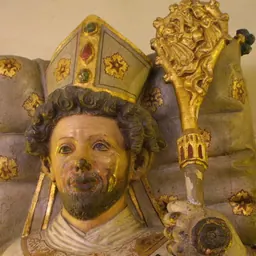
The saint is represented in art as a cardinal bearing a knotted rope (the disciplina) in his hand; also sometimes he is depicted as a pilgrim holding a papal Bull, to signify his many legations.
Peter Daiman is venerated as the patron saint of those suffering from insomnia and other sleep disorders, having forgone sleep during periods of intense prayer during his life. reflect the spiritual conditions of Italy: the groundswell of intense personal piety that would overflow in the First Crusade at the end of the century, and his Latin abounds in denunciatory epithets.
His works include: His most famous work is De Divina Omnipotentia, a long letter in which he discusses God's power. The De Divina Omnipotentia purports to be a letter from Peter Damian to Desiderius, abbot of Monte Cassino. Peter develops a position he had taken in an earlier discussion with Desiderius on the claim of St. Jerome that, although God can do all things, he cannot restore virginity to a woman who had lost it. Desiderius had sided with Jerome; Damian had claimed that God could indeed restore lost virginity. In this letter, Peter defends his views, an undertaking that takes him into the discussion of the scope of divine power, the possibility of God's annulling the past, and the problems that arise from using the language of human temporality to describe divine possibilities in an eternal present. The central question of the nature and scope of divine power is related to previous discussions of the question and to the more sophisticated debates of the later Middle Ages. Damian's apparent claims that the law of contradiction does not apply to God and that God is able to annul the past deserve recognition. In these discussions, Damian shows himself the equal of any of the dialecticians that he so severely criticizes. In the short treatise Dominus vobiscum (The Book of "The Lord be with You") (PL 145:231-252), he questions whether a hermit praying in solitude should use the plural; Damian concludes that the hermit should use the plural since he is linked to the whole church by faith and fellowship. His Life of Romauld and his treatise The Eremitical Order demonstrate his continuing commitment to solitude and severe asceticism as the ultimate form of Christian life. He was especially devoted to the Virgin Mary, and wrote an Officium Beatae Virginis. Liber Gomorrhianus, the treaty about sodomy and insiders of the Catholic Church De Institutione monialis, which had the aim of safeguarding Western Christians from the decadent uses of the East. Notable in this work, among other things, Damiani, then Bishop of Ostia, condemned Maria Argyre's use of a golden fork to eat. Personal table forks were a new invention at the time. Disceptatio synodalis, in defense of Pope Alexander II against Antipope Honorius II De Sancta Simplicitate Liber Gratissimus, against simony
Modern editions Opera Omnia, in JP Migne, ed., Patrologia Latina, (PL), vols 144 and 145, Paris: Vives. [PL144 mostly contains his letters and sermons; PL145 contains his treatises] Pierre Damien: Lettre sur la Toute-Puissance divine, ed. Andre Cantin, SC 191 [a modern critical edition of this work]
Translations St Peter Damian: Selected Writings on the Spiritual Life, trans. Patricia McNulty (London, 1959).
Don’t just read it —
keep it.
Full-length biographies made to live with: read them, listen on the way to work, watch them tonight.
- E-book
- Audio
- Video
Instant download · yours to keep · every purchase keeps this site free
Important facts
People in Peter Damian's life
Named in this biography and alive at the same time


Related people
Same field, nearest in time




Contemporaries
People whose lives overlapped Peter Damian's

Frequently asked questions
Who was Peter Damian?
eleventh-century Benedictine monk
When was Peter Damian born?
Peter Damian was born in 1007 in Ravenna.
When did Peter Damian die?
Peter Damian died on 22 February 1072 in Faenza.
What was Peter Damian's occupation?
Peter Damian was a diplomat, catholic priest, philosopher, catholic bishop and catholic theologian.
Sources & further reading
Cite this page
APA: Biography.guide. (2026). Peter Damian. https://biography.guide/peter-damian/
MLA: "Peter Damian." Biography.guide, https://biography.guide/peter-damian/.
Chicago: "Peter Damian." Biography.guide. https://biography.guide/peter-damian/.
Data last updated: 2026-09-20 · Spot an error? Report a correction.
Page generated 2026-09-27 05:24 UTC