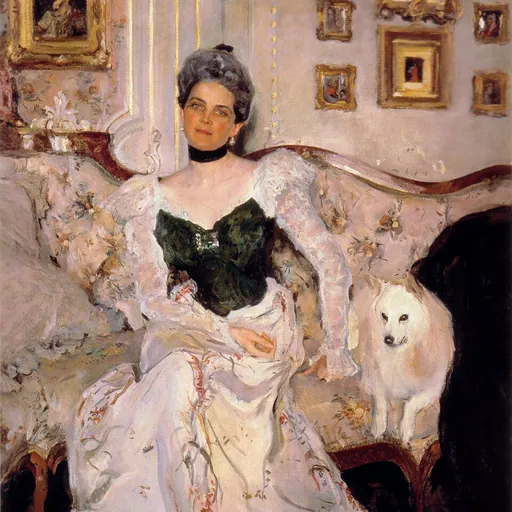
About Zinaida Yusupova
Lived 1861 – 1939 (aged 78). Zinaida Yusupova was a Russian art collector.
Princess Zinaida Nikolaevna Yusupova (; 2 September 1861 – 24 November 1939) was a Russian noblewoman, the only heiress of Russia's largest private fortune of her time. Famed for her beauty, the lavishness of her hospitality, and her extensive charity, she was a leading figure in pre-Revolutionary Russian society. In 1882, she married Count Felix Felixovich Sumarokov-Elston, who served briefly as General Governor of Moscow Military District (1914–1915). Zinaida is best known as the mother of Prince Felix Yusupov, the murderer of Grigori Rasputin. In April 1919 she left Russia and spent her remaining years living in exile.
Early life
Princess Zinaida Nikolaevna Yusupova was the only surviving child of Prince Nicholas Borisovich Yusupov (12 October 1827 – 31 July 1891), Marshal of the Imperial Court, and Countess Tatiana Alexandrovna de Ribeaupierre (29 June 1828 – 14 January 1879). Prince Yusupov was a patron of the arts and served in the chancery of Tsar Nicholas I. Zinaida's mother, a lady-in-waiting to the Empress Alexandra Feodorovna, was the daughter of Count Alexander Ivanovich de Ribeaupierre and his wife Ekaterina Mikhailovna Potemkina, a niece of Prince Potemkin.
Princess Zinaida's only brother, Prince Boris Nikolaevich Yusupov, died in early childhood. She also had a younger sister, Princess Tatiana Nikolaevna. As the only surviving child of a distinguished, highly placed, and vastly rich couple, Zinaida enjoyed great favour at court. She was the greatest Russian heiress of her time, and the last of her line; the House of Yusupov. The Yusupovs, a family of Tatar-Nogai origin, were very wealthy, having acquired their vast fortune generations earlier. Their properties included four palaces in Saint Petersburg, three palaces in Moscow, 37 estates in different parts of Russia (such as Arkhangelskoye, Kursk, Voronezh, and Poltava). They owned more than 100.000 acres (400 km2) of land and their industries included sugar beet factories, brick plants, sawmills, textile and cardboard factories, iron-ore mines, flour mills, distilleries, and oil fields on the Caspian Sea.
Princess Zinaida was known for being intelligent, hospitable, socially skilled, and beautiful; qualities that would last late into her life.
Marriage
Prince Nicholas Borisovich Yusupov was hoping that Zinaida would make an illustrious marriage, but at a reception organised to pair her with Alexander of Battenberg, Zinaida met and fell in love with Count Felix Felixovich Sumarokov-Elston (5 October 1856 – 10 June 1928), a lieutenant in the Horse Guards and son of Count Felix Nikolaevich Sumarokov-Elston. They were married on 4 April 1882 in Saint Petersburg. Princess Zinaida and her husband had four sons, two of whom survived childhood: Prince Nicholas Felixovich Yusupov (1883-1908) and Prince Felix Felixovich Yusupov (1887-1967). After his father-in-law died in 1891 Felix was granted special permission by Tsar Alexander III to carry the title Prince Yusupov as well as that of Count Sumarokov-Elston and to pass them both to his and Zinaida's heir. Prince Felix was appointed adjutant to the Grand Duke Sergei Alexandrovich in 1904 and commanded the Cavalry of the Imperial Guards. In 1914 he was appointed Governor General of Moscow, a position he held briefly.
Aside from the grand Moika Palace (also known as Yusupov Palace) in Saint Petersburg and their many estates, the couple also had a mansion in Liteyny Avenue, where the Saint Petersburg Institute of International Trade, Economics, and Law is currently located. She owned the palace at Nevsky Prospect 86 as well.
Socialite and charity
As a leading figure in pre-Revolutionary Russian society, Zinaida was famed for her beauty, elegance and the lavishness of her hospitality. In her book of memoirs, Ladies of the Russian Court, Meriel Buchanan (1886-1959), daughter of the last British ambassador to Imperial Russia, described Princess Zinaida as: 'Delicate in health, easily exhausted, essentially feminine, she was not one of those capable, competent women, able to run big charitable organisations. She was always ready to give, freely and generously, to anyone who appealed to her, to do what she could to help anyone in distress, to lend her name, her house, her resources for any worthy cause, but she shrank from publicity, from all the complications of executive administration.'
Zinaida Yusupova was also known for her generosity; at Arkhangelskoye, she built schools, hospitals, houses, a church, and even a theatre, all for the use of her servants and those who lived on the estate, and she took a great interest in their lives. Her son Felix later recalled that no one who ever came to her with a request or favor was ever turned away, and her generosity won her many admirers. Her friendship with the Grand Duchess Elizabeth Feodorovna, based on their mutual charity and faith, no doubt inspired Elizabeth to dedicate herself solely to the Church and the poor. 'If all rich people, Princess, were like you, there would be no room for injustice,’ the painter Valentin Serov, who disliked the powerful and flattered no one, told her. ‘Injustice cannot be eradicated, and especially not with money, Valentin Alexandrovich,’ replied the ‘glorious’ Princess (as Serov called her in a letter to his wife). Even when living modestly in exile she participated in charity, mainly supporting Russian refugees. She, for example, established an agency in Rome that found work for emigrants, donated money to those who wanted to learn a profession, and opened sewing workshops and free cafeterias for fellow Russian refugees.
Princess Zinaida Yusupova served as lady-in-waiting to both Empress Maria Feodorovna and later Empress Alexandra Feodorovna. She was a friend of Grand Duchess Elizabeth Feodorovna, wife of Grand Duke Sergei Alexandrovich. the 17th century Diamond Earrings of Marie Antoinette' (two 34.59 carat diamonds), the 'Blue Venus Statuette Sapphire' (4-inch-tall sapphire statuette of the goddess Venus atop a large Spinel) and also the 15th century 'Ruby Buddha' (70+ carat ruby statue).
Following her narrow escape during the Russian Revolution, she was forced to leave all her financial assets behind: her jewel collection was hidden beneath a staircase in her Moscow palace in hopes that she would retain their use in her return to Russia. Following the discovery in April 1925 of the concealed vault, an OGPU inventory recorded 13 diadems, 25 necklaces, 42 bracelets, 255 brooches and numerous other ornaments, together with over a ton of silver and 13 kilograms of gold objets d’art. However, the cache was confiscated and the jewels were dispersed by the Soviet state in 1925. During her exile she took only the major jewels and had them sold to fund her family and charity.
Ancestry
Don’t just read it —
keep it.
Full-length biographies made to live with: read them, listen on the way to work, watch them tonight.
- E-book
- Audio
- Video
Instant download · yours to keep · every purchase keeps this site free
Important facts
more
Zinaïda JoesoepovaFamily & relationships
People in Zinaida Yusupova's life
Named in this biography and alive at the same time

Related people
Same field, nearest in time


Contemporaries
People whose lives overlapped Zinaida Yusupova's


Frequently asked questions
Who was Zinaida Yusupova?
Russian princess (1861-1939)
When was Zinaida Yusupova born?
Zinaida Yusupova was born on 2 September 1861 in Saint Petersburg.
When did Zinaida Yusupova die?
Zinaida Yusupova died on 24 November 1939 in Paris.
What was Zinaida Yusupova's occupation?
Zinaida Yusupova was an art collector.
What nationality was Zinaida Yusupova?
Zinaida Yusupova was Russian.
Sources & further reading
Cite this page
APA: Biography.guide. (2026). Zinaida Yusupova. https://biography.guide/zinaida-yusupova/
MLA: "Zinaida Yusupova." Biography.guide, https://biography.guide/zinaida-yusupova/.
Chicago: "Zinaida Yusupova." Biography.guide. https://biography.guide/zinaida-yusupova/.
Data last updated: 2026-09-22 · Spot an error? Report a correction.
Portrait: Wikimedia Commons · author & licence
Page generated 2026-09-27 05:02 UTC