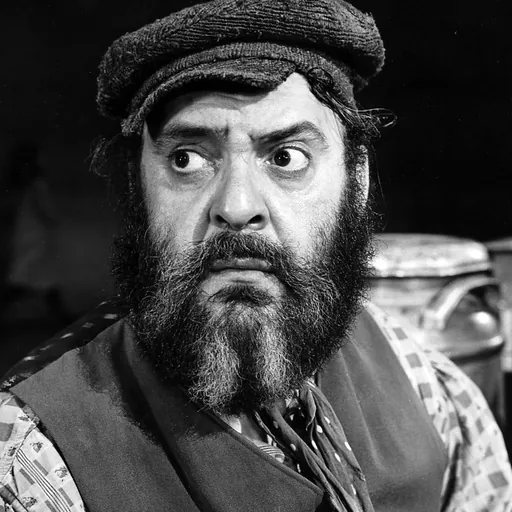
About Zero Mostel
Lived 1915 – 1977 (aged 62). Zero Mostel was an American film actor, stage actor, voice actor, television actor, actor and musician.
Samuel Joel "Zero" Mostel (February 28, 1915 – September 8, 1977) was an American actor, comedian, and singer. Mostel received three Tony Awards and a Drama Desk Award as well as nominations for a British Academy Film Award and a Golden Globe Award. He is also a member of the American Theater Hall of Fame, inducted posthumously in 1979.
Mostel is best known for his portrayal of comic characters, including Leopold Bloom in Marjorie Barkentin's Ulysses in Nighttown, Tevye in Fiddler on the Roof, Pseudolus on stage and on screen in A Funny Thing Happened on the Way to the Forum and Max Bialystock in Mel Brooks's The Producers (1967). Mostel was a student of Don Richardson and he used an acting technique based on muscle memory.
Mostel was blacklisted during the 1950s; his testimony before the House Un-American Activities Committee was well publicized. Mostel starred in the Hollywood Blacklist drama The Front (1976) alongside Woody Allen, for which Mostel was nominated for the British Academy Film Award for Best Supporting Actor. His final roles included a guest spot on The Muppet Show and a voice in Watership Down (1978). Per The New York Times, "Mr. Mostel was the actor's actor, the critic's actor and, perhaps most important, the theatergoer's actor." then in Austria-Hungary, later in Poland, and now in Lviv Oblast, Ukraine. He emigrated to the United States in 1898 with his first wife, Esther Wirklich Mostel, and young daughter, Celia. They would have three more children – Hyman, Sarah (Sadie), and Benjamin – before her death in 1908. His mother, Tzina, grew up in Vienna, Austria, and immigrated in 1906. He kept the moniker when he went into show business, though his mother hated it. Initially living in the Brownsville section of Brooklyn, the family moved to Moodus, Connecticut, where they bought a farm. The family's income in those days came from a winery and a slaughterhouse. The farm failed, and the family moved back to New York, where his father obtained work as a wine chemist. Zero was described by his family as outgoing and lively, and with a developed sense of humor. He showed an intelligence and perception which convinced his father he had the makings of a rabbi, In addition to English, Zero Mostel spoke Yiddish, Italian, and German. He attended Public School 188, where he was an A student. He also received professional training as a painter through The Educational Alliance. He completed his high school education at Seward Park High School, where his yearbook noted: "A future Rembrandt…or perhaps a comedian?". He attended the City College of New York, a public college that allowed many poor students to pursue higher education. He later claimed that he was on the swimming team and the Reserve Officers Training Corps, though the claim is dubious. As only beginner classes were available in art, Mostel took them repeatedly to be able to paint and receive professional feedback. In March 1943, Mostel was drafted by the US Army. Although he gave varying accounts of his Army service, records show he was honorably discharged in August 1943 because of an unspecified physical disability. He entertained servicemen giving USO performances until 1945.
After Zero's discharge from the Army, he resumed his earlier career. He appeared in a series of plays, musicals, operas, and movies. In 1946 he even made an attempt at serious operatic acting in The Beggar's Opera, but received lukewarm reviews. He sang the title role in a short film of Puccini's comic opera Gianni Schicchi. Critics saw him as a versatile performer.
Zero Mostel made notable appearances on New York City television in the late 1940s. He had his own show in 1948 called Off The Record on WABD with comedian partner Joey Faye. Simultaneously, Mostel had a live TV show on WPIX, Channel Zero. He also appeared in the May 11, 1949 Toast of the Town broadcast hosted by Ed Sullivan.
1950–1956: Blacklist years and HUAC testimony Mostel had been a leftist since college and his nightclub routine included political jabs at right-wingers. His MGM contract was terminated, and his role in Du Barry Was a Lady was truncated, because studio executives were upset that he participated in protests against another MGM film, Tennessee Johnson, which protesters believed had downplayed the racism of former US President Andrew Johnson. According to biographer Arthur Sainer, "MGM blacklisted Zero Mostel way before the days of the blacklist". During his Army service he was under investigation for alleged Communist Party membership. The Military Intelligence Division of the U.S. War Department said it was "reliably reported" that he was a Communist Party member. The Post Intelligence Officer at the Army's Camp Croft, where Mostel served, believed that Mostel was "definitely a Communist." As a result of that, his application to be an entertainment director with the US Army Special Services unit was denied. Mostel had lobbied hard to transfer to Special Services, at one point traveling to Washington to request a transfer.
It was not until 1950 that Mostel again acted in movies, for a role in the Oscar-winning film Panic in the Streets, at the request of its director, Elia Kazan. Kazan describes his attitude and feelings during that period, where Each director has a favorite in his cast... my favorite this time was Zero Mostel—but not to bully. I thought him an extraordinary artist and a delightful companion, one of the funniest and most original men I'd ever met... I constantly sought his company... He was one of the three people whom I rescued from the "industry's" blacklist... For a long time, Zero had not been able to get work in films, but I got him in my film.
Mostel played supporting roles in five movies for Twentieth Century Fox in 1950, all in films released in 1951. Fox then abruptly cancelled his contract. Mostel learned this after he was lent out to Columbia for a film role but not permitted on the set. The studio may have received word that he was about to be named as a Communist in Congressional testimony.
On January 29, 1952, Martin Berkeley identified Mostel to the House Un-American Activities Committee (HUAC) as having been a member of the Communist Party. After the testimony he was effectively blacklisted. He was subpoenaed to appear before HUAC on August 14, 1955. Mostel declined to name names and jousted with the members of Congress, invoked the Fifth Amendment, while standing up for his right to the privacy of his personal political beliefs. His testimony won him admiration in the blacklisted community, and in addition to not naming names he also confronted the committee on ideological matters, something that was rarely done. Among other things, he referred to Twentieth Century Fox as "18th Century Fox" (due to its collaboration with the committee), and manipulated the committee members to make them appear foolish. Mostel later commented: “My politics are my business. Besides, what sabotage could actors be accused of—giving acting secrets to the enemy?”
On January 13, 1960, while exiting a taxi on his way back from rehearsals for the play The Good Soup, Mostel was hit by a number 18 (now the M86) 86th Street crosstown bus, and his leg was crushed. The doctors wanted to amputate the leg, which would have ended his stage career. Mostel refused, accepting the risk of gangrene, and remained hospitalized for four months. The injury took a huge toll; for the rest of his life, the massively-scarred leg gave him pain and required frequent rests and baths. He sought compensation for the injury by retaining the famous Harry Lipsig (the 5'3" self-described "King of Torts") as his attorney. The case was settled for an undisclosed sum. From this time forward, whenever he attended the Metropolitan Opera, Mostel carried a cane to go along with the cape that he also favored. Later that year Mostel played Estragon in a TV adaptation of Samuel Beckett's Waiting for Godot.
In 1961, he played Jean in Eugene Ionesco's Rhinoceros to rave reviews. The New Republic's Robert Brustein said Mostel had "a great dancer's control of movement, a great actor's control of voice, a great mime's control of facial expressions." His transition onstage from man to rhinoceros became a thing of legend; he won his first Tony Award for Best Actor in a Play. In 1962 Mostel began work on the role of Pseudolus in Stephen Sondheim's A Funny Thing Happened on the Way to the Forum, which was to be one of his best-remembered roles. The role of Pseudolus was originally offered to Phil Silvers, who declined it, saying he did not want to do this "old shtick". Mostel did not originally want to do the role either, which he thought below his capabilities, but was convinced by his wife and agent. The reviews were excellent, and, after a few slow weeks after which the play was partially rewritten with a new opening song, "Comedy Tonight", which became the play's most popular piece, the show became a great commercial success, running 964 performances and conferring star status on Mostel. He won a Tony Award for Best Actor in a Musical for this role. A film version was produced in 1966, also starring Mostel and Silvers.
In 1964, he was a narrator for the Naumburg Orchestral Concerts, in the Naumburg Bandshell, Central Park, in the summer series. On September 22, 1964, Mostel created the role of Tevye in the original Broadway production of Fiddler on the Roof. Because of Mostel's respect for the works of Sholem Aleichem he insisted that more of the author's mood and style be incorporated into the musical, and he made major contributions to its shape. He also created the cantorial sounds made famous in the song "If I Were a Rich Man". The New York Times wrote "Zero Mostel's Tevye is so penetrating and heartwarming that you all but forget that it is a performance." In later years, the actors who followed Mostel in the role of Tevye invariably followed his staging. The show received rave reviews and ran for 3,242 performances, a record. Mostel received the Tony Award for Best Actor in a Musical for it.
Mostel in 1967 appeared as Potemkin in Great Catherine. He was due to co-star with Julie Newmar in Monsieur Lecoq filmed in France and the U.K., but the film was never completed.
The Producers Mel Brooks cast Mostel as Max Bialystock in The Producers (1967). Bialystock and his partner, Leo Bloom (Gene Wilder), are Broadway producers who plan to produce a flop, as "the IRS isn't interested in flops." Mostel initially balked at the role, but Brooks persuaded him to show the script to his wife, and she talked him into doing it. Upon release, the film received mixed reviews.but has achieved classic status. Roger Ebert included it in his canon of Great Movies, calling Mostel's performance "a masterpiece of low comedy."
1970–1977: Later work and final roles
In his last decade, Mostel's star dimmed as he appeared in movies that were received with indifference by both critics and audiences. These titles include The Great Bank Robbery and Once Upon a Scoundrel. In the 1970s, he often played supporting rather than lead roles. He was in Peter Yates's The Hot Rock (1972) and the 1974 film version of Rhinoceros (with Wilder). He played Hecky Brown, a blacklisted actor, alongside Woody Allen in Martin Ritt's The Front. Screenwriter Walter Bernstein loosely based Brown on television actor Philip Loeb, who was a friend of Mostel. On Broadway, he starred in revivals of Ulysses in Nighttown (receiving a Tony nomination for Best Actor) and Fiddler on the Roof. He made memorable appearances in children's shows such as Sesame Street, The Electric Company (for which he performed the Spellbinder in the Letterman cartoons), and gave voice to the boisterous seagull Kehaar in Watership Down (1978). He also appeared as a guest star during Season 2 of The Muppet Show, taped during mid-1977 and broadcast after his death.
Personal life
Marriages In 1939, Mostel married Clara Sverd, and the couple moved to an apartment in Brooklyn. The marriage did not last, however, since Clara could not accept the many hours Mostel spent in his studio with his fellow artists, and he did not seem to be able to provide for her at the level to which she had been accustomed. They separated in 1941 and divorced in 1944, Clara only agreeing to the divorce in return for a percentage of Mostel's earnings for the rest of his life. The arrangement lasted until the mid-1950s.
Mostel lived in a large rented apartment in The Belnord on the Upper West Side of Manhattan and built a summer house on Monhegan Island in Maine.
On July 2, 1944, Mostel married Kathryn (Kate) Cecilia Harkin, an actress and dancer, after two years of courtship. The pair met at Radio City Music Hall where she was a Rockette. The marriage caused problems in his relationship with his Orthodox Jewish parents: his new wife was not Jewish. His mother never met Kate nor her grandsons. (later described by his friends as a starvation diet) that reduced his weight from to . During rehearsals for Arnold Wesker's new play The Merchant (in which Mostel played a reimagined version of Shakespeare's Shylock) in Philadelphia, he collapsed in his dressing room and was taken to Thomas Jefferson University Hospital. He was diagnosed with a respiratory disorder; it was believed he was in no danger and would be released soon. However, on September 8, 1977, Mostel complained of dizziness and lost consciousness. The attending physicians were unable to revive him, and he was pronounced dead that evening. It is believed that he suffered an aortic aneurysm. Wesker wrote a book chronicling the out-of-town tribulations that beset the play and culminated in Zero's death called The Birth of Shylock and the Death of Zero Mostel.
In accordance with his final requests, his family did not stage any funeral or other memorial service. Mostel was cremated following his death; the location of his ashes is not publicly known.
Reception and collaborations Mostel often collided with directors and other performers in the course of his career. He was described as irreverent, believing himself to be a comic genius (many critics agreed) and showed little patience for incompetence. He often improvised, which was received well by audiences but which often left other performers (who were not prepared for his ad-libbed lines) confused and speechless during live performances. He often dominated the stage whether or not his role called for it. Norman Jewison stated this as a reason for preferring Chaim Topol for the role of Tevye in the film adptation of Fiddler on the Roof. Mostel took exception to these criticisms:
Other producers, such as Jerome Robbins and Hal Prince, preferred to hire Mostel on short contracts, knowing that he would become less faithful to the script as time went on. His exuberant personality, though largely responsible for his success, had also intimidated others in his profession and prevented him from receiving some important roles. In his autobiography Kiss Me Like a Stranger, Gene Wilder describes being initially terrified of Mostel. However, just after being introduced, Mostel got up, walked over to Wilder, hugged him, and planted a big kiss on his lips. Wilder claims to be grateful to Mostel for teaching him such a valuable lesson, and for picking Wilder up every day so that they could ride to work together. He also tells the story of a dinner celebrating the release of The Producers. Mostel switched Wilder's place card with Dick Shawn's, allowing Wilder to sit at the main table. Mostel and Wilder later worked together in Rhinoceros and the Letterman cartoons for The Electric Company. The two remained close friends until Mostel's death.
Mostel was the subject of the play Zero Hour (2006), written and performed by actor/playwright Jim Brochu. It recounts events from Mostel's life and career, including his HUAC testimony, his professional relationships and his theatrical work.
Clive Barnes, reviewing Ulysses in Nightotown, wrote It is part of Mr. Mostel's power that he can play a deflated sack of flour with human dignity, and he can make grotesque faces that suggest pain more than humor. His shambling aggressiveness is vulnerable from the start, and that mustache, that effort to make an aging cherub into an aging satyr never fools anyone. And the voice, mellifluous, and yet always with a slice of irony under its tongue, is as expressive as the upturned eyes, the overemphasized gestures. Some actors use outrageous tricks to disguise themselves; Mr. Mostel uses them to define himself.
Acting credits Film
Television
Don’t just read it —
keep it.
Full-length biographies made to live with: read them, listen on the way to work, watch them tonight.
- E-book
- Audio
- Video
Instant download · yours to keep · every purchase keeps this site free
Important facts
Family & relationships
People in Zero Mostel's life
Named in this biography and alive at the same time



Related people
Same field, nearest in time



Contemporaries
People whose lives overlapped Zero Mostel's




Frequently asked questions
Who was Zero Mostel?
American actor (1915-1977)
When was Zero Mostel born?
Zero Mostel was born on 28 February 1915 in Brooklyn.
When did Zero Mostel die?
Zero Mostel died on 8 September 1977 in Philadelphia.
What was Zero Mostel's occupation?
Zero Mostel was a film actor, stage actor, voice actor, television actor, actor and musician.
What nationality was Zero Mostel?
Zero Mostel was American.
Sources & further reading
Cite this page
APA: Biography.guide. (2026). Zero Mostel. https://biography.guide/zero-mostel/
MLA: "Zero Mostel." Biography.guide, https://biography.guide/zero-mostel/.
Chicago: "Zero Mostel." Biography.guide. https://biography.guide/zero-mostel/.
Data last updated: 2026-09-22 · Spot an error? Report a correction.
Portrait: Wikimedia Commons · author & licence
Page generated 2026-09-27 05:04 UTC