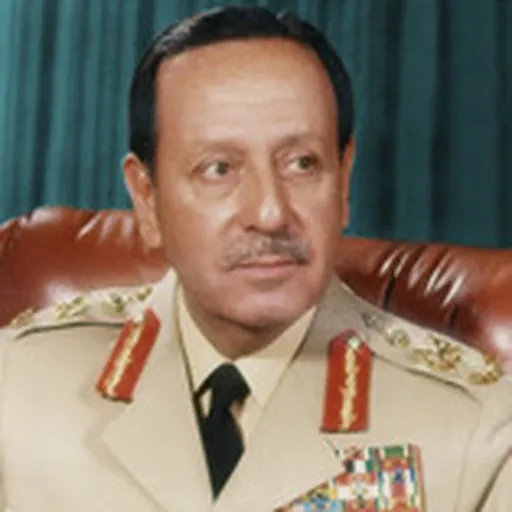
About Zeid bin Shaker
Lived 1934 – 2002 (aged 67). Zeid bin Shaker was a Jordanian military personnel and politician.
Zaid ibn Shaker, GBE, CVO (4 September 1934 – 30 August 2002) was a Jordanian military officer and politician who served as the commander-in-chief of the Jordanian military for more than twelve years and the 27th Prime Minister of Jordan three times. King Hussein awarded him the non-hereditary title of prince on 4 February 1996.
Field Marshal General of the Army Sharif Zaid ibn Shakir was a cousin of King Hussein. He joined the military and served with the future King Hussein. In 1957 and 1958 he was the assistant military attache at the Embassy of Jordan in London. He served in a number of positions in the Jordanian military, including being a tank commander at both the brigade and division level. On 8 January 1996 he was made chief of staff for the armed services, which post he held until resigning in 1988. In June 1987 he was made field marshal. Being a Hashemite, Zaid ibn Shaker's family had always been close to the Royal family, and Zaid ibn Shaker himself had been personally linked with King Hussein throughout his military career. His father, Shakir Ibn Zaid, had participated in the Arab Revolt during the First World War, where he led a group of tribal levies, as well as in the Al-Khurma dispute. At the Battle of Turbah, during the conflict between the Sharifian Caliphate and Ibn Saud, Ibn Shakir's father saved the life of Prince Abdullah (later King Abdullah I) by providing him a horse and camel to escape. Zaid's father had likewise served with T. E. Lawrence, who described him as a "brave and courageous soldier".
Ibn Shaker would go on to be educated at Victoria College in Alexandria.
Ibn Shaker would eventually be married and have two sons: Shaker and Nasreen.
Military career
Ibn Shaker was trained at Sandhurst in the early 1950's, where he met Hussein, and during this time the two became close friends. During the Zarqa incident, when Shaker was Hussein's aide-de-camp, he was sent to the Zarqa barracks to ascertain the situation.
In 1957, he was appointed an assistant to the Jordanian military attache in Britain, and would hold that position until 1958.
In 1963, he would attend the Command and General Staff College in the United States.
Six Day War
In the events leading up to the war in 1967, Jordanian public opinion was strongly in favor of war. Ibn Shaker commented at a press conference in May of that year, "If Jordan does not join the war a civil war will erupt in Jordan."
By the time conflict broke out, Jordanian forces were under the command of Egyptian General Abdul Munim Riad.
Battle of Karameh
During the War of Attrition, Ibn Shaker was stationed on the border between Israel and Jordan. Although he was opposed to Palestinian activities against Israel, he was also opposed to Israeli attacks on Jordanian soil. On March 20, 1968, while gazing out at the Israeli side, he noticed the oncoming attack. "They were massing their forces," he would later say, "and not even bothering to hide their attack." He went to Karameh and inspected the Palestinian positions there. Assured that they were prepared, he went back to Amman to attend the birthday party of Crown Prince Hassan ibn Talal, the king's brother. During the party, Hussein took Ibn Shaker aside and said, "You should leave early and try to get some sleep. The attack will probably happen tomorrow." Sure enough, at 5:00 A.M., Hussein was told that the Israelis were crossing the river into Jordanian territory. He telephoned his officers, Ibn Shakir among them, and said, "The fun has started."
The Jordanian forces fought well, and were aided by a low cloud cover that hampered the Israeli ground-attack aircraft. The Israelis retreated back into their territory after ten hours of fighting. 29 Israeli soldiers were killed, while the Jordanians lost 40 servicemen, and the Palestinians 128. Yasser Arafat claimed the battle as a victory for the Palestinians, much to the chagrin of Hussein.
Black September
Ibn Shaker was opposed to the freedom granted to the fedayeen forces of the Palestine Liberation Organization (PLO). Later that month, fedayeen guerillas not only attempted to kill the king, but also killed Jozza Ibn Shaker, Ibn Shaker's sister.
Ibn Shaker's dismissal did nothing to ease tension, and by late August fighting between the fedayeen and Jordanian army was a near daily occurrence. As a result, Ibn Shaker was reappointed Deputy Chief of Staff. The PLO saw his return to power as a sign that Jordan was "determined to strike and liquidate the resistance movement". As the situation in Jordan escalated, the international community began to lose faith in Hussein's ability to lead. This, combined with pressure from his top generals (Ibn Shaker included) and members of the political elite, led Hussein to decide on military action. Ethnic Palestinians in the Jordanian army deserted to join the fedayeen, and soon PLO forces had taken over Irbid and most of northern Jordan.
On September 19, 300 Syrian tanks attacked Jordanian forces in the Irbid region. They were eventually driven off after attacks from the Jordanian air force, as well as backing from the United States and Israel.
1971-1989
In 1972, Ibn Shaker was appointed Chief of Staff. In 1976, he took the position of Commander in Chief.
In 1987, Ibn Shakir was promoted to field marshal.
Political career
Prime Minister (1989)
In 1989, price increases related to the IMF-mandated austerity program caused riots in Amman and several Jordanian cities, leading to the resignation of Jordanian government under Prime Minister Zaid Rifai. Ibn Shakir was appointed prime minister, with orders to curb corruption, ease discontent over unpopular economic measures, and arrange a general election as soon as possible.
In November of that year, parliamentary elections were held in Jordan, the very first since 1967. Mudar Badran was elected as prime minister.
After this, Ibn Shakir continued as a close adviser to the king.
Eventually, Hussein would appoint Abdul Karim Kabariti as prime minister in February 1996.
Don’t just read it —
keep it.
Full-length biographies made to live with: read them, listen on the way to work, watch them tonight.
- E-book
- Audio
- Video
Instant download · yours to keep · every purchase keeps this site free
Important facts
People in Zeid bin Shaker's life
Named in this biography and alive at the same time





Related people
Same field, nearest in time



Contemporaries
People whose lives overlapped Zeid bin Shaker's




Frequently asked questions
Who was Zeid bin Shaker?
Jordanian military officer and politician (1934-2002)
When was Zeid bin Shaker born?
Zeid bin Shaker was born on 4 September 1934 in Amman.
When did Zeid bin Shaker die?
Zeid bin Shaker died on 30 August 2002 in Amman.
What was Zeid bin Shaker's occupation?
Zeid bin Shaker was a military personnel and politician.
What nationality was Zeid bin Shaker?
Zeid bin Shaker was Jordanian.
Sources & further reading
Cite this page
APA: Biography.guide. (2026). Zeid bin Shaker. https://biography.guide/zeid-bin-shaker/
MLA: "Zeid bin Shaker." Biography.guide, https://biography.guide/zeid-bin-shaker/.
Chicago: "Zeid bin Shaker." Biography.guide. https://biography.guide/zeid-bin-shaker/.
Data last updated: 2026-09-20 · Spot an error? Report a correction.
Portrait: Wikimedia Commons · author & licence
Page generated 2026-09-27 04:58 UTC