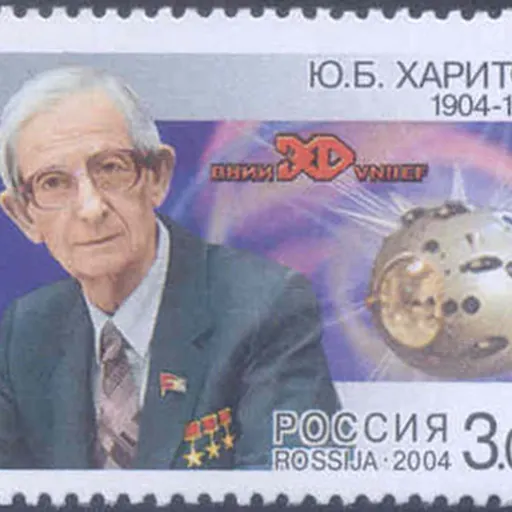
About Yulii Khariton
Lived 1904 – 1996 (aged 92). Yulii Khariton was a Russian physicist, politician and physical chemist, known for Soviet atomic bomb project.
Yulii Borisovich Khariton (; 27 February 1904 – 18 December 1996) was a Russian physicist who was a leading scientist in the former Soviet program of nuclear weapons.
Since the initiation of the Soviet program of developing the atomic bomb by Joseph Stalin in 1943, Khariton was the "chief nuclear weapon designer" and remained associated with the Soviet program for nearly four decades. In honour of the centennial of his birthday in 2004, his image appeared on a Russian postal stamp by the Russian government.
Biography Family, early life and education
Yulii Borisovich Khariton was born in Saint Petersburg, Russian Empire, to an middle class ethnic Russian Jewish family, on 27 February 1904. His father, Boris Osipovich Khariton, was a political journalist, editor, and publisher who had attained a law degree from Kiev University in Ukraine. His father worked for the newspaper Rech, the main organ of the Constitutional Democratic Party, and was a well known figure in the political circles of Russia.
His father, Boris Khariton, remained there until Latvia's annexation by the Soviet Union in 1940 and, at the age of sixty-four, was then arrested by the NKVD and sentenced to seven years of forced labour in a Gulag, where he died. Yulii's mother never returned to Russia and divorced his father, only to marry her psychiatrist, Dr. Max Eitingon.
Yulii was home schooled by his Estonian housekeeper, hired by his father, who taught him the German language.
During World War II, Khariton's knowledge of the physics of explosions was used in experimental studies on Soviet and foreign weaponry, while continuing his leadership of the Institute of Chemical Physics.
Physicist Igor Kurchatov asked Khariton to become part of the Soviet atomic project in 1943, in Laboratory No. 2 of the Russian Academy of Sciences. In May 1945, as part of a team of physicists sent to Berlin to investigate Nazi atomic bomb research, Khariton found 100 tonnes of uranium oxide, which was transported back to Moscow; this reduced development time for domestic plutonium production. After the bombing of Hiroshima and Nagasaki, a Special Committee was established including Kurchatov and Khariton. Khariton was made scientific director of KB-11 (design bureau-11) also known as Arzamas-16 and colloquially as the 'Installation', located in the closed city of Sarov, Nizhny Novgorod Oblast to develop Soviet nuclear weapons (the organisation is now known as the All-Russian Scientific Research Institute of Experimental Physics (VNIIEF). Khariton remained as its scientific director for 46 years. Along with other senior scientists, he was regarded as too important to fly and had his own private train carriage. He was elected as a corresponding member of the Academy of Sciences of the Soviet Union in 1946, and as a full member in 1953.
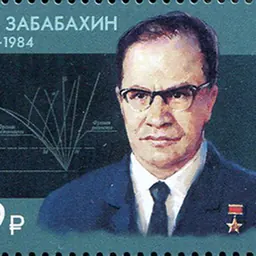
His diplomacy meant absorbing criticism and put-downs from political leaders who came and went. KB-11 was sometimes sneered at for having a significant number of staff with Jewish backgrounds, Khariton included. The second Installation under Yevgeny Zababakhin had fewer, and there had been awkward professional relations; it was comically referred to as "Egypt" by politicians, with obvious comparative implications with KB-11: the dining room at KB-11 was termed 'the synagogue.'
Awards and legacy
Hero of Socialist Labour (1949, 1951, 1954) Stalin Prize (1949, 1951, 1953) Order of Lenin (1949, 1956, 1962, 1964, 1974, 1984) Lenin Prize (1956) Order of the October Revolution (1971) Order of the Red Banner of Labour (1945) Order of the Red Star (1944) Gold Medal of I. V. Kurchatov (1974) Great Gold Medal of M. V. Lomonosov (1982)
In October 1997 in Sarov, Togliati Street was renamed Akademik Khariton Street in his honour. A bronze bust of him was installed in February 2004 next to the House of Scientists of VNIIEF. In 2004, a Russian stamp was issued to commemorate the 100th anniversary of his birthday.
Don’t just read it —
keep it.
Full-length biographies made to live with: read them, listen on the way to work, watch them tonight.
- E-book
- Audio
- Video
Instant download · yours to keep · every purchase keeps this site free
Important facts
People in Yulii Khariton's life
Named in this biography and alive at the same time


Related people
Same field, nearest in time

Contemporaries
People whose lives overlapped Yulii Khariton's




Frequently asked questions
Who was Yulii Khariton?
Soviet physicist (1904-1996)
When was Yulii Khariton born?
Yulii Khariton was born on 27 February 1904 in Saint Petersburg.
When did Yulii Khariton die?
Yulii Khariton died on 18 December 1996 in Sarov.
What was Yulii Khariton's occupation?
Yulii Khariton was a physicist, politician and physical chemist.
What was Yulii Khariton known for?
Yulii Khariton was known for Soviet atomic bomb project.
What nationality was Yulii Khariton?
Yulii Khariton was Russian.
Sources & further reading
Cite this page
APA: Biography.guide. (2026). Yulii Khariton. https://biography.guide/yulii-khariton/
MLA: "Yulii Khariton." Biography.guide, https://biography.guide/yulii-khariton/.
Chicago: "Yulii Khariton." Biography.guide. https://biography.guide/yulii-khariton/.
Data last updated: 2026-09-23 · Spot an error? Report a correction.
Portrait: Wikimedia Commons · author & licence
Page generated 2026-09-27 05:06 UTC