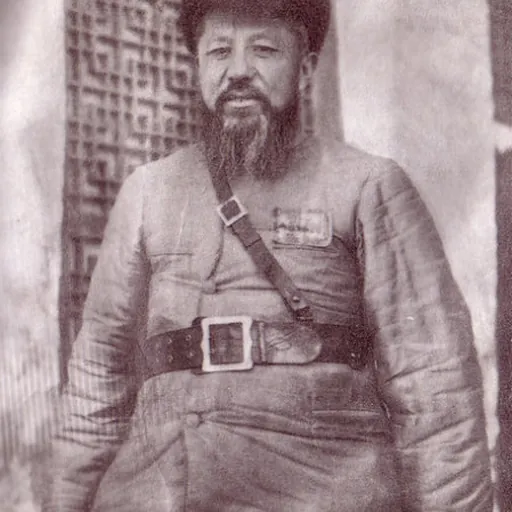
About Yulbars Khan
Lived 1889 – 1971 (aged 81). Yulbars Khan was a Chinese and Taiwanese qadi and politician.
Yulbars Khan (; or ; 13 August 1889 – 27 July 1971), courtesy name Huang Jingfu , was a Uyghur chieftain and Kuomintang general during the Chinese Civil War. He entered the service in the Kumul Khanate of Muhammad Khan of Kumul and later his son Maksud Shah. He served as an advisor at the court, until when Maksud died in March 1930, governor Jin Shuren abolished the khanate. Yulbars then conspired with Khoja Niyaz and Ma Zhongying to overthrow Jin in the Kumul Rebellion. According to some people, Ma restrained Yulbars from traveling to Nanking to ask the Kuomintang for help, Ma earlier had an agreement with the Kuomintang that if he seized Xinjiang, he would be recognized by the Kuomintang as its leader.
Jin was eventually ousted by Sheng Shicai on 12 April 1933, who seized control of the province from 1934 to 1937. On 4 June 1933 Khoja Niyaz concluded a peace agreement with Sheng Shicai in Jimsar under mediation of newly appointed Soviet Consul-General in Urumchi, Garegin Apressof, a close associate of Joseph Stalin, and agreed to turn his Uyghur forces against general Ma Zhongying in exchange for granting control over Southern Xinjiang (Kashgaria or Tarim Basin), which already was lost by the Chinese and where a bloody power struggle between different rebel forces was occurring, also over Turpan Basin and Kumul Region, which was occupied by Ma Zhongying's forces.
All territory south of Tengritagh Mountains was granted the "autonomous status" inside of Xinjiang Province, the Chinese promised in agreement not to cross Tengritagh. Yulbars Khan disagreed with Khoja Niyaz in this decision and remained an ally of Ma Zhongying, who appointed him to be the Chief of Procurement Department of Kuomintang (KMT) 36th Division. In the summer of 1934, after retreating of Ma to the Southern Xinjiang and his following interning on Soviet territory on 7 July 1934, Yulbars Khan managed to conclude peace agreement with Sheng Shicai and was left as commander of Uyghur regiment in Kumul and also given high post of Commissioner for Reconstruction Affairs in Xinjiang Provincial Government. In May 1937, after the 6th Uyghur Division and 36th Tungan Division mutinied against the Xinjiang Provincial Government in Southern Xinjiang, rebels in Kashgaria appealed to Yulbars Khan to cut off communications between Xinjiang and China from his base in Kumul. During suppression of the rebellion by Sheng Shicai with Soviet military support (which included 5,000 Soviet intervention troops, airplanes and tanks BT-7) in summer 1937 he fled to Nanjing and returned to Kumul in 1946.
He led Chinese Muslim cavalry and White Russians against People's Liberation Army (PLA) forces taking over Xinjiang in 1949. He fought at the Battle of Yiwu. In 1951, after most of his troops deserted, he fled to Calcutta in India via Tibet, where his men were attacked by the Dalai Lama's forces. He then took a steamer to Taiwan. The KMT government then appointed him Governor of Xinjiang in absentia, which he held until he died in 1971 in Taiwan. He was also the last person to officially hold that title. In 1969, his memoirs were released.
Yulbars Khan was declared a traitor by Uyghur figures in the East Turkestan Independence Movement like Muhammad Amin Bughra and Isa Yusuf Alptekin for siding with Chiang Kai-shek and the Kuomintang, who continued to claim Xinjiang as a part of the Republic of China.
Don’t just read it —
keep it.
Full-length biographies made to live with: read them, listen on the way to work, watch them tonight.
- E-book
- Audio
- Video
Instant download · yours to keep · every purchase keeps this site free
Important facts
People in Yulbars Khan's life
Named in this biography and alive at the same time

Related people
Same field, nearest in time




Contemporaries
People whose lives overlapped Yulbars Khan's


Frequently asked questions
Who was Yulbars Khan?
National Revolutionary general
When was Yulbars Khan born?
Yulbars Khan was born on 7 September 1889 in Yengisar County.
When did Yulbars Khan die?
Yulbars Khan died on 27 July 1971 in Taipei.
What was Yulbars Khan's occupation?
Yulbars Khan was a qadi and politician.
What nationality was Yulbars Khan?
Yulbars Khan was Chinese and Taiwanese.
Sources & further reading
Cite this page
APA: Biography.guide. (2026). Yulbars Khan. https://biography.guide/yulbars-khan/
MLA: "Yulbars Khan." Biography.guide, https://biography.guide/yulbars-khan/.
Chicago: "Yulbars Khan." Biography.guide. https://biography.guide/yulbars-khan/.
Data last updated: 2026-09-21 · Spot an error? Report a correction.
Portrait: Wikimedia Commons · author & licence
Page generated 2026-09-27 05:01 UTC