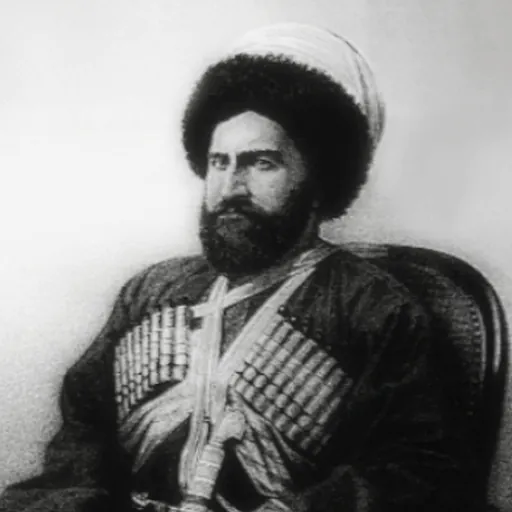
About Muhammad Amin
Lived 1818 – 1899 (aged 80–81). Muhammad Amin was a Turkish politician.
Muhammad "Amin" Asiyalav ("the Trustworthy"; , ; 1818 – 8 April 1901) also known as Naib-Pasha, was a North Caucasian politician, Sufi leader and military commander who served as the de facto leader of Circassia from 1848 to 1859. He was one of the Circassian leaders in the Russo-Circassian War. Under his absolute rule, Circassia transformed from a confederation based on the Adyghe Khabze into a unified "military-theocratic state".
Following a mandate by Imam Shamil to lead the Circassians, Amin arrived in Circassia disguised as an ordinary clergyman and took absolute authority in two years, Although nominally Shamil's governor, he acted independently, as communication between the two parties was very difficult. exiling, imprisoning or executing his opponents, and all secular and spiritual power was concentrated entirely in his hands. Among other things, he believed that "all were equal before Allah" and thus forced many of the nobility to give up their privileges. His goal was to first unite Circassia, then unify with Shamil to form a pan-Caucasian state. Some sources state he was born on October 20, 1818. Some of his descendants claim he was born earlier, around 1790 (1210 AH). who had moved to Avaria in 1681 due to family disputes. Some of his ancestors were said to have descended from Qurayshi warriors who settled in Dagestan during the Abbasid period. According to other sources, his family had migrated to Dagestan from Abkhazia. Imam Shamil started referring to Muhammad as "Muhammad the Trustworthy" when he was eighteen. Muhammad adopted this name, calling himself "Muhammad Amin" in Circassia. He later stated in his autobiography:
He took a formal madrasa education under teachers such as Daut-bek, learning among other things the Arabic, Persian, Russian languages, as well as many of the Dagestani languages. with a strong physique and a "pleasant face". Kazimbek, who met Amin, also described him as a dark-haired, solidly built, tall, and well-proportioned man with a pleasant face and a gentle smile always on his lips. He was part of the Naqshbandiyya-Khalidiyya Sufi order. was a voluntary clan where people or families come together by choice. The National Oath which emerged in the early 1800s sought to unite all of Circassia in this manner as a "national" oath. In 1841, the Ubykh, Natukhaj, Shapsug, Abzakh, and several Abkhaz-Abazin societies wrote down the principles of the National Oath in a written document called the "Defter of 1841". This document was Islamic in character, and sought to unify all of Circassia under one rule. At the meeting, Suleyman Efendi, a Kabardian Circassian, spoke for the Circassians:
Shamil initially refused these requests, arguing that he could not take responsibility for a matter that affected the well-being of the entire country. However, Shamil's secretary, Mirza Amir-Khan, convinced him that the people "could not be left to the mercy of short-sighted leaders". The elders further stated that if Shamil did not provide a suitable person, they would "hold onto the hem of his cherkeska in the afterlife to prevent him from entering paradise". Shamil was concerned by this declaration and offered to appoint his secretary Mirza Amir-Khan to the position, but Mirza Amir-Khan refused. Imam Shamil also stated that financial assistance would be provided from the Imamate Treasury for the establishment of administrative institutions, the recruitment of soldiers, and the procurement of weapons in Circassia. At some point, he was hidden inside a merchant cart.
A skilled orator, Muhammad Amin cultivated a charismatic and somewhat enigmatic public persona, adopting an authoritative posture toward regional elites while maintaining a highly approachable and friendly demeanor with the general peasant populace. His promises of a better future secured him significant influence over the Abzakh. Both Amin and the local leader Hajji Tlam identified an upcoming regional assembly as a strategic opportunity to consolidate power. In October 1848, during a preliminary gathering on the banks of the Pshekha River, Hajji Tlam utilized his political leverage to appoint Amin as the head of the Abzakh delegation for the Khase that was to be held in Adagum.
His overthrowing of the nobility, strong following among the peasants, and secret loyalists got him elected as leader of Circassia in the Khase. Muhammad Amin operated independently in the region and recognized Shamil's authority largely nominally. Communication between the two parties was very difficult, if not impossible. Amin's ideology relied on the Imamate principles of shura, sharia, and jihad. In an early speech, Muhammad Amin argued that "the disgrace of the Adyghe people must be put to an end", meaning, "princes and nobles" must be abolished as the concept of nobles is against the Quran, and slaves must be liberated. The murtaziqs lived in the local mosque and were responsible for executing the naib's orders, enforcing judicial decisions, guarding the fortified administrative centers called mehkeme, and suppressing disobedience among the population. The force was maintained through mandatory taxes collected from the population, including cattle, grain, sheep cheese, and silver rubles. He also recruited abreks, as well as criminals and outlaws. Muhammad Amin rode through the region at the head of his murtaziqs and accompanied by a mobile artillery piece, compelling the inhabitants to gather for prayer and to pay taxes.
Muhammad Amin faced opposition from both pacifist and militant Circassian factions during his efforts to unite Circassia. To establish order, he implemented a stricter penal code. This included capital punishment for individuals convicted of espionage for the Tsarist army. Notwithstanding these severe judicial actions, Amin successfully secured the backing of the majority of the populace. Muhammad Amin used the murtaziqs to crush opposition and enforce compliance. Individuals who disobeyed his orders or maintained contact with the Russians faced severe punishments at the hands of the murtaziq.
The Russians, worried about Amin's rise strengthening Circassia, Despite the ongoing Russo-Circassian War, the opposition, mostly made up of nobles who lost their power, accepted these proposals. A significant part of the population, especially those who submitted recently, began to ignore the Naib's orders, causing the administrative system of Circassia to collapse. ''' In other cases, princes and nobles attempted to get him killed, but failed. On July 16, 1851, the Shapsug region decided to remove all the clergy who were pro-Amin from the administration.
Amin quickly recovered his influence. Anticipating the impending Crimean War, he launched major expeditions in the fall of 1852 against the Gastagaevsky and Tenginsky forts, causing immense confusion among the enemy. Muhammad Amin took it upon himself to lead the Circassian part of this holy war, and started mobilising against Russia. He started enlisting more soldiers. As the Crimean War continued, Amin raided the Darial Gorge, Karachay, and the Laba region, pressuring Russian forces. In 1855, his troops attacked and destroyed Russian military hubs in the Yekaterinodar area and large Cossack settlements along the Kuban river. Meanwhile, the Ottoman government in Istanbul prepared for war by trying to build an anti-Russian coalition. The Sultan sent sealed letters to pro-Ottoman Georgian princes, Azerbaijani Khans, Imam Shamil, and Muhammad Amin. Muhammad Amin's complaint was rejected, and Seferbiy was declared leader of Circassians.
Archival correspondence from the same year reveals Muhammad Amin's communication with Imam Shamil. In a detailed letter, Amin outlined the administrative challenges he faced in the years following his 1848 appointment at the Adagum Khase and the subsequent countermeasures he implemented. He reported his inability to establish communication with the Karachay region despite six separate attempts. Amin detailed the arrival of three large warships from Istanbul, which transported his returning envoys alongside supplies of gunpowder, ammunition, and axes. Furthermore, he mentioned receiving official correspondence from high ranking Ottoman officials, including the grand vizier, sheikh ul-Islam, serasker, and kapudan pasha. The letter recorded the Russian capture of twenty local fortresses and stated Amin's intention to travel to the coast to receive sixteen troop transport ships arriving from Istanbul. In 1855, Muhammad Amin forced the Bzhedug aristocrats to take an oath to renounce their rights. Many princes and nobles were massacred and robbed by the Bzhedug commoners.
Acting independently, Amin made his boldest attempt to seize Karachay and unite with Shamil in August 1855. He was intercepted by Russian General Kozlovsky. On August 25, 1855, Kozlovsky personally led an attack on Amin's fortified position at Kadyko, decisively defeating the Naib and driving him out of Karachay. Despite this, Amin rallied 10,000 men in the Maykop gorge in October 1855, initiating gradual siege operations against the Belorechenskoye fortification and other outposts.
In May 1856 another battle took place on the banks of the Sup River. The ongoing civil war with Seferbiy and his son severely hindered Amin's ability to fight the Russians. The Circassian elders, who wanted to stop the hostility, increased the pressure on their leaders. Seferbiy and Muhammad Amin were forced to swear an oath to the people that they would go to the Sultan and demand that he resolve their dispute over authority. However, due to intense Russian diplomatic pressure, the Ottoman Ministry of Foreign Affairs placed him under house arrest shortly after he arrived. Under the guise of being a "guest of the state," he was separated from his delegation and exiled to Damascus, Syria, as a "consultant to the Damascus Governorate", stuck in a "forced paradise", with a high-rank and a salary, but no freedom to return to Circassia.
Return to Circassia and Negotiations with Russia Amin was guaranteed a comfortable life in Damascus with a large salary, but wished to return to Circassia. Despite returning to Circassia to resume his leadership, Muhammad Amin found himself increasingly isolated as he had lost his absolute authority and promised foreign assistance failed to materialize. The ongoing Circassian genocide had severely hindered resistance as well.
Qarabatir's faction and Amin's faction directly clashed in 1857 near the Tuapse pass. The skirmish resulted in fifteen deaths on each side and forty wounded. Unwilling to see more bloodshed between the Circassians, Muhammad Amin chose to pull his forces back. He theorised that the Russian army would now focus all its forces in Circassia and concluded that further resistance was useless, At the request of the elders, the Russians allowed Muhammad Amin to remain among the Abzakh on equal terms with the elders, without special authority. The delegation was subsequently sent to Tbilisi and then to St. Petersburg in 1860, where they were received by Tsar Alexander II. During the audience, Muhammad Amin addressed the Tsar, vouching for the Circassians. After the treaty was signed, the delegation returned to the Taman region, but Amin separated from the group. He made a final speech to the Abzakh delegation:
In Istanbul, Muhammad Amin began suffering from a severe nervous illness. Seeking a quieter environment for his health, he sold his Istanbul mansion and moved his family to the village of Karabiga (Yeni Çiftlik) near the Marmara coast. As per his surrender agreement, the Russian government paid him a pension. Despite this, he attempted to organise Circassian societies in the region. He was buried in the village's "Beyler Mezarlığı" (Lords' Cemetery) alongside his daughter, Behice Hanım (who died in Hijri 1316), and his sister, Nefise Hanım (who died in Hijri 1342). The upkeep of the grave site was organized by retired Turkish generals of Caucasian descent.
Kumyk poet Abdurrahman Gaziev wrote about Amin:
You, the honest Naib of Imam Shamil, Went there with great missions.
Your heartfelt loyalty to the Imam,
You showed through the organizations you founded.
They loved you in the Circassian homeland,
They believed in your every word.
By calling them to Gazawat-Jihad,
You gave courage to their hearts.Avar poet Muhammed Ahmedov also wrote about him: It is also a site of ziyarat.
Don’t just read it —
keep it.
Full-length biographies made to live with: read them, listen on the way to work, watch them tonight.
- E-book
- Audio
- Video
Instant download · yours to keep · every purchase keeps this site free
Important facts
more
Muhammad-Amin AsiyalavPeople in Muhammad Amin's life
Named in this biography and alive at the same time


Related people
Same field, nearest in time





Contemporaries
People whose lives overlapped Muhammad Amin's



Frequently asked questions
Who was Muhammad Amin?
naib of Imam Shamil, one of Caucasian leaders in Caucasus War
When was Muhammad Amin born?
Muhammad Amin was born in 1818 in Gonoda.
When did Muhammad Amin die?
Muhammad Amin died in 1899 in Bursa.
What was Muhammad Amin's occupation?
Muhammad Amin was a politician.
What nationality was Muhammad Amin?
Muhammad Amin was Turkish.
Sources & further reading
· DBpedia: Muhammad Amin Asiyalav
Cite this page
APA: Biography.guide. (2026). Muhammad Amin. https://biography.guide/muhammad-amin-politician/
MLA: "Muhammad Amin." Biography.guide, https://biography.guide/muhammad-amin-politician/.
Chicago: "Muhammad Amin." Biography.guide. https://biography.guide/muhammad-amin-politician/.
Data last updated: 2026-09-23 · Spot an error? Report a correction.
Portrait: Wikimedia Commons · author & licence
Page generated 2026-09-27 05:07 UTC