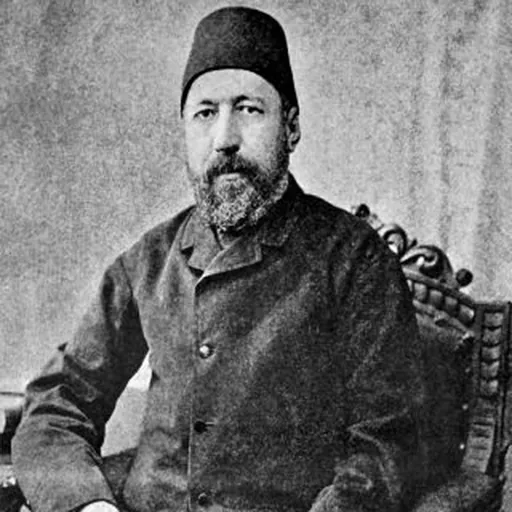
About Yousef al-Khalidi
Lived 1829 – 1907 (aged 77–78). Yousef al-Khalidi was a Turkish statesperson, lexicographer, writer, beamter, local government officer and interpreter.
Yusuf Dia Pasha al-Khalidi (, ; 1842–1906) was a prominent Ottoman politician who served as mayor of Jerusalem during several non-consecutive terms in the nineteenth and early twentieth centuries. Al Khalidi served as mayor of Jerusalem from the years 1870 to 1876, 1878 to 1879, and 1899 to 1906.
He was an elected member of the first Ottoman parliament, where he represented Jerusalem. He was also a governor, translator, professor and prolific writer. As an Ottoman patriot and an active participant in the reform of the system following Egyptian withdrawal from Syria, Khalidi was proud of his Jerusalem heritage, and was a relentless reformer of the Ottoman system from within, rather than a precursor of Arab, or Syrian independence from the Ottomans. He continuously referred to his homeland (watani) as Jerusalem.
Early life and education Al-Khalidi was born in Jerusalem, Ottoman Palestine in 1842. His father, al-Sayyid Muhammad Ali al-Khalidi, served as deputy qadi and chief of the Jerusalem Sharia court secretariat in Jerusalem, Ottoman Empire for about fifty years. Members of the Khalidi family, one of the politically prominent old families of the local nobility (the others being the al-Husayni family and the Nashashibi family), continuously held the office through the 18th and 19th centuries. Although the Husayni family was larger and wealthier, the Khalidis were more united and noted for their intellect.
As a teenager, al-Khalidi may have been influenced by the Ottoman Reform Edict of 1856. At the age of 17, he wrote of his thoughts about the state of the world, personal dignity and the individual's quest to become free, in the context of meditations on why the Ottoman Empire was being increasingly surrounded by European powers pilfering the region of its wealth and identified the cause of the situation to be the disparity in knowledge between the region and Europe. The interests of the country, he argued, could only be defended by dropping frivolous studies and acquiring scientific, historical and philosophical knowledge.
Yousef's initial requests to receive an education in Egypt was turned down because he lacked an invitation from that country and his father rebuffed his proposal that he be educated in Europe. Afterward he and his cousin Husayn left Jerusalem without the family's permission and reached Malta where they were enrolled into the Protestant college through the mediation of the Anglican bishop Gobat of Jerusalem. There, he studied English and French. Yousef's brother Yasin persuaded him after two years in the Protestant college to attend the Imperial Medical School in Constantinople, capital of the Empire. Yousef was dissatisfied with his time at the medical school after a year, finding no "salvation, he enrolled in an American Protestant missionary school outside of the capital, Robert College." He remained there for a year and a half before returning to Jerusalem because of the death of his father.
Later in life he taught Semitic languages in the Oriental Academy of Vienna, where he also wrote the first Kurdish-Arabic dictionary.
Career Al-Khalidi served as mayor of Jerusalem from the years 1870 to 1876, 1878 to 1879, and 1899 to 1906.
Al-Khalidi played a key role in the opposing political factions established to prohibit the Ottoman Empire's attempts to violate the constitution. Al-Khalidi was very familiar with Zionist thought, and the anti-Semitic environment in Europe out of which it emerged. He also perceived the danger Zionism could expose Jews to throughout the domains of the Ottoman Empire.
Compelled by a "holy duty of conscience" to voice his concerns that Zionism would jeopardize the friendly associations between Muslims, Christians and Jews, he wrote a letter On 1 March 1899 to Zadok Kahn, the chief rabbi of France, to prevail on Zionists, through Kahn's offices, to leave the area of Palestine in peace.
According to Rashid Khalidi (al-Khalidi's great-great-great-nephew), Alexander Scholch and Dominique Perrin, Khalidi was prescient in predicting that, regardless of Jewish historic rights, given the geopolitical context, Zionism could stir an awakening of Arab nationalism uniting Christians and Muslims.
On 19 March 1899 Herzl replied to al-Khalidi arguing that both the Ottoman Empire and the non-Jewish population of Palestine would benefit from Jewish immigration. As to al-Khalidi concerns about the non-Jewish majority population of Palestine, Herzl replied rhetorically: "who would think of sending them away?" and concluded ambiguously that "If he (the Ottoman Sultan) will not accept it, we will search and, believe me, we will find elsewhere what we need."
Death Al-Khalidi died on 25 January 1906.
Don’t just read it —
keep it.
Full-length biographies made to live with: read them, listen on the way to work, watch them tonight.
- E-book
- Audio
- Video
Instant download · yours to keep · every purchase keeps this site free
Important facts
People in Yousef al-Khalidi's life
Named in this biography and alive at the same time

Related people
Same field, nearest in time


Contemporaries
People whose lives overlapped Yousef al-Khalidi's

Frequently asked questions
Who was Yousef al-Khalidi?
Ottoman statesperson (1829–1907)
When was Yousef al-Khalidi born?
Yousef al-Khalidi was born in 1829 in Jerusalem.
When did Yousef al-Khalidi die?
Yousef al-Khalidi died in 1907 in Jerusalem.
What was Yousef al-Khalidi's occupation?
Yousef al-Khalidi was a statesperson, lexicographer, writer, beamter, local government officer and interpreter.
What nationality was Yousef al-Khalidi?
Yousef al-Khalidi was Turkish.
Sources & further reading
· Wikipedia: Yousef al-Khalidi
Cite this page
APA: Biography.guide. (2026). Yousef al-Khalidi. https://biography.guide/yousef-al-khalidi/
MLA: "Yousef al-Khalidi." Biography.guide, https://biography.guide/yousef-al-khalidi/.
Chicago: "Yousef al-Khalidi." Biography.guide. https://biography.guide/yousef-al-khalidi/.
Data last updated: 2026-09-24 · Spot an error? Report a correction.
Portrait: Wikimedia Commons · author & licence
Page generated 2026-09-27 05:09 UTC