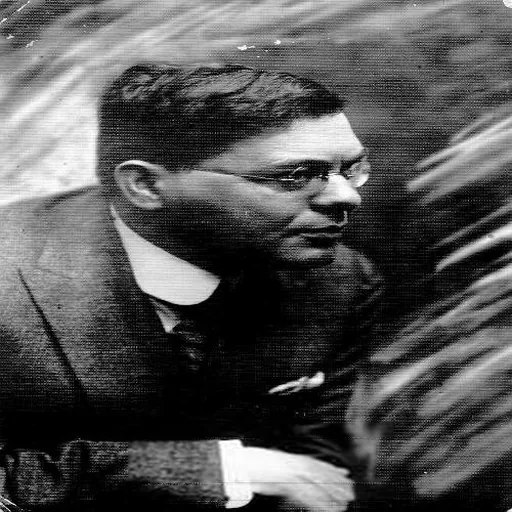
Yosef Tunkel
Belarusian-American Yiddish-language poet and satirist
About Yosef Tunkel
Lived 1881 – 1949 (aged 67–68). Yosef Tunkel was a Belarusian and American writer, poet and journalist.
Yosef Tunkel (1881 – August 9, 1949) was a Jewish–Belarusian–American writer of poetry and humorous prose in Yiddish commonly known by the pen name Der Tunkeler or 'The dark one' in Yiddish.
Biography In 1878, Tunkel was born into the family of a poor melamed in Babruysk (in Belarus, then part of the Russian Empire), Tunkel was a sickly child whose drawing ability prompted charitable members of the community to send him to Ivan Trutnev's art school in Vilnius at age fifteen. He finished his studies in 1899 and, too short sighted to be a painter, turned to writing. His poetry was first published in in 1901 and from then on his poems, satires, drama and children's stories appeared in Yiddish publications throughout Europe and North America.
Between 1906 and 1910 he travelled to the United States and settled in New York where he started the humorous journal Der kibitser (continued for two decades under the title Der Groyser Kundes). He returned home to Babruysk in 1910 due to family emergency. Moving to Warsaw in 1911 he wrote for Der moment, editing its humour pages, Der krumer spiegel, or The Crooked Mirror. AT this time, he started using the pseudonyms "Khoyshekh" and "Der Tunkeler". He spent World War I first at home in Babruysk, then in Ukraine, mainly in Kiev and Odessa. In the early twenties, he adapted several works of German poet Wilhelm Busch. He returned to independent Poland, and Der Moment, after the war. He also occasionally wrote for other newspapers such as Der Haynt and the Folkszeitung (People's Paper) under the pseudonym "Androginus". Around this time, he visited Israel, where he was feted by the Hebrew Writers Union and Khaim Nakhman Bialik, who declared himself a great admirer of Tunkeler's works. Tunkler subsequently wrote his first travel narrative based on his experiences in the Holy Land.
In the 1920s, Tunkler published numerous books, plays, feuilletons, parodies and humorous articles. He often personally acted out his works on stage while traveling around the country. When the Warsaw cabaret Azazel opened in 1925, Der Tunkeler's writings were part of the repertoire; his works were staged in Łódź and the Warsaw cabaret theater Sambatyon (which opened in 1927) as well.
In 1931 he visited what was then the British Mandate of Palestine, then traveled to the United States in 1932/1933 to visit his brothers and old friends as well as to gather material for a travel narrative. He stayed in Springfield where his brother Alex and sister-in-law Rose lived. Around 1934, he traveled to the Soviet Union to gather material for a subsequently published travel narrative. He lived in Paris for some time. In 1938 he adapted the Polish film Neighbors into Yiddish. The outbreak of World War II found him in Belgium from which he escaped into France with a group of Jewish refugees, only to be arrested by the Vichy authorities. He was sent to a detention center for foreign Jews in Strasbourg, where he befriended the Parisian novelist W. Wowiorka.
Escaping in early 1941, he managed to find his way to the US once more, where he wrote for the major New York Yiddish daily The Jewish Daily Forward despite failing health. He settled permanently in New York. In 1943, he published the autobiographical work Goles: Ksovim von a Flichtling (Exile - The Writings of an Exile) about his experiences in Belgium and France in an attempt to shed light on the plight of European Jewry. In 1948, Tunkel published his last book Der Groyser Genits Oder a Nudner Tag in Nyu York (The Great Genius or an Annoying Day in New York). His last work of literature was an article for the Lithuanian Yizkor Book Lite "The Chapter of Vilna in my Life" which is published posthumously in 1951.
His physical health was worsened by his experiences in the French camps and he spent the last several years of his life ill and nearly blind. On August 9, 1949, Iosef Tunkel died and was interred in the New Mount Carmel cemetery in Ridgewood, Queens, New York.
Throughout his life, numerous collections of his work were published in Warsaw, Kiev and New York. He is recognized as one of the Yiddish language's outstanding humorists.
Don’t just read it —
keep it.
Full-length biographies made to live with: read them, listen on the way to work, watch them tonight.
- E-book
- Audio
- Video
Instant download · yours to keep · every purchase keeps this site free
Important facts
People in Yosef Tunkel's life
Named in this biography and alive at the same time

Related people
Same field, nearest in time





Contemporaries
People whose lives overlapped Yosef Tunkel's





Frequently asked questions
Who was Yosef Tunkel?
Belarusian-American Yiddish-language poet and satirist
When was Yosef Tunkel born?
Yosef Tunkel was born in 1881 in Babruysk.
When did Yosef Tunkel die?
Yosef Tunkel died on 9 August 1949 in New York City.
What was Yosef Tunkel's occupation?
Yosef Tunkel was a writer, poet and journalist.
What nationality was Yosef Tunkel?
Yosef Tunkel was Belarusian and American.
Sources & further reading
Cite this page
APA: Biography.guide. (2026). Yosef Tunkel. https://biography.guide/yosef-tunkel/
MLA: "Yosef Tunkel." Biography.guide, https://biography.guide/yosef-tunkel/.
Chicago: "Yosef Tunkel." Biography.guide. https://biography.guide/yosef-tunkel/.
Data last updated: 2026-09-22 · Spot an error? Report a correction.
Portrait: Wikimedia Commons · author & licence
Page generated 2026-09-27 05:03 UTC