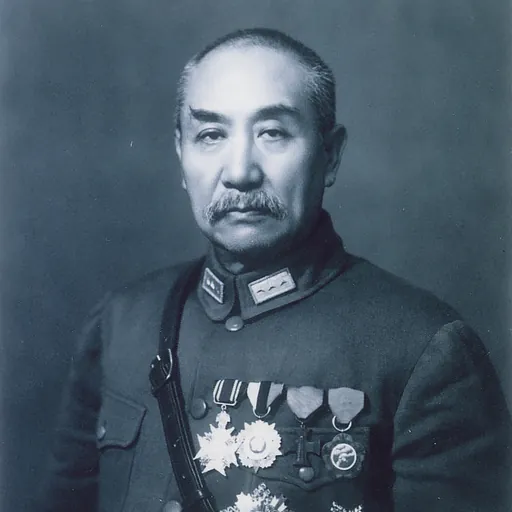
About Yen Hsi-shan
Lived 1883 – 1960 (aged 76). Yen Hsi-shan was a Chinese and Taiwanese politician and military personnel.
Yan Xishan (; 8 October 1883 – 23 May 1960; also romanized as Yen Hsi-shan) was a Chinese warlord who served in the government of the Republic of China from June 1949 to March 1950 as its last premier in mainland China and first premier in Taiwan. He effectively controlled the province of Shanxi from the 1911 Xinhai Revolution to the 1949 Communist victory in the Chinese Civil War. He maintained an ambivalent attitude towards the Communists until 1939, and participated in the Second United Front against the Japanese from 1937. He subsequently negotiated with the Japanese from 1940 to 1943, and allied himself with the Japanese against the Communists from 1944 until fleeing Shanxi in 1949. The resistance of his well-armed forces in Taiyuan posed a major obstacle to Communist victory in the Civil War.
As the leader of a relatively small and land-locked province, he survived Yuan Shikai, the Warlord Era, the Nationalist Era, the Japanese invasion of China and the subsequent civil war, being forced from office only when the Nationalist armies with which he was aligned had completely lost control of the Chinese mainland, isolating Shanxi from any source of economic or military supply.
Early life Childhood Experience in Japan Yan also joined an even more militant organization of Chinese revolutionaries, the "Dare-to-Die Corps."
Return to China When Yan returned to China in 1909, he was assigned as a division commander of the New Army in Shanxi but secretly worked to overthrow the Qing. After Yuan's death in 1916, China descended into a period of warlordism.
Efforts to reform Shanxi
Yan attempted to modernize the state of medicine in China by funding the Research Society for the Advancement of Chinese Medicine, based in Taiyuan, in 1921. One of less than twenty schools in China at the time, the school had a four-year curriculum and included courses in both Chinese and western medicine. Its courses were taught in English, German, and Japanese. Yan hoped that his support of the school would eventually lead to increased revenues in the domestic and international trade of Chinese drugs, improved public health, and improved public education.
Yan sent students from Shanxi to complete science and engineering degrees at Japanese, American and English universities. In 1936, he provided a scholarship for the future nuclear physicist He Zehui, the daughter of He Cheng, another early member of the Tongmenghui, to embark on a PhD in experimental ballistics at the Technische Universität Berlin.
Involvement in Northern Expedition
Yan's assistance to Chiang was rewarded shortly afterwards by his being named minister of the interior and deputy commander-in chief of all Kuomintang armies.
Yan's support for Chiang's military campaigns and his suppression of Communists influenced Chiang to recognize Yan as the governor of Shanxi and to allow him to expand his influence into Hebei. Chiang's defeat of Yan and Feng in 1930 is considered the end of China's Warlord Era.
Yan was unable to match the quality of leadership in Chiang's officer corps and the prestige that Chiang and the Nationalist Army had at the time. Before Chiang's armies defeated Feng and Yan, Yan Xishan was billed on the cover of the Time magazine as "China's Next President."
Return to Shanxi Subsequent relationship with Nationalist government Yan sent representatives to negotiate for unity against the Japanese invasion and prevent Chiang's execution.
Public policies Military policies Yan's military doctrine was based on the maintenance of a high-quality, professional core army supplemented by local defense groups. Following the completion of his village reforms in 1922, he established defense groups composed of male villagers aged 18–35, organized in a five-tier system from squads to regional commands. This system allowed him to mobilize large numbers of irregulars while keeping his core forces well-armed and loyal.
Attempts at social reform Yan's most ambitious social project was his rural construction movement, which aimed to make the village the foundational layer of society. He reorganized Shanxi's rural administration into a four-tier hierarchy: Village, alley, neighborhood, household.
To modernize the province, he implemented the "Six Policies and Three Tasks". The "Six Policies" included water conservation, tree planting, silkworm cultivation, opium eradication, hair cutting, and discouraging foot binding. The "Three Tasks" were cotton cultivation, afforestation, and animal husbandry. He engaged in a sustained campaign against foot binding, with foot inspectors and fines for those who continued the practice.
Attempts to eradicate opium use Yan took a hardline stance against opium, establishing the "Six Policies Assessment Office" to oversee suppression efforts. While hair cutting and foot binding reforms were highly successful, opium eradication proved difficult due to its economic influence and the influx of drugs from neighboring provinces. He established the Opium Suppression Division within his Village Governance Office to enforce anti-opium laws through house-to-house investigations.
Limitations of economic reforms Yan's economic strategy focused on state-led industrialization through his "Ten Year Plan", making Shanxi one of the most industrialized provinces in China. At the center of this plan was the Northwestern Industrial Company (NIC), a massive state-owned conglomerate that operated 35 factories and mines, including ironworks, chemical plants, and power stations. To fund these projects, Yan utilized the province's traditional banking expertise.
Ideology Yan Xishan's personal ideology, often referred to as "Yan Xishan Thought", was a unique synthesis of Confucianism, Nationalism, and Socialism. Central to his vision was the belief that the village was the political foundation of the nation, and that self-reliance was the only path to national salvation during a period of foreign imperialism.
Influence of Confucianism Yan's governance was based upon Confucian ethics, which he attempted to modernize for a republican era. In 1918, he declared the "Citizen-Oriented Governance Based on Civic Morality, Intelligence, and Wealth", which established four key virtues of trustworthiness, integrity, ambition, and altruism as core moral elements. Yan promoted these virtues through educational books such as What People Must Know and What Families Must Know, which were distributed to every household in Shanxi.
Influence of Christianity and Western Thought While primarily a Confucian, Yan was influenced by Western concepts of progress and administrative efficiency. He admired the Japanese model of local autonomy and industrialization, which he had studied firsthand in Tokyo. This influence manifested in his approach to social engineering, where he utilized pilot programs and phased implementation for his reforms.
Influence of Chinese Nationalism Yan's nationalism was centered on the preservation of Shanxi as a "Model Province" that could serve as a blueprint for a strong, reunified China. This often led to an ambivalent relationship with the central Kuomintang government; while he ostensibly supported the National Revolutionary Army, his primary loyalty remained to the Shanxi identity he had cultivated. His construction of provincial identity relied on Shanxi's historical role as the heart of Chinese civilization, promoting the province as a "living museum" of Chinese tradition.
Influence of socialism and communism Yan's economic policies were often described as "warlord capitalism," but they contained significant state-socialist elements. Influenced by Soviet central planning, Yan's "Ten Year Plan" aimed to establish state-controlled heavy industry to ensure the province's survival. He viewed private capitalism as potentially disruptive and preferred state-sponsored enterprises like the NIC to the control key resources of coal and iron. At the 1920 Jinshan Conference, he explored the idea of "how to effectively organize human groups," which eventually led to his village-based political system designed to enhance social control and productivity.
Extent of success By the late 1920s, Yan's reforms had made Shanxi significantly more stable and prosperous than surrounding provinces, gaining the title of "Model Province." However, his self-reliance and his refusal to fully integrate with the national government ultimately limited the province's potential when faced with the dual threats of Japanese invasion and Communist insurgency.
Threats to rule Early conflict with Japan Early conflict with Communists Invasion by Mengjiang
Second Sino-Japanese War Alliance with Communists He allowed Communist agents working under Zhou Enlai to establish a secret headquarters in Taiyuan and released Communists that he had been holding in prison, including at least one general, Wang Ruofei.
Early campaigns
Fall of Taiyuan
Re-establishment of Yan's authority Negotiations with Japanese As the Japanese invasion pushed Yan's administration into the southwest corner of Shanxi, he established a base there where he lived in sparse conditions for eight years. During this period, Yan practiced what American diplomat John S. Service described as "eight-faceted glittering gem" diplomacy: maintaining "two faces for the Central Government, two faces for the Japanese, two faces for the Communists, and two more for the people."
In 1940 Yan's old friend, Ryūkichi Tanaka, became chief of staff of the Japanese First Army. Tanaka initiated negotiations to bring Yan into an anti-communist alliance. Yan proposed a policy of co-operating to oppose the communists, which resulted in several direct meetings, including one with Japanese commander Iwamatsu Yoshio in 1942. While Yan never officially signed a "peace" treaty, a virtual ceasefire existed between his forces and the Japanese by 1944, allowing his troops to cross Japanese lines to attack Communist guerrillas.
The efforts of the Japanese Army to convince Yan Xishan to cooperate with them was referenced in the Japanese military's monograph Senshi Sōsho as the Operation Targetting Bo (対伯工作) or Operation Targetting Yan Xishan (対閻錫山工作). The efforts to appease and win over Yan Xishan, the commander of the Second Military Front, were considered a promising operation to undermine the Chinese generals and a first step to collapse the Chongqing government, and was something the Army Ministry, the East Asia Development Board, and the China Expeditionary Army placed great importance on.
A basic agreement and ceasefire arrangement were concluded on September 11, 1941, and detailed provisions of the ceasefire were concluded on October 27. However, in order to advance the situation, the Japanese side proposed a summit meeting and demanded that Yan Xishan issue a declaration of independence to show that he had severed ties with Chiang Kai-Shek. In response, Yan Xishan only expressed agreement with the fundamental principles of cooperation, but stated that he would only issue the declaration when he received the military funds and weapons as stipulated in the agreement, which delayed the matter. He argued that his Shanxi Army of more than a hundred thousand troops lacked supply, fighting spirit, and strength, and was under close supervision by the Chongqing Central Army while also in conflict with the Communists. The Japanese Army was unsure if Yan Xishan was being sincere or if this was a delaying tactic to build up his army. Moreover, since the agreement was accepted too hastily, the Japanese Army faced difficulty in fulfilling the exaggerated promises they had made to draw in Yan Xishan.
Yan died in Taiwan on 24 May 1960. He was buried in the Qixingjun region of Yangmingshan. For decades, Yan's residence and grave were cared for by a small number of former aides, who had accompanied him from Shanxi. In 2011, when the last of his aides turned 81 and was unable to care for the residence, the responsibility of maintaining the site was taken over by the Taipei City Government.
Legacy
Don’t just read it —
keep it.
Full-length biographies made to live with: read them, listen on the way to work, watch them tonight.
- E-book
- Audio
- Video
Instant download · yours to keep · every purchase keeps this site free
Important facts
People in Yen Hsi-shan's life
Named in this biography and alive at the same time




Related people
Same field, nearest in time





Contemporaries
People whose lives overlapped Yen Hsi-shan's


Frequently asked questions
Who was Yen Hsi-shan?
Chinese military officer (1883–1960)
When was Yen Hsi-shan born?
Yen Hsi-shan was born on 8 August 1883 in Dingxiang County.
When did Yen Hsi-shan die?
Yen Hsi-shan died on 23 May 1960 in Taipei.
What was Yen Hsi-shan's occupation?
Yen Hsi-shan was a politician and military personnel.
What nationality was Yen Hsi-shan?
Yen Hsi-shan was Chinese and Taiwanese.
Sources & further reading
Cite this page
APA: Biography.guide. (2026). Yen Hsi-shan. https://biography.guide/yen-hsi-shan/
MLA: "Yen Hsi-shan." Biography.guide, https://biography.guide/yen-hsi-shan/.
Chicago: "Yen Hsi-shan." Biography.guide. https://biography.guide/yen-hsi-shan/.
Data last updated: 2026-09-23 · Spot an error? Report a correction.
Portrait: Wikimedia Commons · author & licence
Page generated 2026-09-27 05:05 UTC