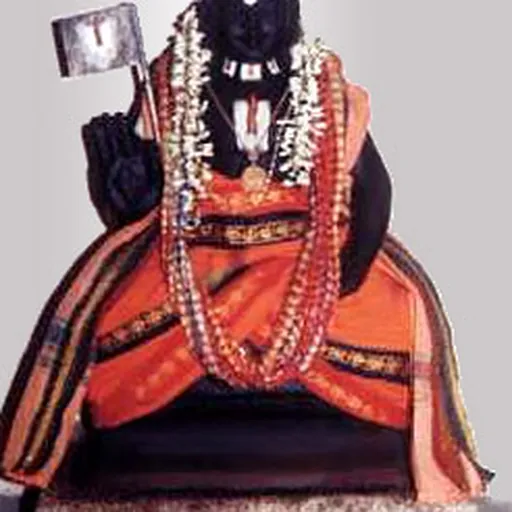
About Yamunacharya
Lived 950 – 1038 (aged 87–88). Yamunacharya was a philosopher and translator.
Yamunacharya (IAST: Yāmunāchārya), also known as Alavandar and Yamunaithuraivan, was a Vishishtadvaita philosopher based in Srirangam, Tamil Nadu, India. He is best known as a preceptor of Ramanuja, one of the principal leaders of the Sri Vaishnava tradition. He was born in the early 10th century CE and was the grandson of Nathamuni, a famed yogi who collected the works of the Tamil Alvars.
Life
Debate and Royal Patronage Yamunacharya lived from around 918–1038 CE and grew up studying Vedic texts under Rama Misra, developing great skill in the mimamsa philosophy. According to Sri Vaishnava tradition, as a teenager he challenged Akkiyalvan, the court scholar of the Pandya king, to a debate. Upon seeing the youth's age, Akkiyalvan sarcastically asked, "Aalavandharaa?" (meaning "Has he come to rule me?"). He defeated Akkiyalvan by logically proving that Akkiyalvan's mother was barren, the king was not righteous, and the queen was unchaste. The king and queen, impressed that the boy had understood the shortcomings of logic, adopted him. The queen hailed the youth with the title "Alavandar" ("one who came to rule"). In other versions of the legend, he was given half the kingdom. There is no historical record documenting his rule, suggesting that this event may have occurred in a local chieftaincy rather than the main Pandya kingdom.
Renunciation and Leadership at Srirangam After years of royal life, Rama Misra led him into visit the Ranganathaswamy Temple in Srirangam. There, he experienced a spiritual awakening, renounced his royal duties, and became a sanyasin, embracing the path of sharanagati (total self-surrender). He is believed to have composed the Chatushloki and Stotra Ratna at that moment. Rama Misra entrusted the leadership of Nathamuni's monastic institution to him, along with the Naalayira Divya Prabandham, bestowing upon him the name Yamunacharya.
Following the passing of Alavandar, the community at Srirangam was led by his son, Thiruvarangan. According to a legend, the deity Ranganatha himself instructed Yamunacharya to go to Kanchipuram and invite Ramanuja to Srirangam. Yamunacharya is traditioned to have expressed three last desires prior to his death:
To commemorate the names of Sage Parashara and Veda Vyasa by bestowing them upon worthy desciples. To compose a comprehensive commentary on Tiruvaymoli of Nammalvar. To compose commentaries on Upanishads, Vedanta Sutras, and Bhagavad Gita.
Works Alavandar, like his successor Ramanuja, focused both on philosophical debates defending Vishishtadvaita against Advaita and rival doctrines. His bhakti (devotional) prayers and philosophical works are written in Sanskrit, although he systematically preserved and codified the heritage of the Tamil Alvars. The major works attributed to him are: Chatuh Shloki – A four-verse hymn in praise of the goddess Lakshmi and her divine attributes. Stotra Ratna – A 65-verse devotional hymn ("Gem of Hymns") in praise of Narayana (Vishnu). Agama Pramanya – A work establishing the canonical authority and the Vedic validity of the Pancharatra agama scriptures. Maha Purusha Nirnayam – A now-lost treatise extolling the divine couple Lakshmi-Narayana as the Ultimate Reality. Gitartha Sangraha – A 32-verse summary and commentary outlining the central themes of the Bhagavad Gita. Nityam – A short liturgical manual detailing daily ritual worship duties.
Don’t just read it —
keep it.
Full-length biographies made to live with: read them, listen on the way to work, watch them tonight.
- E-book
- Audio
- Video
Instant download · yours to keep · every purchase keeps this site free
Important facts
Related people
Same field, nearest in time

Contemporaries
People whose lives overlapped Yamunacharya's


Frequently asked questions
Who was Yamunacharya?
Indian philosopher
When was Yamunacharya born?
Yamunacharya was born in 950 in Srirangam.
When did Yamunacharya die?
Yamunacharya died in 1038.
What was Yamunacharya's occupation?
Yamunacharya was a philosopher and translator.
What nationality was Yamunacharya?
Yamunacharya's recorded nationality: Chola dynasty.
Sources & further reading
Cite this page
APA: Biography.guide. (2026). Yamunacharya. https://biography.guide/yamunacharya/
MLA: "Yamunacharya." Biography.guide, https://biography.guide/yamunacharya/.
Chicago: "Yamunacharya." Biography.guide. https://biography.guide/yamunacharya/.
Data last updated: 2026-09-20 · Spot an error? Report a correction.
Portrait: Wikimedia Commons · author & licence
Page generated 2026-09-27 04:57 UTC