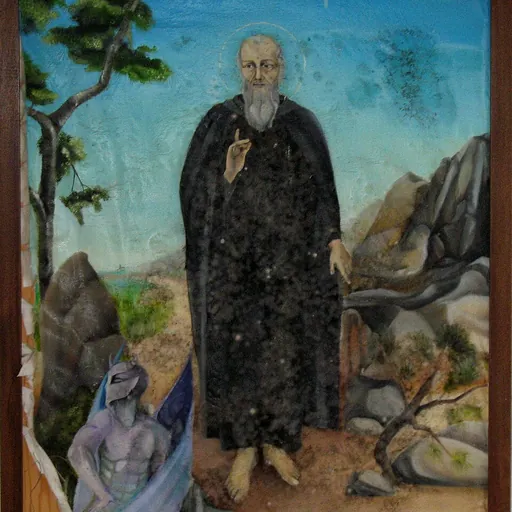
About Nilus the Younger
Lived 910 – 1004 (aged 93–94). Nilus the Younger was a Byzantine monk, hermit and founder.
Nilus the Younger, also called Neilos of Rossano (, ; 910 – 27 December 1005) was a Griko monk and abbot from Calabria, Italy. He was the founder of Italo-Byzantine monasticism in southern Italy. He is venerated as a saint in the Eastern Orthodox#tag:ref|"After a carefree youth in the south of Italy, he became a monk at the monastery of St Adrian in Calabria, where he later became abbot. In 981 the invading Saracens drove the monks to Vellelucio, where they lived on land given to them by the monastery of Montecassino. Shortly before his repose, Nilus designated that as the place where his monastery was to be definitively established. This monastery, of Grottaferrata, was for long faithful to Orthodoxy." Sickness brought about his conversion, however, and from that time he became a monk and a propagator of the rule of Saint Basil in Italy.
At the time Calabria was under the Byzantine rule and was Koine Greek in language, culture, and spiritual and liturgical tradition.
He was known for his ascetic life, his virtues, and theological learning. For a time he lived as a hermit, but his reputation drew followers to Rossano, whom he began to instruct. However, after a while, he realized that he was viewed as a local authority, and hearing that there was talk of making him bishop, Nilus fled to Capua, where he stayed for fifteen years. Later he spent certain periods of his life at various monasteries which he either founded or restored. Although Nilus instructed his monks according to the Rule of St. Basil, he maintained cordial relations with the Benedictines at Monte Cassino, where he spent some time, as well as at the Alexius monastery in Rome.
The site was granted to Nilus by Gregory, count of Tusculum; he is counted the first abbot. He spent the end of his life partly in the Sant'Agata monastery in Tusculum and lived for fifteen years in a monastery in Valleluce's frazione in Sant'Elia Fiumerapido.
When Nilus was once asked by a Latin Rite monk about the criticisms of the Cluniac Reforms and the Roman Rite emanating from adherents of the Photian schism in Constantinople, Nilus replied, "However we differ, both do all things for the glory of God. Don't allow yourselves to be disturbed by these criticisms."
He died in the Sant'Agata monastery in 1005.
Saint Nilus is revered as the patron saint of scribes and calligraphers. The abbey continues in the Byzantine rite.
Don’t just read it —
keep it.
Full-length biographies made to live with: read them, listen on the way to work, watch them tonight.
- E-book
- Audio
- Video
Instant download · yours to keep · every purchase keeps this site free
Important facts
Related people
Same field, nearest in time



Contemporaries
People whose lives overlapped Nilus the Younger's


Frequently asked questions
Who was Nilus the Younger?
Italian saint
When was Nilus the Younger born?
Nilus the Younger was born in 910 in Rossano.
When did Nilus the Younger die?
Nilus the Younger died on 26 September 1004 in Grottaferrata.
What was Nilus the Younger's occupation?
Nilus the Younger was a monk, hermit and founder.
What nationality was Nilus the Younger?
Nilus the Younger was Byzantine.
Sources & further reading
· Wikipedia: Nilus the Younger
Cite this page
APA: Biography.guide. (2026). Nilus the Younger. https://biography.guide/nilus-the-younger/
MLA: "Nilus the Younger." Biography.guide, https://biography.guide/nilus-the-younger/.
Chicago: "Nilus the Younger." Biography.guide. https://biography.guide/nilus-the-younger/.
Data last updated: 2026-09-21 · Spot an error? Report a correction.
Portrait: Wikimedia Commons · author & licence
Page generated 2026-09-27 05:00 UTC