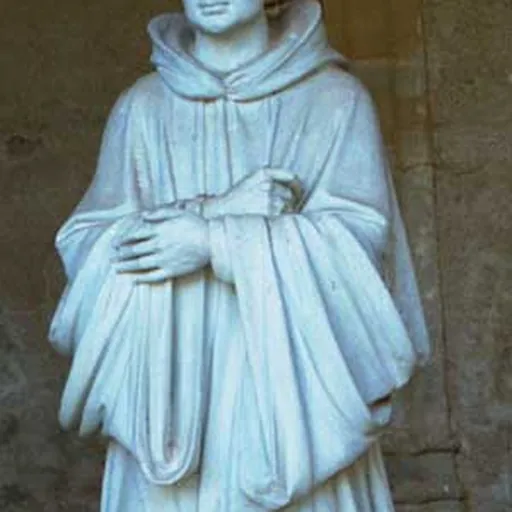
Majolus of Cluny
French abbot of Cluny
About Majolus of Cluny
Lived 910 – 994 (aged 83–84). Majolus of Cluny was a French catholic monk.
Majolus of Cluny (Maieul, Mayeul, Mayeule, Mayol) (c. 906 – May 11, 994
Life Majolus' father, named "Fulcher", was from a wealthy provincial family of Avignon. His mother was named Raimodis. They had two sons: Majolus and Cynricus. It is not known for sure which was the older, but traditionally the younger sons of noble families were given to the church and the elder sons were made the heirs to the father's estate, hence because Majolus became a monk, it is sometimes assumed he is the younger.
Around 916, Majolus fled his family's estates near Rietz to stay with relatives at Mâcon due to the feudal wars. Both his parents died while he was young.
Lyons and Macon Majolus studied the liberal arts at Lyon and became canon, and later archdeacon of Mâcon; his ordination to the priesthood was in Mâcon. While in Mâcon he gave classes to a large body of clerks for free. He built a small oratory on the opposite side of the river from the town, where he would retire for prayer. In personal habits he was always kind, never telling lies, detraction or flattery, and he was severe against sinners, if it was necessary to call them to repent. He gained a reputation among the local people as a holy person and so when Besançon needed a new bishop, many people, called on him to become bishop, but he refused. in Provence. A number of monks and others accompanying were captured by the Arabs from Fraxinet. Much venerated by his monks, a ransom was quickly raised. The monks responded, however, once their abbot was released, by stirring up a fury in Provence against the raiders. The peasantry and the nobles together implored their overlord William Count of Provence, to act.
William, equally disturbed by the treatment of the abbot, raised a feudal host and took to the offensive. His army consisted not only of men from Provence, but also the lower Dauphiné and Nice. He defeated the Muslims at the Battle of Tourtour, thus securing the mountain passes.
Political life
The Holy Roman Emperor Otto I had a good relationship with Majolus, as did his wife Adelheid of Burgundy. In 971, Majolus founded the Monastery of San Salvatore in Lombardy with Adelaide's support. Majolus visited the imperial court in Pavia at the Emperor's request, and many people sought out Majolus as an intermediary to help them with their petitions. He supposedly predicted the Emperor's death, when he had a dream seeing a lion in a cage that burst through its chains. Majolus interpreted that as a sign that the Emperor would die that year. Not long after this dream, the Emperor did die.
In 974 Adelheid and her son Otto II, summoned Majolus to Italy to make him Pope, but Majolus refused. Otto II married Theophanu, a relative of the Byzantine Emperor John I Tzimiskes. She was frequently at odds with her mother-in-law, Adelaide, which caused an estrangement between mother and son. In Pavia, around 980, Otto II and his mother, the dowager empress, were reconciled after years of being apart, in part through the efforts of Majolus. This episode and other convinced contemporaries of the influence that Majolus and Cluny had over the Emperor. Majolus advised the Emperor against his Italian campaign in 983, telling him that he would die if he went on it, and the Emperor died in that year.
Monastic Reform Up until that time, Benedictine houses were autonomous. The Cluniac reform movement had already begun with Berno of Cluny at the beginning of the 10th century, but the monasteries reformed by the monks of Cluny during the tenures of Odo and Aymard (2nd and 3rd abbots of Cluny) remained independent of Cluny. Reform was the personal work of the abbot, and it was not uncommon for the abbots of Cluny to hold abbacies at two or more monasteries. The relationship, however, was with the abbot, not with Cluny, and on the death of the abbot, rather than the position reverting to Cluny, the monks continued to elect their own successor abbot.
He reformed many German monasteries at the request of Emperor Otto the Great. In 972 Otto appointed Majolus abbot of Sant'Apollinare in Classe, near Ravenna. He reformed San Giovanni Evangelista in Parma in 982, and the canons at Monte Celio in Pavia in 987. At some point between 966 and 990, King Conrad of Burgundy renounced all rights and gave Romainmôtier Priory to Abbot Majolus. In the 980s Henry I, Duke of Burgundy asked Majolus to take charge of the Abbey of Saint-Germain d'Auxerre. Majolus would appoint a prior to manage things in his absence, but not necessarily a monk of Cluny.
Under Majolus, a network of monasteries dependent under Cluny's leadership began to take shape and would continue to develop under Majolus' successors Odilo and Hugh. In 965, the Empress Adelaide placed Payerne Priory under Cluny Abbey. The Priory of Paray-le-Monial was founded by Lambert of Chalon and his wife, Adelaide of Chalon, both friends of Abbot Majolus, in 973 as a house of Cluny. In 989 Bruno of Roucy, Bishop of Langres, requested Majolus, to send monks to re-settle the Abbey of St. Benignus in Dijon, grown decadent, as a Cluniac house. Among places that Cluny reformed or gave support to during this period include Saint-Maur-des-Fossés. Majolus sent William of Volpiano to reform the Abbey of Saint-Sernin at Toulouse.
Cluny's wealth and property grew as people donated gave gifts of land, churches, and other valuables. possessions, which periodically gave rise to disputes between Cluny and various feudal lords. Cluny was not known for the severity of its discipline or its asceticism, but the abbots of Cluny supported the revival of the papacy and the reforms of Pope Gregory VII. The Cluniac establishment found itself closely identified with the Papacy. The Popes in this time period were strongly supportive to Cluny and they placed the penalty of excommunication upon anyone who disturbed or usurped Cluny's rights.
Character Majolus was revered in his own time as a holy man. He spent much time in prayer and solitude, he rebuked sinners, he disliked public praise and high honours, but he would do much good in secret away from the eyes of the public. Whenever he went on a journey he would have an open book in his hand, which could be either a spiritual or philosophical work, which he would read as he rode. He had great knowledge of the scriptures and other subjects, but would never show off his knowledge to anyone, and would only speak when asked his opinion on something. He always spoke very briefly. He was not extreme in asceticism, whenever he sat down at table with the rich or powerful, he would eat the same things they would; he wore decent clothes that were neither too shabby nor too expensive. He drank a little wine. He was said to be a very gentle and kind person.
Miracles Vita S. Maioli attributes a number of miracles to Majolus, some of them are reported as happening during his lifetime. Majolus was said to have cured the sick, restored sight to the blind, healed those bitten by serpent, dogs or wolves, he also miraculously rescued people from death by drowning or fire. Among the stories of miracles attributed to him, the following are here related:
Once when Majolus was returning from Aquitaine, he decided to visit a monastery along the way and sent a messenger ahead of him to say he was coming. The monks of this monastery were happy that he was coming, but the purveyor of the monastery felt bad because they had run out of fish. However, the purveyor of the monastery told the monks to go down to the river and call on the name of Majolus, and when they did, they caught an enormously large salmon.
The water that Majolus used to wash his hands in was said to have healing powers. Once in Vallavaense a blind mendicant caught hold of Majolus' bridle as he was leaving the town and begged Majolus to bless water in a jar he had brought. Majolus was moved by this show of faith and so he blessed the water. The beggar then washed his eyes with the water and received his sight.
One time several pilgrims returning from his tomb reached the Loire river and they could not cross it because the boat was on the other side, and the boatman refused to come over for them. They called on the name of Majolus, and the boat crossed over by itself to them, waited for them to enter, and when they got in, it took them without being rowed to the other side of the river.
A woman who brought her dead child to Majolus' tomb in Souvigny. She put the body of her child in front of the altar, where it remained the whole night. At nine o'clock in the morning the eyes of the boy opened and the boy called for his mother, who ran to him.
Death
Majolus lived to the old age of 84. Two years before he died, he gave up the abbacy and made Odilo his coadjutor, just as Aymard had done with him many years earlier. He retired to one of the smaller Cluniac houses where he devoted time to serving the brothers there by instruction, correction and inspiration. He continued to work even into his old age, and he died on his way to reform Saint-Denis in Paris. He did not get far and stopped at Souvigny Priory, where he died and was buried.
Veneration After he died, the monks at Cluny wanted to bring him to Cluny, but the monks at Sovigny protested and insisted that he remain there. The tomb of Majolus became the focus of pilgrimages. Hugh Capet, King of France, came there in 994 after the death of Mayeul. His feast day is May 11; he is also commemorated on April 29, the Feast of the Holy Abbots of Cluny", along with Odo, Odilo of Cluny, and Hugh of Cluny.
Don’t just read it —
keep it.
Full-length biographies made to live with: read them, listen on the way to work, watch them tonight.
- E-book
- Audio
- Video
Instant download · yours to keep · every purchase keeps this site free
Important facts
People in Majolus of Cluny's life
Named in this biography and alive at the same time





Related people
Same field, nearest in time




Contemporaries
People whose lives overlapped Majolus of Cluny's


Frequently asked questions
Who was Majolus of Cluny?
French abbot of Cluny (c.906–994)
When was Majolus of Cluny born?
Majolus of Cluny was born in 910 in Valensole, Avignon.
When did Majolus of Cluny die?
Majolus of Cluny died on 11 May 994 in Souvigny Priory.
What was Majolus of Cluny's occupation?
Majolus of Cluny was a catholic monk.
What nationality was Majolus of Cluny?
Majolus of Cluny was French.
Sources & further reading
Cite this page
APA: Biography.guide. (2026). Majolus of Cluny. https://biography.guide/majolus-of-cluny/
MLA: "Majolus of Cluny." Biography.guide, https://biography.guide/majolus-of-cluny/.
Chicago: "Majolus of Cluny." Biography.guide. https://biography.guide/majolus-of-cluny/.
Data last updated: 2026-09-23 · Spot an error? Report a correction.
Portrait: Wikimedia Commons · author & licence
Page generated 2026-09-27 05:05 UTC