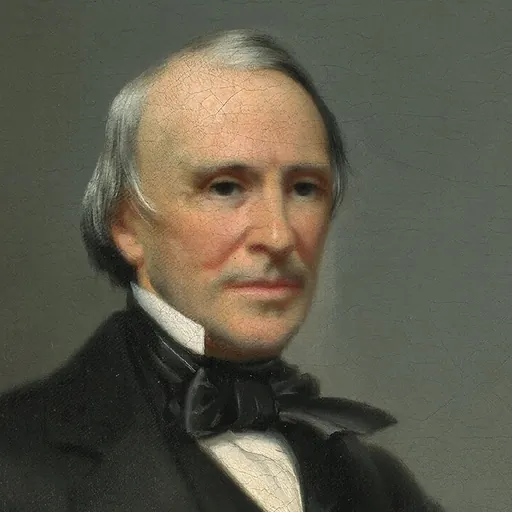
About Wyndham Robertson
Lived 1803 – 1888 (aged 85). Wyndham Robertson was an American judge, historian, politician, genealogist, lawyer and governor.
Wyndham Robertson (26 January 180311 February 1888) was the Acting Governor of the U.S. state of Virginia from 1836 to 1837. He also twice served multiple terms in the Virginia House of Delegates, the second series representing Richmond during the American Civil War.
A Whig, Robertson advocated for the United States during the secession crisis that precipitated the Civil War. However, after Lincoln's call for troops, he joined in Virginia's secession. After the war, he became a member of the Committee of Nine that helped usher Virginia back into the Union without imposing disabilities upon former Confederates. Towards the end of his life, Robertson published a book about Pocahontas and her descendants, including himself.
Early life and family He was born in 1803 near Manchester, in Chesterfield County, Virginia across the James River from Richmond, to William Robertson (1750–1829) and his wife Elizabeth Bolling, who was descended from Pocahontas and John Rolfe. His paternal grandfather Archibald Robertson emigrated from Scotland to become a factor (tobacco merchant) on the James River. His father was a member of the Virginia Council of State. Robertson's elder brothers included Thomas B. Robertson (1779–1828), who became Governor of Louisiana, and John Robertson (1787–1823), who became a U.S. Congressman. Wyndham Robertson attended private schools in Richmond. He graduated from The College of William and Mary in 1821 and read law.
In 1831, Robertson married Mary Trigg Smith, daughter of Captain Francis Smith (d.1843) of Washington County, Virginia, who served the Continental Army and in the Virginia Senate during the War of 1812. They had at least four daughters—Mary Robertson (1834–1866), Elizabeth Robinson (1837- ), Kate Robertson White (1845–1922), Pocahontas (1847–1923), and two sons—Francis Smith Robertson (1841–1926), and Wyndham Robertson Jr. (1851–1923).
Career Admitted to the Virginia bar in 1824, Robertson made a short trip to Paris and London three years later. In 1830 legislators elected him to Virginia's Council of State, where his late father had sat. Robertson was re-elected to the Council of State in 1833. In 1834, at the first meeting of the James River Canal Company, Robertson suggested that instead of constructing a canal to Lynchburg and attempting to extend it across the Appalachian Mountains to the Kanawha River, the company instead construct a railroad, which could ultimately continue to the Mississippi River.
On March 31, 1836, Robertson became the Council of State's senior member, Lieutenant-Governor of Virginia. When Governor Littleton Waller Tazewell resigned that same day, Robertson became (acting) governor. Since the Virginia General Assembly, which elected the Governor, was Democratic, and he, being a Whig, was not, Robertson was not elected Governor when that term expired in 1837 and was replaced by David Campbell. Richmond voters re-elected Robertson for three successive sessions, until 1841, when Raleigh T. Daniel replaced him as Richmond's delegate.
In 1841, Robertson moved to his wife's home, "Mary's Meadows", just south of Abingdon, in southwest Virginia, and farmed. He was made a Justice of the Peace for Washington County on July 25, 1842, and a trustee of Abingdon Academy in 1843, shortly before his father-in-law's death. In 1849, Robertson chaired a meeting to elect delegates to extend the Virginia and Tennessee Railroad to town. In 1850, Robertson leased the King Saltworks for five years. Thomas L. Preston had leased them the previous years and would again lease them in 1858. Salt production in those days used enslaved labor to keep fires burning to evaporate brine, and the salines which came to be run by Stuart, Palmer, and Parker by 1863 helped supply much of the salt required by the Southern States.
Enslaver, Unionist, and legislator in the American Civil War In 1858, Robertson returned to Richmond. and at least 28 enslaved persons in the 1850 U.S. Federal Census. His father-in-law Capt. Francis Smith had enslaved 107 people in the 1840 census, of whom 20 were engaged in farming. In the 1860 census, Robertson owned seven enslaved persons in Richmond and at least 75 enslaved persons in Washington County, Virginia.
In 1859, Richmond voters again elected Robertson to the Virginia House of Delegates as one of their three delegates in the 1859-1861 session based on the representational changes after adopting the Virginia Constitution of 1850 and population shifts documented in the census. As Virginia struggled with the idea of seceding from the United States, Robertson was a staunch Unionist and tried to prevent its secession. He later characterized himself as a "friend to peace and the Union" and noted that he had actively opposed South Carolina's call for a Southern Convention in 1859.
After South Carolina and several other states started seceding in the winter of 1860–61, Robertson still advocated against Virginia following suit. When President Abraham Lincoln made his call for troops on April 15, 1861, Robertson believed the Anti-Coercion scenario met and was "from that time forth zealously active in all measures for the defence of his State."
Robertson continued as the leading vote-getter within Richmond's delegation to the House of Delegates for two additional terms; his legislative service ended as the Confederacy fell in 1865. In 1863, Robertson opposed and helped to defeat a bill to fix food prices, which he believed "fraught with the direst mischief", despite food riots in Richmond.
Postwar After the war, Robertson moved back to Abingdon. During Congressional Reconstruction, Robertson was a member of the Committee of Nine, led by Alexander H. H. Stuart, that sought Virginia's readmission to the Union. At issue was the new state constitution, which included a provision disenfranchising former Confederates, which went beyond the terms of surrender. The committee successfully negotiated with President Ulysses S. Grant and others in the Federal government to have that clause voted on separately. It was defeated, but the remainder of the new state constitution (without the former version's pro-slavery provisions) was adopted so that Virginia could rejoin the Union.
After the American Civil War, some Northern writers began questioning the validity of the rescue story of Captain John Smith and Pocahontas, attacking the accounts of the historical role played by both as well as that of her husband John Rolfe. Harvard historian Henry Adams, who had served as his secretary to his father, Charles Francis Adams, Lincoln's Ambassador to Britain during the American Civil War, helped the debunkers. Robertson noted his descent from John Adams, a rival of John Randolph of Roanoke, who was descended from Pocahontas. His thesis was that because her descendants were notable, so was she. Tracing her descendants, who included the First Families of Virginia including the Bollings, Branches, Lewises, Randolphs, and Pages, as well as his own family, Robertson wrote, "History, poetry, and art have vied with one another in investing her name from that day to the present with a halo of surpassing brightness."
Don’t just read it —
keep it.
Full-length biographies made to live with: read them, listen on the way to work, watch them tonight.
- E-book
- Audio
- Video
Instant download · yours to keep · every purchase keeps this site free
Important facts
People in Wyndham Robertson's life
Named in this biography and alive at the same time



Related people
Same field, nearest in time


Contemporaries
People whose lives overlapped Wyndham Robertson's





Frequently asked questions
Who was Wyndham Robertson?
Governor of Virginia (1803-1888)
When was Wyndham Robertson born?
Wyndham Robertson was born on 26 January 1803 in Chesterfield County.
When did Wyndham Robertson die?
Wyndham Robertson died on 11 February 1888 in Abingdon.
What was Wyndham Robertson's occupation?
Wyndham Robertson was a judge, historian, politician, genealogist, lawyer and governor.
What nationality was Wyndham Robertson?
Wyndham Robertson was American.
Sources & further reading
· Wikipedia: Wyndham Robertson
Cite this page
APA: Biography.guide. (2026). Wyndham Robertson. https://biography.guide/wyndham-robertson/
MLA: "Wyndham Robertson." Biography.guide, https://biography.guide/wyndham-robertson/.
Chicago: "Wyndham Robertson." Biography.guide. https://biography.guide/wyndham-robertson/.
Data last updated: 2026-09-22 · Spot an error? Report a correction.
Portrait: Wikimedia Commons · author & licence
Page generated 2026-09-27 05:02 UTC