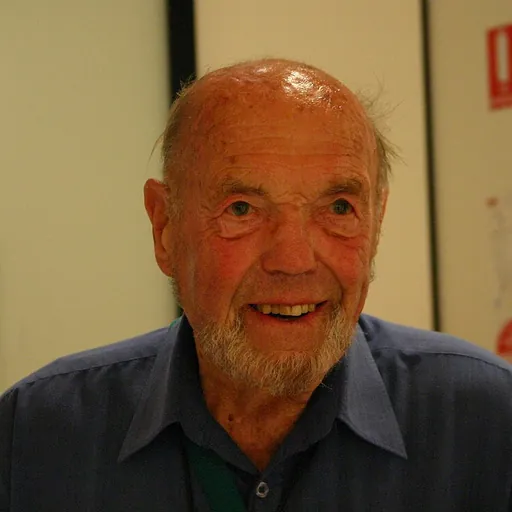
About Wolfgang Sievers
Lived 1913 – 2007 (aged 93). Wolfgang Sievers was an Australian and German photographer and architectural photographer.
Wolfgang Georg Sievers, AO ( – ) was an Australian photographer who specialised in architectural and industrial photography.
Early life and career
Sievers was born on , in Berlin, Germany. His father was Professor Johannes Sievers, an art and architectural historian with the German Foreign Office until his dismissal by the government in , and author of the first 4 volumes of a monograph on the neo-classical architect Karl Schinkel. His mother was Herma Schiffer, a writer and educator of Jewish background who was Director of the Institute for Educational Films.
From to , he studied at the Contempora Lehrateliers für neue Werkkunst in Berlin, a progressive private art school created by architect Fritz August Breuhaus de Groot, which, like the famous Bauhaus, strongly emphasised the unity of all applied arts. Sievers took architectural photographs for his father's books on Berlin's historical buildings, particularly the work of Karl Schinkel. He also spent a year working in Portugal, from to . In , he was retained as a teacher at the Contempora, but decided to emigrate to Australia following rumours of the school's imminent closure by the authorities. He had arranged for his photographic equipment to be transported, but was briefly questioned by the Gestapo, then conscripted as an aerial photographer for the Luftwaffe. He fled the country immediately, going first to England in :
In Australia, Sievers opened a studio in South Yarra, Melbourne. After war was declared, he volunteered for the Australian Army and served from to . Following demobilisation, he established a studio at Grosvenor Chambers in fashionable Collins Street, initially drawing many of his commissions from fellow European immigrants including the architect Frederick Romberg, and Ernst Fuchs, who had arrived from Vienna. During his early years in Melbourne, Sievers became a lifelong friend of fellow émigré photographer Helmut Newton and his Australian actress wife, June Browne, who later made photographs herself under the pseudonym "Alice Springs".
Work
Significant corporate clients included Alcoa, Australian Paper Manufacturers, Comalco, Hamersley Iron, John Holland Group, John Lysaght, Shell and Vickers Ruwolt. He also received commissions from architectural firms including Bates, Smart and McCutcheon, Hassall & McConnell, Leith & Bartlett, Winston Hall and Yuncken Freeman. In the 1950s, Sievers was engaged by the then Department of Overseas Trade with a brief to change Australia's image from a land of sheep and wool to an image of a sophisticated industrial and manufacturing nation. Many of these images were published in the magazine Walkabout.
Sievers' work after the war was imbued with the Bauhaus ethos and philosophy of the New Objectivity he had learned in Berlin, combined with a socialist belief in the inherent dignity of labour. His photographs were often overtly theatrical, as he commonly photographed industrial machinery at night, isolating details with artificial light and posing workers for heightened effect. This can be seen in the Gears for Mining Industry, perhaps his best-known image, depicting a worker assembling a giant gear. Despite the contrived nature of many of these images, this approach was influential in Australian post-war commercial photography. Ennis considers that:His photography championed the spirit of the modern age and some of its fundamental principles, especially functionalism, purity of design and objectivity. In keeping with his direct experience of European modernism, Sievers saw his role as a photographer in radical terms, aiming to unite art and industry. He approached professional photography as a creative endeavour and developed a distinctive style, characterised by bold compositions, dramatic tonal contrasts and an often extraordinary depth of field. Sievers' work also displays a penchant for grand scale and theatrical effects. In , the Australian National Gallery staged a retrospective of his work, an exhibition which travelled around the country, often accompanied by Sievers' lectures. In , he was the subject of a major retrospective exhibition held in Lisbon, Portugal at the Arquivo Fotografico Municipal de Lisboa. He was appointed an Officer of the Order of Australia (AO) in "or service to the arts as a photographer, and to recording Australian cultural life and heritage through the visual documentation of Australian industry and architecture of the 20th Century."
The National Library of Australia has an archive of more than 50,000 of Sievers' negatives and transparencies.
Sievers was active in Australia, Germany and Austria, with research into the emigration of war criminals to Australia from to . In , he donated several hundred photographs from his archive, worth up to , to raise money "for justice and civil liberties" causes.
Don’t just read it —
keep it.
Full-length biographies made to live with: read them, listen on the way to work, watch them tonight.
- E-book
- Audio
- Video
Instant download · yours to keep · every purchase keeps this site free
Important facts
People in Wolfgang Sievers's life
Named in this biography and alive at the same time




Related people
Same field, nearest in time


Contemporaries
People whose lives overlapped Wolfgang Sievers's




Frequently asked questions
Who was Wolfgang Sievers?
Australian photographer (1913–2007)
When was Wolfgang Sievers born?
Wolfgang Sievers was born on 18 September 1913 in Berlin.
When did Wolfgang Sievers die?
Wolfgang Sievers died on 7 August 2007 in Melbourne.
What was Wolfgang Sievers's occupation?
Wolfgang Sievers was a photographer and architectural photographer.
What nationality was Wolfgang Sievers?
Wolfgang Sievers was Australian and German.
Sources & further reading
Cite this page
APA: Biography.guide. (2026). Wolfgang Sievers. https://biography.guide/wolfgang-sievers/
MLA: "Wolfgang Sievers." Biography.guide, https://biography.guide/wolfgang-sievers/.
Chicago: "Wolfgang Sievers." Biography.guide. https://biography.guide/wolfgang-sievers/.
Data last updated: 2026-09-22 · Spot an error? Report a correction.
Portrait: Wikimedia Commons · author & licence
Page generated 2026-09-27 05:04 UTC