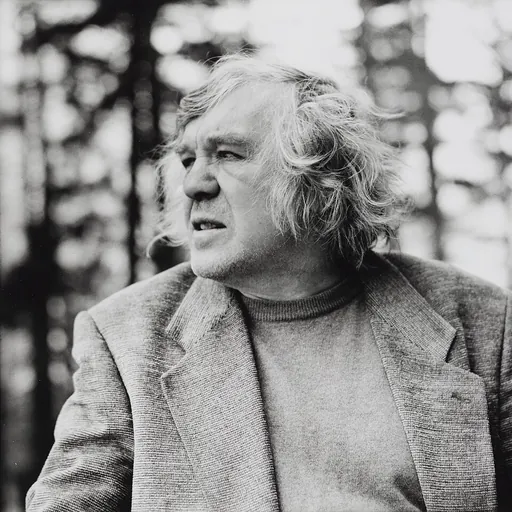
About Wolfgang Hilbig
Lived 1941 – 2007 (aged 65). Wolfgang Hilbig was a German writer, poet, novelist, laborer, artisan and librettist.
Wolfgang Hilbig (31 August 1941 2 June 2007) was a German writer and poet.
Life Wolfgang Hilbig was born in Meuselwitz, Germany. His grandfather had emigrated from Biłgoraj (Congress Poland, Russian Empire) before the First World War. In 1942, his father was reported missing at Stalingrad, leaving behind Hilbig and his mother.
After his schooling in his home town, Hilbig began to work at a boring mill. Later, after military service, he worked as a tool maker and in assembly construction at the Meuselwitz lignite mine.
In 1978, Hilbig moved to East Berlin, and in 1979 he became an independent writer. In 1985, he left the GDR with a travel visa and moved to West Germany.
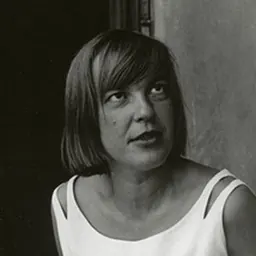
He lived in Berlin after the fall of the Berlin Wall and married writer and translator Natascha Wodin in 1994. They had one daughter and divorced in 2002.
Hilbig died from cancer in 2007 and is buried in the Dorotheenstädtischen Cemetery in Berlin.
Work At first Hilbig favoured poetry, but his works remained widely unpublished in the GDR. He received attention from the West however, as a result of his poems in the anthology Cries for Help from the Other Side (1978). His first volume of poetry, Absence (1979) was published by S. Fischer Verlag in Frankfurt am Main. For this, Hilbig was fined.
At the end of the 1970s, Hilbig gave up his day job and began to work exclusively as a writer. With the support of Franz Fühmann, a few of his poems were printed in a GDR newspaper for the first time. His prose anthology, Unterm Neomond (1982) was published by S. Fischer, followed by Stimme Stimme (1983), a prose and poetry anthology published by Reclam in Leipzig.
In 1985 Hilbig gained a visa for West Germany valid until 1990. During this time he published not only further poetry and prose, but also his first novel, Eine Übertragung (1989), which was received well by literary critics.
Even after reunification, the main themes of his work remained the dual-existence of working and writing in the GDR and the search for individuality. His further works include: his second novel, »Ich« (1993); his novellas and collections of short stories, such as Die Kunde von den Bäumen (1992) and Die Arbeit an den Öfen (1994); and his third novel Das Provisorium (2000). Autobiographical themes are often prevalent.
Awards 1983 Hanau Brothers-Grimm-Prize 1989 Ingeborg Bachmann Prize for Eine Übertragung 1992 Berlin Literature Prize 1993 Brandenburg Literature Prize 1997 Fontane Prize (the Berlin Academy of Arts) 2002 Georg Büchner Prize 2002 Walter Bauer Prize 2002 Peter Huchel Prize for Poetry 2007 Erwin Strittmatter Prize
Don’t just read it —
keep it.
Full-length biographies made to live with: read them, listen on the way to work, watch them tonight.
- E-book
- Audio
- Video
Instant download · yours to keep · every purchase keeps this site free
Important facts
Family & relationships
People in Wolfgang Hilbig's life
Named in this biography and alive at the same time

Related people
Same field, nearest in time



Contemporaries
People whose lives overlapped Wolfgang Hilbig's

Frequently asked questions
Who was Wolfgang Hilbig?
German novelist (1941–2007)
When was Wolfgang Hilbig born?
Wolfgang Hilbig was born on 31 August 1941 in Meuselwitz.
When did Wolfgang Hilbig die?
Wolfgang Hilbig died on 2 June 2007 in Berlin.
What was Wolfgang Hilbig's occupation?
Wolfgang Hilbig was a writer, poet, novelist, laborer, artisan and librettist.
What nationality was Wolfgang Hilbig?
Wolfgang Hilbig was German.
Sources & further reading
Cite this page
APA: Biography.guide. (2026). Wolfgang Hilbig. https://biography.guide/wolfgang-hilbig/
MLA: "Wolfgang Hilbig." Biography.guide, https://biography.guide/wolfgang-hilbig/.
Chicago: "Wolfgang Hilbig." Biography.guide. https://biography.guide/wolfgang-hilbig/.
Data last updated: 2026-09-21 · Spot an error? Report a correction.
Portrait: Wikimedia Commons · author & licence
Page generated 2026-09-27 05:01 UTC