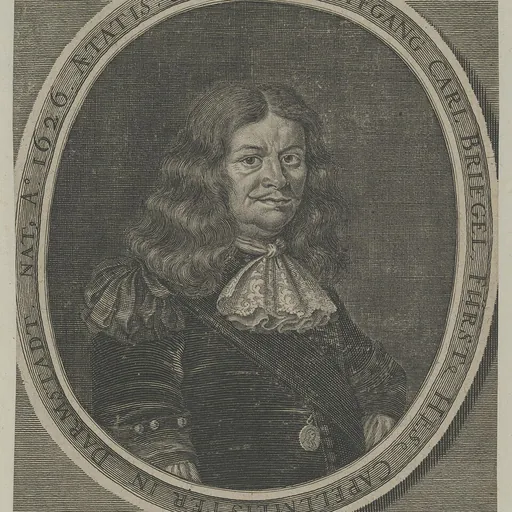
About Wolfgang Carl Briegel
Lived 1626 – 1712 (aged 86). Wolfgang Carl Briegel was a German organist, chapelmaster, teacher, composer and cantor.
Wolfgang Carl Briegel (21 May 1626 – 19 November 1712, Darmstadt) was a German organist, teacher and composer.
Biography Born 21 May 1626, in Königsberg, Bavaria, he was a student in Nuremberg and sang in the Frauenkirche choir. He later studied at the University of Altdorf and became the organist at St. Johannis church and a grammar school teacher in Schweinfurt. In 1650, Duke Ernst the Pious appointed him to his court at Gotha as cantor and music tutor to his family, and he eventually rose to the post of Kapellmeister. He became well-known through his work in Gotha, and it was there that he became acquainted with Johann Rudolph Ahle and members of the Bach family.
Duke Ernst's eldest daughter, the wife of Landgrave Louis VI of Hesse-Darmstadt, called Briegel to Darmstadt as Kapellmeister in 1671. He stayed in this post until his death, but in his later years he was assisted by Christoph Graupner and Ernst Christian Hesse.
Music Briegel was prolific in his sacred music output, completing 24 published collections between 1654 and 1709. He also wrote several "occasional" pieces and some secular works.
He attracted attention with the publication of his Evangelische Gespräch, a set of dialogue cantatas for the liturgical year in varied forms made up of solos, choruses and chorales. Another set of his works, the Evangelischer Blumengarten, is a group of motets and meditative choral songs. Among his solo songs are settings of odes by Andreas Gryphius, perhaps the only set of German Baroque songs that might be regarded as a cycle. At Darmstadt he produced several stage works, but none of that music has survived. His writing for voices is clear and eloquent, and his contrapuntal choruses are direct forerunners of those by Bach. His music enjoys an extraordinarily wide circulation throughout Germany and in Scandinavia, but is rarely heard outside of Europe.
Works Stage Works Von den freien Künsten, ballet, 2 July 1661, Gotha Musikalischer Freudenwunsch, ballet, 1 Oct 1665, Gotha Wedding ballet, 5 Dec 1666, Gotha Das verliebte Gespenst, opera, 1673, Darmstadt Triumphierendes Siegespiel der wahren Liebe (comédie, 1, J. Mylius), 8 June 1673, Darmstadt Das verbesserte Parisurteil, opera-ballet, 6 Jan 1674, Darmstadt Die beglückwünschte Majorennität des Fürsten, 22 June 1676, Darmstadt Quadriga activa, festival piece, 25 Jan 1677 Bewillkommende Frühlingsfreude, ballet, 6 May 1683 Das Band der beständigen Freundschaft, singspiel, 8 May 1683, Darmstadt Die siegende Weisheit, 8 Jan 1686 Die wahren Seelenruhe oder gekrönte Eustathia, tragi-comedy, May 1686, Darmstadt Die triumphierende Tugend, opera-ballet, 29 July 1686, Darmstadt L'enchantement de Medée, ballet, 11 Nov 1688, Darmstadt Tugendgespräch, allegorical comedy, 19 Nov 1700 Other ballets and incidental music for plays, 1683, 1687, 1700, 1705
Cantatas Evangelische Gespräch I–III, 5–10vv (Mühlhausen and Darmstadt, 1660–81); no.6 of vol.iii ed. F. Noack, Kirchenmusik der Darmstädter Musiker des Barock, iii (Berlin, 1955) Evangelischer Blumengarten I–IV, 4vv, bc (Gotha, 1660–69); 6 pieces ed. K. Ameln and H. Kümmerling, Biblische Motetten für den Kirchengesang (Kassel, 1970) J.S. Kriegmanns Evangelisches Hosianna, 1–5vv, insts, bc (Frankfurt, 1677); no. 5 ed. F. Noack, Vier kleine Kantaten (Wolfenbüttel, 1961), no.25 ed. E. Noack, Drei kleine Kantaten (Berlin, n.d.) Musicalische Trostquelle, 4vv, 2/4 vn, bc (Darmstadt, 1679) Musicalischer Lebensbrunn, 4vv, 4 insts, bc (Darmstadt, 1680) Christian Rehefelds evangelischer Palmenzweig, 1–5vv, 2–5 insts, bc (Frankfurt, 1684); nos.15, 44, 56 ed. F. Noack, Vier kleine Kantaten (Wolfenbüttel, 1961) J.G. Braunens, Cithara Davido-Evangelica, 4vv, 2 vn, bc (Giessen, 1685); no.62 ed. E. Noack, Drei kleine Kantaten (Berlin, n.d.) Concentus apostolico-musicus, 3, 4vv, 2 vn, bc (Giessen, 1697) Other unpublished works
Sacred vocal works Psalter Davids, Teil I, 4vv (Gotha, 1654) Geistlicher musikalischer Rosengarten, 1–5vv, insts (Gotha, 1658) Geistlicher Arien, Teil I, 1, 2vv, 2 and more vn, bc (Gotha, 1660) Geistlicher Arien, Teil II, 1, 2vv, 2 and more vn, bc (Mühlhausen, 1661) Die Verschmähete Eitelkeit [songs after J. Rist] (Gotha, 1669), lost Geistliche Oden Andreae Gryphii, 1v, 2 vn, bc (Gotha, 1670); facs. in Thomas Zwölf madrigalische Trostgesänge, 5, 6vv (Gotha, 1670–71) Geistliche Gespräche und Psalmen, 6vv, bc (Gotha, 1674) Das grosse Cantional oder Kirchen-Gesangbuch (Darmstadt, 1687) [ed., with H. Müller] Des Königs und Propheten Davids sieben Busspsalmen, 6vv/4vv, 2 vn, bc (Gotha, 1692) Letzter Schwanen-Gesang, 4, 5vv, bc ad lib (Giessen, 1709) Ten wedding and funeral songs, 2–6vv, insts (Gotha, 1653–70) One funeral song, 4vv (Darmstadt, 1678) Three funeral songs, 5vv (n.p., 1664–79) Several occasional songs in collections (see Noack, 1963)
Instrumental works 10 Paduanen, 10 Galliarden, 10 Balletten, 10 Couranten, a 3, 4 (Erfurt, 1652) Intraden, Sonaten, a 4, 5 (Leipzig and Erfurt, 1669) Allemanden und Couranten (Jena, 1664); facs. edn 1970 Musikalisches Tafelkonfekt, 4vv, 2 vn, bc (Frankfurt, 1672) Musikalischer Erquickstunden, 4vv, str, bc (Darmstadt, 1679); lost MSS organ works, D-Dl; Acht Fugen durch die Kirchentöne, ed. W. Krumbach, Die Orgel, ii/19 (Köln, 1963)
Footnotes
Don’t just read it —
keep it.
Full-length biographies made to live with: read them, listen on the way to work, watch them tonight.
- E-book
- Audio
- Video
Instant download · yours to keep · every purchase keeps this site free
Important facts
People in Wolfgang Carl Briegel's life
Named in this biography and alive at the same time




Related people
Same field, nearest in time


Contemporaries
People whose lives overlapped Wolfgang Carl Briegel's





Frequently asked questions
Who was Wolfgang Carl Briegel?
German musician and composer
When was Wolfgang Carl Briegel born?
Wolfgang Carl Briegel was born on 21 May 1626 in Königsberg in Bayern, Nuremberg.
When did Wolfgang Carl Briegel die?
Wolfgang Carl Briegel died on 19 November 1712 in Darmstadt.
What was Wolfgang Carl Briegel's occupation?
Wolfgang Carl Briegel was an organist, chapelmaster, teacher, composer and cantor.
What nationality was Wolfgang Carl Briegel?
Wolfgang Carl Briegel was German.
Sources & further reading
· Wikipedia: Wolfgang Carl Briegel
· DBpedia: Wolfgang Carl Briegel
Cite this page
APA: Biography.guide. (2026). Wolfgang Carl Briegel. https://biography.guide/wolfgang-carl-briegel/
MLA: "Wolfgang Carl Briegel." Biography.guide, https://biography.guide/wolfgang-carl-briegel/.
Chicago: "Wolfgang Carl Briegel." Biography.guide. https://biography.guide/wolfgang-carl-briegel/.
Data last updated: 2026-09-23 · Spot an error? Report a correction.
Portrait: Wikimedia Commons · author & licence
Page generated 2026-09-27 05:05 UTC