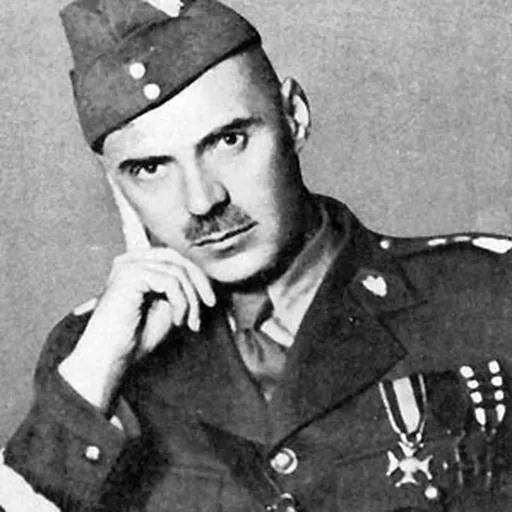
Władysław Anders
Polish general, politician and national hero
About Władysław Anders
Lived 1892 – 1970 (aged 77). Władysław Anders was a Russian and Polish military officer, politician, career soldier, military commander and military personnel.
The tombstone of General Anders at the Polish War Cemetery at Monte Cassino in Italy.
Władysław Albert Anders (; 11 August 1892 – 12 May 1970) was a Polish military officer and politician, and a prominent member of the Polish government-in-exile in London.
Born in Krośniewice-Błonie, then part of the Russian Empire, he served in the Imperial Russian Army during World War I and later joined the Polish Land Forces after Poland regained its independence in 1918.
During World War II, Anders was captured by Soviet forces and imprisoned, but he was later released to form a Polish Army to fight against the Germans alongside the Red Army. He led the Polish II Corps throughout the Italian campaign, including the capture of Monte Cassino.
After the war, Anders was deprived of his citizenship and military rank by the Soviet-installed communist government of Poland. He remained in Britain, working for the Polish government in exile and various charities. In 1989, after the collapse of communist rule in Poland, his citizenship and military rank were posthumously reinstated.
Biography Before World War II Anders was born on 11 August 1892 to his father, Albert Anders, and mother, Elżbieta (née Tauchert), in the village of Krośniewice–Błonie, west of Warsaw, then part of the Russian Empire. Both his parents were of Baltic German origin and had been polonized long before his birth. He was baptised as a member of the Protestant Evangelical-Augsburg Church in Poland. He had three brothers – Karol, Tadeusz and Jerzy, all of whom also went on to pursue careers in the military.
Anders attended a technical high school in Warsaw and later studied at Riga Technical University, where he became a member of the Polish student fraternity . After graduation, Anders was accepted into a Russian Military School for reserve officers. As a young officer, he served in the 1st Krechowiecki Lancers Regiment of the Imperial Russian Army during World War I.
When Poland regained its independence in November 1918, Anders joined the newly formed Polish Land Forces. During the Polish–Soviet War of 1919–1921, he commanded the 15th Poznań Uhlans Regiment and was awarded the Silver Cross of the Virtuti Militari. After the war, Anders continued his military education in France at the École spéciale militaire de Saint-Cyr, and upon graduation he returned to Poland, where he served on the general staff of the Polish Army under General Tadeusz Rozwadowski, Chief of the General Staff from 1920 to 1921.
Anders opposed Józef Piłsudski's May Coup in Poland in 1926, but unlike Rozwadowski, he avoided persecution by the Sanation regime that assumed power after the coup. Piłsudski made him the commander of a cavalry brigade in 1931 and he was promoted to the rank of general three years later.
World War II Anders commanded the Nowogródzka Cavalry Brigade during the German invasion of Poland in September 1939 and was immediately called into action, taking part in the Battle of Mława. After the collapse of the Polish Northern Front the brigade withdrew towards Warsaw, and also fought heavy battles against the Germans around Mińsk Mazowiecki and in the second phase of the Battle of Tomaszów Lubelski. After learning about the Soviet invasion of Poland, Anders retreated south in the direction of Lwów, hoping to reach the Hungarian or Romanian border, but was intercepted by Soviet forces and captured on 29 September, after being wounded twice.
Anders was initially jailed in Lwów and subsequently transferred to the Lubyanka prison in Moscow on 29 February 1940. During his imprisonment, he was interrogated, tortured and unsuccessfully urged to join the Red Army.
After the launch of Operation Barbarossa and the signing of the Sikorski-Maisky agreement, Anders was released by the Soviets with the aim of forming a Polish Army to fight against the Germans alongside the Red Army. Continued friction with the Soviets over political issues as well as shortages of weapons, food and clothing, led to the eventual evacuation of Anders' men – known as Anders' Army – together with a sizeable contingent of Polish civilians who had been deported to the USSR from Soviet-occupied Poland, via the Persian Corridor into Iran, Iraq, and finally into Mandatory Palestine. The evacuation, which took place in March 1942, was based on the British-Soviet-Polish understanding. The soldiers involved were evacuated from the Soviet Union and made their way through Iran to British-ruled Palestine, where they passed under British command. Here, Anders formed and led the Polish II Corps, while continuing to agitate for the release of Polish nationals still in the Soviet Union.
General Władysław Anders and the Commander of the Allied Armies in Italy, General Harold Alexander salute, after Alexander had invested Anders with the Order of the Bath in recognition of Polish services at Monte Cassino. Lieutenant Eugeniusz Lubomirski, Anders' adjutant, is standing behind his commander
The Polish II Corps became a major tactical and operational unit of the Polish Armed Forces in the West. Anders commanded the Corps throughout the Italian Campaign, capturing Monte Cassino on 18 May 1944, Ancona on 18 July 1944; afterward his Corps took part in the breaking of the Gothic Line and in the final spring offensive.
The morale of the Polish forces was weakened by the outcome of the Yalta Conference which ended on 11 February 1945, where Winston Churchill and Franklin D. Roosevelt, without consulting the Polish government-in-exile, accepted Soviet control over a major part of the 1921–1939 Polish territories. When Anders asked for his unit to be withdrawn from the front line, Churchill replied "you are no longer needed" though the Allied commanders Richard McCreery, Mark Wayne Clark and Harold Alexander requested Anders to order his units remain in their positions, as they had no troops to replace them. Anders eventually decided to keep the Polish units engaged, and they subsequently fought in the Battle of Bologna.
Private life Anders was married twice. He had two children with his first wife Irena Maria Jordan-Krąkowska.
In 1948, he married the actress and singer Irena Jarosiewicz, better known under her stage name Renata Bogdańska, with whom he had a daughter, Anna Maria.
Medals
Anders received numerous awards and decorations:
Poland
Virtuti Militari
Order of Polonia Restituta
Medal for Long Service
Foreign Czechoslovakia
France
Italy
The Sovereign Military Order of Malta Grand Cross of Merit
Persia
Imperial Russia Order of St. George IV class Order of St. George (4th class, 1915) Order of St. Vladimir Order of St. Vladimir with Swords (4th class, 1915) Order of St. Anna Order of St. Anna with Swords (2nd, 3rd (1918) and 4th class)
United Kingdom
United States of America
Order of Lafayette
Kingdom of Yugoslavia
Don’t just read it —
keep it.
Full-length biographies made to live with: read them, listen on the way to work, watch them tonight.
- E-book
- Audio
- Video
Instant download · yours to keep · every purchase keeps this site free
Important facts
People in Władysław Anders's life
Named in this biography and alive at the same time




Related people
Same field, nearest in time
Contemporaries
People whose lives overlapped Władysław Anders's
Frequently asked questions
Who was Władysław Anders?
Polish general, politician and national hero (1892–1970)
When was Władysław Anders born?
Władysław Anders was born on 11 August 1892 in Błonie.
When did Władysław Anders die?
Władysław Anders died on 12 May 1970 in London.
What was Władysław Anders's occupation?
Władysław Anders was a military officer, politician, career soldier, military commander and military personnel.
What nationality was Władysław Anders?
Władysław Anders was Russian and Polish.
Sources & further reading
Cite this page
APA: Biography.guide. (2026). Władysław Anders. https://biography.guide/wladyslaw-anders/
MLA: "Władysław Anders." Biography.guide, https://biography.guide/wladyslaw-anders/.
Chicago: "Władysław Anders." Biography.guide. https://biography.guide/wladyslaw-anders/.
Data last updated: 2026-09-22 · Spot an error? Report a correction.
Portrait: Wikimedia Commons · author & licence
Page generated 2026-09-27 05:02 UTC