
Willis Ward
Track and field athlete and American football player
About Willis Ward
Lived 1912 – 1983 (aged 71). Willis Ward was an American athletics competitor and american football player.
Willis Franklin Ward (December 28, 1912 – December 30, 1983) was an American track and field athlete, college football player, lawyer, and judge who was inducted into the University of Michigan Athletic Hall of Honor in 1981.
Ward was the Michigan High School Athlete of the Year, after setting a national prep record in the high jump. At the University of Michigan, he was a collegiate champion in the high jump, the long jump, the 100-yard dash, and the 440-yard dash, and finished second in the voting for the Associated Press Big Ten Athlete of the Year award in 1933. In track and field he was a three-time All-American and eight-time Big Ten champion.
In football, Ward was only the second African-American to win a varsity letter for the Michigan Wolverines football team, lettering in 1932, 1933, and 1934. In 1934, a controversy developed when Georgia Tech refused to play if Ward took the field, and university officials opted to keep Ward out of the game. Teammate Gerald R. Ford reportedly threatened to quit the team in response to the university's decision. After being excluded from the Georgia Tech game, Ward went on to score all 12 of Michigan's points that year outside of the Georgia Tech game, without another Wolverine even having an extra point or a field goal.
Ward later became a lawyer in Detroit, worked for Ford Motor Company through the early 1940s. He was a member of the Michigan Public Service Commission from 1966 to 1973, serving as chairman from 1969 to 1973. He also served as a probate court judge in Wayne County, Michigan.
Early life Ward was born in Alabama in 1912. His father, Henry R. Ward, was an Alabama native who moved to Detroit and worked there in a Ford Motor Company factory. His mother, Bessie, was a Georgia native.
Ward attended Detroit's Northwestern High School where he excelled in both track and football.
University of Michigan
Freshman track star
Ward attended the University of Michigan from 1931 to 1935, where he became one of the most successful track athletes in the school's history. As a freshman in 1932, Ward's specialty was the high jump. Ward won the NCAA high jump championship in June 1932 with a jump of 6–7 1/3. He jumped as high as 6-7-1/2 in his freshman year. Ward's best jump in 1932 was two inches above the mark that won the gold medal at the 1932 Summer Olympics (Canada's Duncan McNaughton won the gold with a jump of 6 feet, 5½ inches), but Ward did not qualify for the team. Some reports attribute the de facto segregation of the football team to racism on the part of Yost, who was the son of a Confederate soldier.
While in high school, Ward had decided to attend Dartmouth College. Behee wrote that "on several occasions Kipke took off his coat and was prepared to fight with those who bitterly opposed having a Negro play for Michigan." The United Press reported on the results of spring practice: "Three young freshmen at the University of Michigan—Jerry Ford, of Grand Rapids; Russell Oliver, of Pontiac, and Willis Ward, Detroit Negro—displayed such brilliance during spring football practice that they are expected to become important cogs next fall in the Wolverine varsity eleven." Another report in July 1932 described Ward, the "giant negro," as being "the outstanding athlete becoming eligible for play."
Ward made the team in 1932 and started four games at end. Ivy Williamson, captain of the 1932 football team, greeted Ward at the field house and told him, "If you have any problems with anybody, let me know because we're prepared to take care of them." One report noted: "He is altogether likeable, for he always speaks without raising his voice and never protests a decision. … Ward is a star now, but he is just finishing his first year of competition. Unless injuries hamper him it is likely he will be as great an attraction or possibly even greater than the two Negro track stars who preceded him here, DeHart Hubbard and Eddie Tolan." At the meet, Ward won the 100-yard dash and the high jump and placed second in the 120 yard high hurdles and the broad jump.
At the Drake Relay Carnival in April 1933, he finished second in the 100-yard dash, narrowly losing to Ralph Metcalfe. The 1934 Michigan yearbook, the Michiganensian, noted: "Michigan climaxed a successful season by winning the Annual Butler Relays and taking the title from Indiana. Willis Ward won the meet almost single-handed when he scored thirteen of the team's 18¾ points. In winning the 60 yard dash, the Flashy negro star equaled the recognized world mark of 6.2 seconds." At the Big Ten indoor track championship, the Michiganensian noted that Ward, "Michigan's all around athlete, was easily the outstanding star of the meet." Ward won the 60-yard dash, the 70-yard high hurdles and the high jump. Time magazine credited the work of Ward and halfback Herman Everhardus: "Michigan came perilously close to slipping from the top of the Big Ten, where it has been for three years. That it did not slip was largely due to a crack halfback named Herman Everhardus and to Willis Ward, a rangy Negro end. It was Ward who, after hard-fighting Illinois had marched to a touchdown in the first period, shot through and blocked the place kick which would have given Illinois a seventh point." After the season was over, Coach Kipke also credited the play of Everhardus and his ends for the undefeated season: "Our ends, Ward and Petoskey, were near perfection." Michigan's left end, Ted Petoskey was named a first-team All-American in 1933, and Ward earned honorable mention All-American honors at right end. In the AP's polling of conference coaches and sports writers, 55 votes were cast, with Purvis receiving 17 votes to 15 for Ward, described by the AP as "Michigan's 'one-man track team.'"
1934 football season The 1934 football season proved to be one of the low points in the school's history, both because of the team's 1–7 record, and the ugly racial incident that kept Ward out of the game against Georgia Tech. Though excluded from the Georgia Tech game, Willis started every other game—five games at right end, and two games at halfback. Michigan was shut out in the first two games, before beating Georgia Tech in the season's third game. The following week, Michigan lost to Illinois, 7–6, as Ward scored Michigan's only touchdown from the line of scrimmage of the entire 1934 season. (The season's only other touchdown came on a punt return against Georgia Tech.) Ward's touchdown came on a trick play, as fullback Johnny Regeczi passed the ball to end Mike Savage who lateraled to Ward. According to the Chicago Tribune, the lateral "enabled the fleet Negro to outfoot the Illinois secondary." According to Time, 200 "campus radicals" threatened to prevent the game from being played by standing in the middle of the field. In an attempt to thwart any attempt to disrupt the game, Yost hired a Pinkerton agent to infiltrate "The United Front Committee on Ward", a conglomerate of student organizations that supported Ward's right to play.
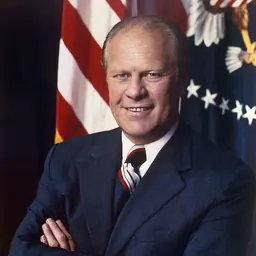
In the end, Ward was not allowed to play. But in exchange, Georgia Tech agreed to reciprocate by benching their own star end, Hoot Gibson. As his teammates faced Georgia Tech, there are conflicting reports as to Ward's whereabouts. According to Time, Ward "sat calmly in a radio booth, watched his teammates defeat the Southerners, 9-to-2, earning what turned out to be their only win of the season." When Ford learned that the school had capitulated to Georgia Tech, some accounts indicate that he "quit the team" or threatened to quit in order "to make a statement and take a stand because Willis Ward was his friend." Ford wrote about the Georgia Tech incident in his autobiography, recalling that he felt the decision to keep Willis out of the game was "morally wrong." Years later, Ford wrote that the Ward incident had influenced his thinking about race. Ford noted: "His sacrifice led me to question how educational administrators could capitulate to raw prejudice." Ford used the story to voice his support for U-M's affirmative action admissions policy saying, "Do we really want to risk turning back the clock to an era when the Willis Wards were isolated and penalized for the color of their skin, their economic standing or national ancestry?" "Jerry was very concerned," Ward recalled. "His brother told me, 'Jerry was so upset he wrote father asking him if he should quit the team. He was that angry.'" At Ford's funeral, President George W. Bush also spoke about the Willis Ward incident. Bush said: "Long before he was known in Washington, Gerald Ford showed his character and his leadership. As a star football player for the University of Michigan, he came face to face with racial prejudice when Georgia Tech came to Ann Arbor for a football game. One of Michigan's best players was an African American student named Willis Ward. Georgia Tech said they would not take the field if a black man were allowed to play. Gerald Ford was furious at Georgia Tech for making the demand, and for the University of Michigan for caving in. He agreed to play only after Willis Ward personally asked him to. The stand Gerald Ford took that day was never forgotten by his friend. And Gerald Ford never forgot that day either and three decades later, he proudly supported the Civil Rights Act and the Voting Rights Act in the United States Congress."
Impact of racism on Ward Ward proved to be one of the most successful athletes in the history of the University of Michigan. He earned six varsity letters in football and track.
Later life
Ward went on to earn a law degree from the Detroit College of Law in 1939, and was employed by the Ford Motor Company during and after his studies, serving as the employment director for colored workers at Ford's River Rouge plant.
Military service
In March 1941, Ward volunteered for induction into in the United States Army. Entering service in April, he was assigned to the 184th Field Artillery Regiment, a segregated unit stationed at Fort Custer, Michigan.
Willis Ward doing artillery training at Camp Custer, from February 1942 issue of The Crisis. Army Signal Corps photo
In December 1941, Ward was transferred to inactive duty as he was older than twenty-eight when he had volunteered, and he rejoined his employment at Ford. In 1942, he worked as a director for Ford's "ad hoc civil rights division, serving as the liaison between black and white workers" and an advocate for African American employees in the personnel department. He invited Owens to Detroit to replace him and remained with Ford until 1946. Ward was recalled back to active service in February 1943. He was medically discharged in fall 1943.
Political career
In 1964, Ward spoke out against Barry Goldwater and in favor of Michigan Governor George Romney as a possible presidential candidate. In 1966, Romney appointed Willis to the Michigan Public Service Commission, the state agency responsible for regulating Michigan's public utilities; Willis became chairman of the PSC in 1969, serving in that capacity until 1973. Ward later was elected a probate judge in Wayne County, Michigan.
Ward was inducted into the University of Michigan Athletic Hall of Honor in 1981, as part of the fourth group inducted. He died of cancer, on December 30, 1983, at a hospital in Detroit.
Don’t just read it —
keep it.
Full-length biographies made to live with: read them, listen on the way to work, watch them tonight.
- E-book
- Audio
- Video
Instant download · yours to keep · every purchase keeps this site free
Important facts
People in Willis Ward's life
Named in this biography and alive at the same time



Related people
Same field, nearest in time

Contemporaries
People whose lives overlapped Willis Ward's



Frequently asked questions
Who was Willis Ward?
track and field athlete and American football player
When was Willis Ward born?
Willis Ward was born on 28 December 1912 in Gadsden.
When did Willis Ward die?
Willis Ward died on 30 December 1983 in Detroit.
What was Willis Ward's occupation?
Willis Ward was an athletics competitor and american football player.
What nationality was Willis Ward?
Willis Ward was American.
Sources & further reading
Cite this page
APA: Biography.guide. (2026). Willis Ward. https://biography.guide/willis-ward/
MLA: "Willis Ward." Biography.guide, https://biography.guide/willis-ward/.
Chicago: "Willis Ward." Biography.guide. https://biography.guide/willis-ward/.
Data last updated: 2026-09-25 · Spot an error? Report a correction.
Page generated 2026-09-27 05:13 UTC