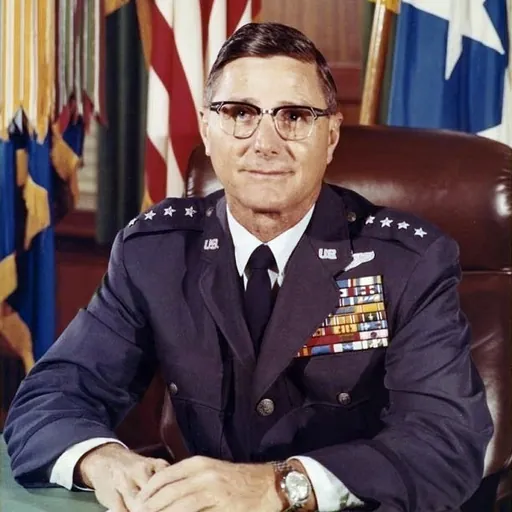
About William W. Momyer
Lived 1916 – 2012 (aged 95). William W. Momyer was an American military officer.
Early life Momyer was born in 1916, the son of a lawyer in Muskogee, Oklahoma. He was 14 when his father died of a heart attack and he moved with his mother to Seattle, Washington, where he attended Broadway High School and graduated with a Bachelor of Arts degree from the University of Washington in 1937.
Momyer entered military service in 1938 as an aviation cadet in the Air Corps, and after successfully completing primary and basic pilot training at Randolph Field, moved on to the advanced training school at Kelly Field, Texas, graduating in February 1939. He received his commission as a second lieutenant and a rating of pilot, assigned to pilot and flight commander duties until February 1941, when he became military observer for air with the military attaché in Cairo, Egypt. In this capacity, he was technical advisor to the Royal Air Force in equipping the first squadrons of the Western Desert Air Force with Curtiss Tomahawk fighters, which enabled him to fly combat missions. His nickname within the service was "Spike".
Service in World War II Early in 1942, during World War II at the age of 25, Momyer replaced Colonel Elwood R. Quesada as commanding officer of the Curtiss P-40 Warhawk-equipped 33d Fighter Group (FG). In October the group was carried to North Africa aboard the USS Chenango as part of Operation Torch. Launching from the aircraft carrier on November 10, the group attempted to land at the Port Lyautey airfield in French Morocco, which was still under occasional fire from French forces. Several aircraft were disabled in landing accidents and Momyer was awarded the Silver Star for personally extricating a trapped pilot from a P-40 that had flipped onto its back.
From Telergma Airfield, Algeria, and Thelepte Airfield, Tunisia, Momyer led the 33rd FG on combat missions in the Tunisia, Sicily and Naples-Foggia campaigns. For his performance during several combat actions of the North African campaign, he received the Distinguished Service Cross and two oak leaf clusters to his Silver Star. In North Africa, while leading his group on a ground attack against German positions near El Guettar, he single-handedly engaged 18 Junkers Ju 87 (Stuka) aircraft escorted by German and Italian fighters on 31 March 1943, and had four confirmed kills. He accrued more than 200 combat flying hours and became an ace with eight credited aerial victories. Because of the inadequate training and equipment of the A-20 Havoc light bomber complement of the XII Air Support Command and the tactical ineffectiveness of the Free French Air Forces P-40 squadron attached, the burden of air support fell primarily on the understrength 33rd FG. Thus despite cautions from Generals Jimmy Doolittle and Howard Craig to group commanders to conserve strength, Momyer was compelled to commit his aircraft to battle in small increments.
The priority of demands by ground force commanders for "umbrellas" (defensive air cover from attacks by Stukas) meant that other tactical missions such as close air support and escort were necessarily left to small elements, and without air superiority, attrition was high during the German offensives in central Tunisia of 18 and 30 January 1943. On 2 February 1943, during German attacks on Faid Pass, where the Luftwaffe had been reinforced by the remains of the Desert Luftwaffe retreating with field marshal Erwin Rommel, the group was tasked to provide both air cover for Allied ground forces under attack by Stukas and escort for attacking USAAF bombers, losing nine aircraft. As a consequence, the 33rd FG was one of four Twelfth Air Force groups so debilitated that they were withdrawn from combat to make up losses in pilots and acquire better aircraft.
Of the situation, Momyer himself said:
Soon after, during the Battle of the Kasserine Pass, Allied tactical airpower was reorganized in North Africa with the activation on 18 February of the Northwest African Tactical Air Force (NATAF), under the command of Royal Air Force Air Marshal Arthur Coningham. The 33rd FG returned to combat on 22 February from Youks-les-Bains Airfield, the last forward field for the Twelfth Air Force. Coningham, like Momyer, advocated attacks on the Luftwaffe including their airbases to achieve air superiority, which they considered essential before direct air support of ground units could be undertaken. NATAF initiated a counter-air campaign in mid-March that achieved air superiority soon after. The 33rd FG, operating from the recaptured Sbeitla Airfield, transitioned at the direction of Coningham to the role of fighter-bomber at the same time and increased its effectiveness while decreasing its losses.
Following the surrender of Axis forces in North Africa on 13 May, the Allied air forces immediately began a campaign of softening up the island of Pantelleria in preparation for Operation Corkscrew, the amphibious landing to seize the island scheduled for 11 June as a preliminary step in the Allied invasion of Sicily. The 33rd FG began fighter-bomber attacks on the island on 29 May, augmented by attachment to the group of the segregated 99th Fighter Squadron (known unofficially as the "Tuskegee Airmen"), which flew its first combat mission on 2 June. Following the surrender of Pantelleria on 11 June, the 33rd FG maintained patrols over the island and Allied shipping until 26 June, when it moved to the island's airfield to begin attacks on Sicily, invaded in July. The 99th FS was then sent to another group.
Racial controversy In September 1943, after the 99th FS was again attached to his group, Momyer recommended in a memo to Major General Edwin J. House, commanding XII Air Support Command, that it be removed from operations and assigned coastal patrol duties in P-39 Airacobras, alleging that it was ineffective in combat because "(in) my opinion... they have failed to display the aggressiveness and desire for combat that are necessary to a first-class fighting organization. It may be expected that we will get less work and less operational time out of the 99th than any squadron in this group." One source claimed that Momyer had blamed the squadron for seeing little air-to-air combat while ignoring both their being awarded a Distinguished Unit Citation and that he had personally ordered them into a ground attack role. House forwarded his own memo with a similar recommendation to NAAF Deputy Commander Major General John K. Cannon based partly on Momyer's report, and within four days the memo went up the chain of command to Headquarters USAAF in Washington D.C.
Reports in the press that the USAAF was considering downgrading the combat role of the 99th FS, partly based on Momyer's assessment, were followed in October by a review conducted by the War Department's Advisory Committee on Negro Troop Policies, after House's report reached it, in which Colonel Benjamin O. Davis Jr. refuted the allegations and defended his former command. The 99th FS continued to serve in combat, although with different groups, and by July 1944 was reassigned to the African-American 332nd Fighter Group, which consisted of the 100th, 301st, and 302nd FSs. An official study was then undertaken to compare the 99th's performance with that of other P-40 units operating in the Mediterranean; it reported on 30 March 1944 that the 99th had performed as well as the other Warhawk outfits. Historian Walter J. Boyne wrote: "Momyer's illustrious combat record was tarnished by (the) incident of racial intolerance... at a time when such attitudes were still pervasive... Momyer's assessment was wrong."
Momyer was replaced in command of the 33rd FG in October 1943, and did not receive another combat command during the remainder of the war.
He returned to the United States in 1944 to become chief of the Combined Operations Branch of the Army Air Forces Board, with the mission of devising doctrine for cooperation of air, land, and sea forces in combat operations. From his work came USAAF (and later USAF) doctrine that after the first priority of achieving air superiority was successful, the next priority for airpower was isolating an enemy's forward forces by destroying his forces in the rear.
Momyer has been subject to criticisms for his relationship to subordinates and insistence on implementation of his own views. Brigadier General Chuck Yeager, in his autobiography, related that in early 1968 he had been assigned as prospective commander of the 35th Tactical Fighter Wing, a unit at Phan Rang Air Base in Vietnam. While he was awaiting orders, Yeager was advised that Momyer had rejected him because as Seventh Air Force commander, he was entitled to select his own wing commanders and had not been consulted about the assignment. This resulted in Yeager being forced on Momyer by General John D. Ryan, Pacific Air Forces (PACAF) commander and a Yeager admirer. Although Momyer prevailed in the subsequent political tug of war, the controversy resulted in Momyer's lasting enmity towards Yeager, whom he had never met, for reasons that Yeager was unable to discern. Later that year Momyer became commander of TAC, in which Yeager was now a wing commander, culminating in early 1969 in a showdown in which Momyer purportedly threatened to terminate Yeager's command and possibly career. Yeager instead was promoted to brigadier general when the promotion board requested that Yeager be added to its selection choices after Momyer did not include him as one of his TAC recommendations.
Boyne stated: "(Momyer) brushed off subordinates’ opinions even though he often questioned his superiors’ views when they differed from his own." and implemented the tactical initiative Operation Bolo proposed by Olds even while expressing personal disapproval of Olds' public persona.
Momyer retired from the USAF on September 30, 1973. He and his wife, Marguerite Willson Momyer, were married 69 years until her death in 2004. He died from heart failure on August 10, 2012, at an assisted living center in Merritt Island, Florida, aged 95.
Awards and decorations Momyer received the following awards and decorations:
Don’t just read it —
keep it.
Full-length biographies made to live with: read them, listen on the way to work, watch them tonight.
- E-book
- Audio
- Video
Instant download · yours to keep · every purchase keeps this site free
Important facts
People in William W. Momyer's life
Named in this biography and alive at the same time




Related people
Same field, nearest in time

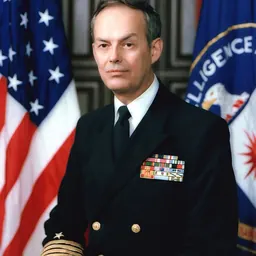
Contemporaries
People whose lives overlapped William W. Momyer's



Frequently asked questions
Who was William W. Momyer?
United States general and flying ace
When was William W. Momyer born?
William W. Momyer was born on 23 September 1916 in Muskogee.
When did William W. Momyer die?
William W. Momyer died on 10 August 2012 in Merritt Island.
What was William W. Momyer's occupation?
William W. Momyer was a military officer.
What nationality was William W. Momyer?
William W. Momyer was American.
Sources & further reading
· Wikipedia: William W. Momyer
Cite this page
APA: Biography.guide. (2026). William W. Momyer. https://biography.guide/william-w-momyer/
MLA: "William W. Momyer." Biography.guide, https://biography.guide/william-w-momyer/.
Chicago: "William W. Momyer." Biography.guide. https://biography.guide/william-w-momyer/.
Data last updated: 2026-09-21 · Spot an error? Report a correction.
Portrait: Wikimedia Commons · author & licence
Page generated 2026-09-27 04:59 UTC