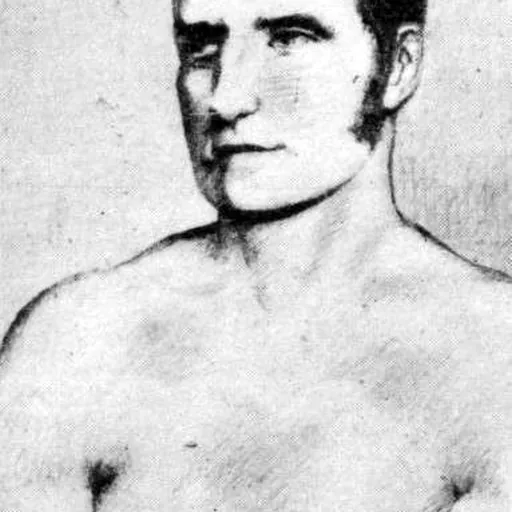
About William Thompson
Lived 1811 – 1880 (aged 68). William Thompson was a British boxer.
William Abednego Thompson (11 October 1811 – 23 August 1880), also known as Bendigo Thompson and mononymously as Bendigo, was an English bare-knuckle boxer who won the heavyweight championship of England from James Burke on 12 February 1839.
Early life Born in New Yard, now Trinity Walk, Nottingham on 11 October 1811, Thompson claimed to be one of a set of triplets named Shadrach, Meshach, and Abednego, after the young men in the Book of Daniel who are thrown into the fiery furnace of Babylon. However, he was baptised at St Mary's Church, Nottingham on 16 October 1811 with his twin brother Richard.
Over the next two years, Thompson fought three bouts, first dispatching the renowned John Leachman of Bradford in a 52-round contest, before moving to Newcastle the following year to defeat Charley Langham in 51 rounds.
A few months later, Thompson responded to a letter in a newspaper from Liverpudlian William Looney, challenging "... any man in the world for £200 stake and £200 a-side". The two met on 13 June 1838, on a hill known as Chapel-en-le-Frith, the halfway point between their home towns. The fight lasted for 92 rounds, but will probably be remembered for Thompson's reaction to Looney contemplating a haymaker in the fifteenth round, falling to the floor "on his nether end throwing up his legs and laughing". Thompson took control of the fight shortly after and started somersaulting in the ring, endearing him to the crowds. However, despite receiving a continuous barrage of punches, Looney fought bravely on, nearly winning the fight with a massive right hand counterpunch. Eventually Thompson's athleticism shone through and he was declared the winner after dominating over an hour of fighting.
When order was restored, Thompson was given brandy and recovered his stamina. In the fiftieth round, it was Thompson's turn for some underhand tactics, lashing out some kicks on Caunt but the referee dismissed the complaint. In the seventy-fifth round, the referee stopped the fight, because Thompson had fallen to the ground without being struck, an illegal tactic according to London Prize Ring Rules. After the fight, Thompson claimed it was a slip, a claim backed up by contemporary accounts, putting him well ahead and coasting. After the referee called the foul against Thompson, pandemonium broke out. His supporters attacked Caunt with whatever weapons were to hand. Caunt was dragged to his coach by his seconds and attempted to flee. The coach was arrested by Thompson's mob who dragged Caunt out, but he escaped during the ensuing melee, riding bareback on a stolen horse.
Champion of England, 1839 On 8 February 1839, when Thompson was 28, he was given the task of defeating the fearsome Londoner James "Deaf" Burke for the All England Title and a purse of £220. The fight was one of the first Thompson fought under the new London Prize Ring Rules. The backers admired his wit and courage, and now a crowd favourite he was a perfect match for the title. The fight was held in a field at No Mans Heath in Leicestershire, near the village of Heather, in front of an unruly crowd of roughly 15,000 people. It lasted just ten rounds, with Thompson battering the helpless Burke, who himself had just successfully toured America. After half an hour, the frustrated Burke became so enraged with the barrage of punches and insults coming from his younger, faster and stronger challenger, he grabbed hold of Thompson and full-on head butted him twice, thus losing on a foul and gifting the championship away. The "Nottingham Jester", Champion Prize Fighter Of All England was presented his Champion's Belt a few weeks later at a ceremony in The Queens Theatre, Liverpool. When he got home to Nottingham, Thompson met his supporters on 23 March 1840, and in his excitement while somersaulting he hurt his kneecap and was laid up for two years. Thompson never stepped down from a challenge, and once he recovered from his knee injury he defeated 19 opponents over the next 4 years, including 7 in one month. Thompson would be declared the winner on a foul despite Caunt's advantage in height, weight, and youth. The fight was described by a contemporary writer as "one of the most scandalous brawls in boxing history. Both men used every foul under the sun and invented a good many others ... Thompson was tossed from the ring ... Caunt trying to crash him on the ring stakes to break his back. Thompson's [followers] attempted to bludgeon Caunt whenever within striking distance ... on one occasion missing by a hairs breadth, the blow landing on Caunt's brawny shoulder ..." Bells Life wrote that Thompson's methods were opposed to the principles of a fair, stand-up fight, and were the actions of a coward.
Years later, when speaking on the fight, Lord Longford, a former backer, reacted to Thompson's evangelising with the comment: "I hope you fight Beelzebub with more fairness than you fought Caunt or else I might change sides."
This fight seemed to have taken a lot out of Thompson, who went back to his childhood pastime of fishing. He became very friendly with a well-known angler called William Bailey, who made and sold fishing tackle from his shop in Broadmarsh. Thompson won several All England fishing awards.
Last title bout with Tom Paddock, 1850
Although enjoying his quiet life, Thompson accepted a challenge from young Tom Paddock from Redditch and, on 5 June 1850, the 39-year-old William Abednego Thompson began his last fight. In two minds as to whether to accept the challenge or not, his 82-year-old mother encouraged him by saying "And I tell you this Bendy, if you don't take up the challenge you are a coward. And I tell you more, if you won't fight him I'll send and take up his challenge myself."
The fight was a close one and lasted over an hour. In the seventh, Paddock was suspected of kicking Thompson but no foul was called. Paddock, the younger man by far, was getting the better of Thompson, who started to go to ground very easily causing the end of several rounds. That infuriated Paddock who, after flooring Thompson with a right hand in the 49th, thought Thompson had gone down again. Paddock charged across the ring, and pulled him to his feet shouting, "Get up and fight like a man". In what became the last round, Paddock hit Thompson while he was down and lying across the ropes. Thompson's corner man called foul and the referee concurred, giving Thompson the decision.
Retirement and decline Feeling he was getting too old for prize fighting, Thompson, "The Nottingham Jester", stepped down undefeated as champion, with two prize belts and four silver cups to his name. His outspoken character and record in the ring attracted a massive fan base, including Sir Arthur Conan Doyle, who wrote a verse to the fighter, titled "Bendigo's Sermon";
You didn't know of Bendigo? Well that knocks me out! Who's your board schoolteacher? What's he been about? Chock a block with fairy tales; Full of useless cram, And never heard of Bendigo The Pride Of Nottingham
Speaking about his own career, Thompson said proudly: "I was engaged in 21 matched fights and never was beaten in one. What is more, I never in my life had a hit on the nose hard enough to make it bleed; and in all my battles I never once got a black eye." After declaring his retirement, he took up an unofficial role as boxing coach at Oxford University, teaching the art of pugilism. Because it was an unofficial role, the staff described him as a professor, to avoid suspicion and hide his lower-class origins. That job was a step up from his impoverished life in the Nottingham work house. He eventually moved to Beeston to try to curb his drinking with his friends in Nottingham, but could not stop his habit for long, having only a few sober moments fishing by the Trent. Once, at the age of 59, he dived into the river to save three people who appeared to be drowning. When a woman he had rescued offered him a reward, he rejected her offer with scorn, reminding her that he was the champion of England.
In 1872, Thompson attended a congregation led by preacher Richard Weaver. Though Thompson was illiterate, he delivered a strong and convincing sermon. When preaching at the Ebenezer Lodge of Good Templars, he would take up a boxer's stance, turn to his trophies and say, "See them belts? See them cups? I used to fight for those, but now I fight for Christ." During one sermon, he became perturbed by hecklers at the back of the room and shouted in frustration "Good Lord, Thou knowest that since I gave up my wicked ways I have devoted my life to Thy service, and have given Thee the whole of my time." Though suffering from a fractured rib and punctured lung, he clung to life for seven weeks. His funeral procession was exceedingly long and was watched by thousands lining the roads, including a number of the wealthy and famed. Impressively, The Times of London published an obituary, usually an honour bestowed only on the most famous Britons. He was buried on 27 August 1880 in St Mary's burial ground, Sneinton, Nottingham, and not, as has been claimed, in his mother's grave. She died in 1854 and is buried almost away in the General Cemetery. Thompson's tomb, which features a crouching lion, can be seen at the burial ground in Bath Street Rest Gardens, near Victoria Leisure Centre in Nottingham. It bears the inscription;
Win Joe Hanley Oct 1832 England 16 rounds Win Ben Caunt 21 June 1835 Nottingham England 22 Rounds Won on a foul, Caunt struck Thompson when he was down Win Bill Looney 13 June 1837 Chapel-en-le-Firth, England 99 Rounds Loss Ben Caunt 3 April 1838 Shelby, England 75 rounds Lost on foul Win James Burke 12 February 1839 Heather, England 10 rounds Won Championship of England, on foul Win Ben Caunt 9 September 1845 Stoney Stratford, England 75 rounds Defended English Championship, won on foul Win Ben Caunt 5 June 1850 Mildenhall, England 75 rounds Retained English Champion, won on foul, then retired
Legacy
A public house in Sneinton, Nottingham was named after its famous resident. The Old Wrestlers pub was converted to Bendigo's in 1957 and became popular among Sneinton locals. Ironically the pub was forced to close in the late 1990s due to brawling but re-opened as The Hermitage in 1999 and remained in operation for another decade before closing again in 2009. As of 2013, the building has been renovated and is used for private events, although the statue of Thompson above the entrance still remains and locals commonly refer to the site as Bendigo`s or The Bendigo to this day.
The area of Sneinton just north east of the pub falls within the Nottinghamshire Police beat called Bendigo. This covers the area from Kentwood Rd north east to Highcliffe Rd and part of Colwick Wood, including the north part of Racecourse Rd (opposite the entrance to Nottingham racecourse). Just off this road is a small new-build housing area, the main road being Bendigo Lane.
One of the trams operated by Nottingham Express Transit carries the name of Bendigo Thompson. was also a bare-knuckle boxer with a style reminiscent of Thompson, and hence was given the same nickname, which was then applied to the area as Bendigo's Creek. The town that grew up around the area in the 19th century was named as Sandhurst but reverted to Bendigo in 1891.
In Bestwood, a suburban part of Nottingham, there is a small nature reserve on Sunrise Hill that was a copse known locally as "Bendigo's Ring". The name is now mistakenly associated with nearby Glade Hill which still carries a highly visible copse.
A character named Gonolph Bendigo, clearly meant to be analogous to William Thompson, appeared in the second series of Defoe, a comic anthologised in 2000AD. Although Defoe is set in the seventeenth, rather than nineteenth, century, the character owes a lot to the real-life boxer, being a retired bare-knuckle fighter of note whose nickname was also "Bendy" and who famously defeated a Ben Caunt.
A Nottingham-based group called the 'Bendigo Memorial Fund' are raising money to have a statue of Bendigo in Nottingham city centre.
Southpaw stance Thompson is often credited with introducing the southpaw stance.
Don’t just read it —
keep it.
Full-length biographies made to live with: read them, listen on the way to work, watch them tonight.
- E-book
- Audio
- Video
Instant download · yours to keep · every purchase keeps this site free
Important facts
People in William Thompson's life
Named in this biography and alive at the same time




Related people
Same field, nearest in time

Contemporaries
People whose lives overlapped William Thompson's




Frequently asked questions
Who was William Thompson?
boxer from England
When was William Thompson born?
William Thompson was born on 11 October 1811 in Sneinton.
When did William Thompson die?
William Thompson died on 23 August 1880 in England.
What was William Thompson's occupation?
William Thompson was a boxer.
What nationality was William Thompson?
William Thompson was British.
Sources & further reading
· DBpedia: William Thompson (boxer)
Cite this page
APA: Biography.guide. (2026). William Thompson. https://biography.guide/william-thompson/
MLA: "William Thompson." Biography.guide, https://biography.guide/william-thompson/.
Chicago: "William Thompson." Biography.guide. https://biography.guide/william-thompson/.
Data last updated: 2026-09-20 · Spot an error? Report a correction.
Portrait: Wikimedia Commons · author & licence
Page generated 2026-09-27 04:57 UTC