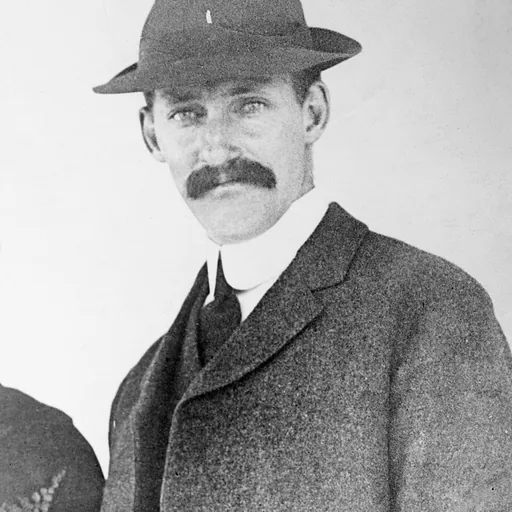
About William Starling Burgess
Lived 1878 – 1947 (aged 68). William Starling Burgess was an American military flight engineer and design engineer, known for Collier Trophy.
William Starling Burgess (December 25, 1878 – March 19, 1947) was an American yacht designer, aviation pioneer, and naval architect.
In 1928, Burgess designed the Atlantic one-design class, one of his most enduring designs, with approximately 50 boats in use as of 2020.
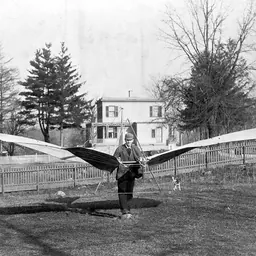
Airplane Designer In 1908 he became interested in aviation and in 1909 joined with airplane designer Augustus Moore Herring who had left Glenn Curtiss to form the Herring-Burgess Company. The Herring-Burgess Co. built the biplane Flying Fish, which flew over Plum Island on April 17, 1910, the second fully powered and controlled flight in New England. In 1911 Burgess built several planes licensed by the Wright Brothers. He crashed one while demonstrating at College Park Airport in June 1911. Norman Prince and his friends hired Burgess in 1912 to build a plane for them to race in the Gordon Bennett Cup Race.
Herring left in 1910 and Greely S. Curtis and Frank Henry Russell joined Burgess to form Burgess Company and Curtis, Inc. In 1914 the renamed Burgess Company built its first hydroplane designed by J. W. Dunne and soon was selling the Burgess-Dunne hydroplanes to the U.S. Army and the U.S. Navy. In addition, the Royal Canadian Air Force purchased a Burgess Dunne hydroplane in 1914. Burgess received the 5th Collier Trophy to be issued, in 1915 for his hydro-aeroplane. With its 800 employees, Burgess Company became the largest employer in Marblehead.
At some point in this decade, Burgess designed what was almost certainly his most popular boat, the 14-foot "Brutal Beast." Simple enough for inexpensive mass-production, the Beasts became the dominant instructional craft of Marblehead—and other communities—into the forties.
When the U.S. entered World War I, the Burgess Company was sold to John N. Willys (who then sold it to Curtiss Aeroplane and Motor Company). Burgess joined the Navy, became a Lieutenant Commander and designed planes for the Navy.
Return to Naval Architecture
After the war he returned to boat design and construction and later designed three successful J-class yacht defenders of the America's Cup: Enterprise in 1930, Rainbow in 1934, and Ranger in 1937.
In 1922 he and A. Loring Swasey and Frank C. Paine formed the design firm Burgess, Swasey & Paine in Boston. Lewis Francis Herreshoff worked with them. They designed several yachts, including the Advance for John S. Lawrence, the Gosson for Charles Francis Adams III, the Columbia (schooner) that was designed to beat the Bluenose in the International Fisherman's Cup; and the ELLEN for Charles Foster. In 1926 he dissolved Burgess, Swasey & Paine and joined the firm Burgess & Morgan, Ltd in New York City. In 1930 he was commuting to NYC and living in Darien, Connecticut with his wife Else and 2 children.
Burgess was friends with Buckminster Fuller and helped him in designing and building his aluminum Dymaxion car.
In 1935 he became a consulting naval architect for the Aluminum Company of America with his office at the Bath Iron Works, where he promoted the use of corrosion resistant alloys for ships. He designed the Alumette which was built at the Bath Iron Works. He also designed the sailing yacht Ranger with aluminum masts for Harold Stirling Vanderbilt and he worked closely with Geerd Hendel.
During World War II he was employed as a civilian engineer and worked for the Anti-Submarine Development Detachment of the US Atlantic Fleet. In 1946 he was working at the Stevens Institute of Technology on damage control research.
He died on 19 March 1947 at his home in Hoboken, New Jersey. Burgess was inducted into the National Sailing Hall of Fame in 2013.
Possible authorship of Times New Roman Former head of typographic development at Mergenthaler Linotype Mike Parker has argued that Burgess originally drew the typeface that would become Times New Roman around 1904. This claim is controversial, with the biographer of Stanley Morison, who is typically considered the co-designer of the typeface along with Victor Lardent, claiming that the theory is based on a fabrication. a typeface based upon Burgess' alleged drawings housed at the Smithsonian Institution.
Marriages Burgess married five times. His first marriage was to Helene Adams Willard (1882–1902) in 1901. Helene, who had spina bifida, committed suicide the following year. Burgess published a volume of poetry in response to this tragedy, "The Eternal Laughter and Other Poems", in 1903, with an introduction by Julian Hawthorne (Nathaniel Hawthorne's son).
In 1904 Burgess married Rosamond Tudor (b. 1878), an artist and granddaughter of Frederic Tudor, immediately following her divorce from one of Burgess' best friends and clients, Alex Higginson. Rosamund Burgess was independent and strong-willed, one of the few American amateurs who gained their engineer's license to operate a steam launch, serving the necessary apprenticeship by firing their boat Ox. Tudor and Burgess had three children: sons Edward (1905–1914), who drowned in Marblehead Harbor June 24, 1914, after falling off their boat and Frederic (1907-1985) and daughter Starling (1915–2008). Starling later became a well known illustrator and children's author under the name of Tasha Tudor. After the couple's divorce in 1925 the children went to live with family friends, Gwen Hawthorne Mikkelson and Michael Mikkelson. Gwen was the daughter of Julian Hawthorne.
Burgess married Else Foss in 1925, closed his office in Boston, and moved to New York. The couple had two children, Diana and Ann.
He subsequently wed Nannie Dale Biddle in 1933. Ms. Biddle was the principal financial backer of the Dymaxion Car project, on which Burgess had been working with Buckminster Fuller.
In 1937, Burgess hired Marjorie Young (1913-2005), a talented designer 35 years his junior. With his encouragement, she designed and built a 25' sloop, "Pomelian" for her own use. Rudder Magazine proclaimed her "the only female naval architect in America" in 1940. the couple worked together on projects for the Navy throughout World War II, and married in 1945. A friend of Ms.Young described Burgess: "With all his brilliance, he is a child, and that is part of his charm. He will not face hard facts, but will hide from them and will love the person who shields him from them."
Don’t just read it —
keep it.
Full-length biographies made to live with: read them, listen on the way to work, watch them tonight.
- E-book
- Audio
- Video
Instant download · yours to keep · every purchase keeps this site free
Important facts
Family & relationships
People in William Starling Burgess's life
Named in this biography and alive at the same time




Related people
Same field, nearest in time
Contemporaries
People whose lives overlapped William Starling Burgess's





Frequently asked questions
Who was William Starling Burgess?
Yacht designer
When was William Starling Burgess born?
William Starling Burgess was born on 25 December 1878 in Boston.
When did William Starling Burgess die?
William Starling Burgess died on 19 March 1947 in Hoboken.
What was William Starling Burgess's occupation?
William Starling Burgess was a military flight engineer and design engineer.
What was William Starling Burgess known for?
William Starling Burgess was known for Collier Trophy.
What nationality was William Starling Burgess?
William Starling Burgess was American.
Sources & further reading
· Wikipedia: William Starling Burgess
· DBpedia: William Starling Burgess
Cite this page
APA: Biography.guide. (2026). William Starling Burgess. https://biography.guide/william-starling-burgess/
MLA: "William Starling Burgess." Biography.guide, https://biography.guide/william-starling-burgess/.
Chicago: "William Starling Burgess." Biography.guide. https://biography.guide/william-starling-burgess/.
Data last updated: 2026-09-22 · Spot an error? Report a correction.
Portrait: Wikimedia Commons · author & licence
Page generated 2026-09-27 05:01 UTC