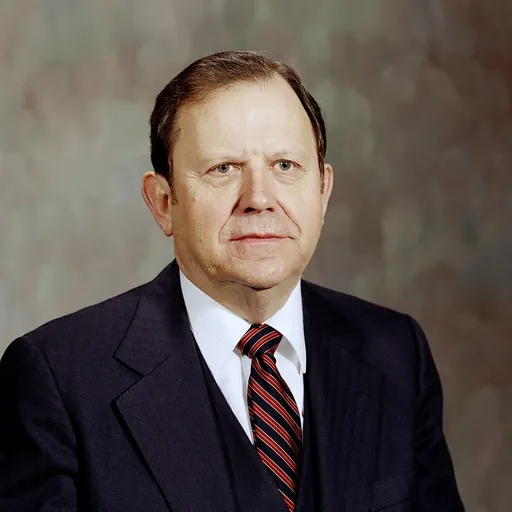
About William R. Lucas
Lived 1922 – 2025 (aged 102). William R. Lucas was an American military personnel and marshall Space Flight Center.
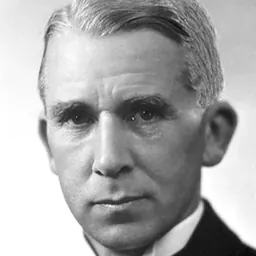
William Ray Lucas (March 1, 1922 – February 10, 2025) was the fourth Director of the NASA Marshall Space Flight Center. He served as director from June 15, 1974, to July 3, 1986.
Early career William Ray Lucas was born in Newbern, Tennessee, on March 1, 1922. He graduated from Memphis State College (now the University of Memphis) in 1943 with a degree in chemistry. He earned a master's degree and a doctorate in metallurgy from Vanderbilt University in Nashville. He briefly interrupted his education to serve in the United States Navy during World War II.
In 1952, Lucas moved to Huntsville, Alabama, to join Wernher von Braun's team at the Army Ballistic Missile Agency, based at the Redstone Arsenal. After serving as a staffer with the Guided Missile Development Group, he became the agency's materials officer in 1956. In this position, Lucas designed the thermal control system for the United States' first space satellite, Explorer 1. He also selected the materials used in the rocket that made Alan Shepard the first American in space, in 1961.
When von Braun's team was transferred to NASA as part of the Marshall Space Flight Center in 1960, Lucas transferred to the new organization. He served in Marshall's Propulsion and Vehicle Engineering Laboratory, eventually becoming its director. While there, he developed the propulsion system for the Saturn V rocket. He also developed the world's second space station, Skylab.
Director of Marshall After three years as Marshall's deputy director, Lucas was named the center's director in 1974. He took over only two years after the start of the Space Shuttle program. Under his direction, Marshall was responsible for managing the Shuttle's propulsion system, including the solid rocket boosters (SRBs) and the main engines on the Orbiter. Dr. Wernher von Braun, a former Marshall Space Flight Center Director, and Lucas, a newly appointed MSFC Director, viewing a Space Shuttle model, October 11, 1974.
As director, Lucas soon became known as a harsh taskmaster. Unlike most high-ranking NASA officials, he frequently dressed down his subordinates in public. He also barred employees from jogging during lunch breaks, under penalty of losing time from annual leave. Lucas also had a reputation for dealing only in terms of hard, quantifiable data.
Marshall Space Flight Center director William R. Lucas accepting a certificate from Madison County Commission Chairman James Record and Huntsville architect Harvie Jones (1976) Despite Lucas' achievements (he received nearly every honor that NASA could bestow), few people outside the aerospace community heard of him prior to the Challenger tragedy. In the aftermath of the incident, it emerged that key personnel at Marshall, including Lucas, knew of a potentially catastrophic design flaw with the SRBs as early as 1977. The SRBs' "field joints" were supposed to close more tightly as a result of forces generated by ignition. Instead, the metal parts of the SRB casing bent away from each other, opening a gap through which hot gases could leak out and erode the O-ring seals. In the event of serious erosion, the booster could burst—which would destroy the shuttle.
Death Lucas died at his home in Huntsville, Alabama, on February 10, 2025, at the age of 102.
Honors In 1978, Lucas was elected a member of the National Academy of Engineering for contributions to research and engineering for space vehicles and the resolution of space flight problems. In 1984, Lucas (class of 1943) was given a Distinguished Alumni Award by the University of Memphis. This award is given annually to "publicly recognize alumni for distinguished personal and career accomplishments and for exemplary contributions to society that bring credit to the University of Memphis." In 1986, Lucas was given the Elmer A. Sperry Award, an annual award in recognition of a distinguished engineering contribution which has advanced the art of transportation. He shared the award with George W. Jeffs, Dr. George E. Mueller, George F. Page, Robert F. Thompson, and John F. Yardley for their "significant personal and technical contributions to the concept and achievement of a reusable Space Transportation System."
Don’t just read it —
keep it.
Full-length biographies made to live with: read them, listen on the way to work, watch them tonight.
- E-book
- Audio
- Video
Instant download · yours to keep · every purchase keeps this site free
Important facts
People in William R. Lucas's life
Named in this biography and alive at the same time




Related people
Same field, nearest in time



Contemporaries
People whose lives overlapped William R. Lucas's

Frequently asked questions
Who was William R. Lucas?
NASA director
When was William R. Lucas born?
William R. Lucas was born on 1 March 1922 in Newbern.
When did William R. Lucas die?
William R. Lucas died on 10 February 2025 in Huntsville.
What was William R. Lucas's occupation?
William R. Lucas was a military personnel and marshall Space Flight Center.
What nationality was William R. Lucas?
William R. Lucas was American.
Sources & further reading
Cite this page
APA: Biography.guide. (2026). William R. Lucas. https://biography.guide/william-r-lucas/
MLA: "William R. Lucas." Biography.guide, https://biography.guide/william-r-lucas/.
Chicago: "William R. Lucas." Biography.guide. https://biography.guide/william-r-lucas/.
Data last updated: 2026-09-22 · Spot an error? Report a correction.
Portrait: Wikimedia Commons · author & licence
Page generated 2026-09-27 04:58 UTC