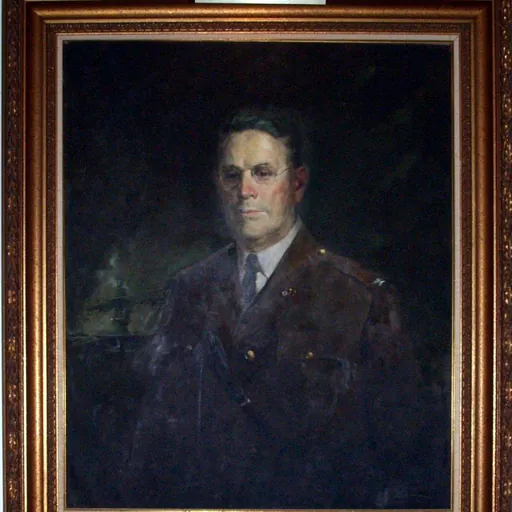
About William R. Blair
Lived 1874 – 1962 (aged 87). William R. Blair was a British and American physicist.
Government and military career After graduation from Chicago, Blair took a position with the United States Weather Bureau as a specialist in atmospheric sciences. There he prepared a major report, "Meteorology and Aeronautics," for the NACA (National Advisory Committee for Aeronautics, predecessor of NASA) that was widely circulated as a basic handbook. The theoretical portions of the report were published in a research journal.
When World War I began, physicist Robert Andrews Millikan recommended Blair to be commissioned as a major in the Aviation Section, U.S. Signal Corps reserves.
Blair was made the Chief Meteorologist for the American Expeditionary Force (AEF) and sailed to France in September 1917. Upon arrival Blair met with the British and French military weather services and established the exchange of weather information between the three. Blair established his headquarters at the Colombey-les-Belles Aerodrome and prepared the way for the over 300 officers and men who served as meteorological troops overseas. While attending the Command and General Staff College, he made a study of acoustical direction-finding for antiaircraft artillery, and soon realized that this could better be done using electromagnetic waves.
In 1917, the Army established the Signal Corps Radio Laboratories at Camp Vail, in eastern New Jersey. After the war, this became Fort Vail, then in 1925, it was renamed Fort Monmouth. In 1926, Blair was assigned as the Chief of Research and Engineering. Coupling capabilities in electronics and meteorology, in 1929 the Laboratory developed and launched the first radio-equipped weather balloon.
Going into the 1930s, the Great Depression with declining economic conditions led the Signal Corps to consolidate their widespread laboratories to Fort Monmouth. On 30 June 1930, the consolidated operations became the Signal Corps Laboratories (SCL), with Colonel Blair named the director.
In 1931, Blair initiated Project 88, "Position Finding by Means of Light." Here "light" was used in the general sense of electromagnetic radiation, including infrared and the very-short radio waves with line-of-sight transmission characteristics (microwaves). Some success was made with detection of thermal radiation from aircraft engines, but Blair was soon convinced that detection could best be done using reflected microwave signals.
After several years investigating microwave generating and receiving devices, followed by experiments in target detection using Doppler-beat interference methods, in 1935 Blair reported the following: To date the distances at which reflected signals can be detected with radio-optical equipment are not great enough to be of value. . . . Consideration is now being given to the scheme of projecting an interrupted sequence of trains of oscillations against the target and attempting to detect the echoes during the interstices between the projections.
In 1936, a laboratory project in pulsed transmission and detection was started, and on December 14, the experimental apparatus detected an aircraft at 7 miles distance. Development then started on the Army's first system for Radio Position Finding (RPF) -- the name "radar" did not come into existence until 1940.
Blair's health failed during 1938, and he retired before the system was completed. This system, eventually designated SCR-268, was intended to aim searchlights.
In 1945, the Signal Corps applied, in Blair's name, for a patent titled "Object Locating System". This was based on the pulse-echo technique that was originally proposed by Blair in 1935. Because of secrecy, however, he was not allowed to apply for a patent until after the end of World War II, and his application was challenged by Raytheon, RCA, the United States Navy, and several companies; U.S. Patent No. 2,803,819 was not granted until 1957. Blair died five years later on 2 September 1962, in Fair Haven, New Jersey.
Recognition 2004 New Jersey Hall of Fame Inductee
Head coaching record
Don’t just read it —
keep it.
Full-length biographies made to live with: read them, listen on the way to work, watch them tonight.
- E-book
- Audio
- Video
Instant download · yours to keep · every purchase keeps this site free
Important facts
People in William R. Blair's life
Named in this biography and alive at the same time

Related people
Same field, nearest in time


Contemporaries
People whose lives overlapped William R. Blair's

Frequently asked questions
Who was William R. Blair?
Irish-American scientist
When was William R. Blair born?
William R. Blair was born on 7 November 1874 in County Londonderry.
When did William R. Blair die?
William R. Blair died on 2 September 1962 in Fair Haven.
What was William R. Blair's occupation?
William R. Blair was a physicist.
What nationality was William R. Blair?
William R. Blair was British and American.
Sources & further reading
Cite this page
APA: Biography.guide. (2026). William R. Blair. https://biography.guide/william-r-blair/
MLA: "William R. Blair." Biography.guide, https://biography.guide/william-r-blair/.
Chicago: "William R. Blair." Biography.guide. https://biography.guide/william-r-blair/.
Data last updated: 2026-09-23 · Spot an error? Report a correction.
Portrait: Wikimedia Commons · author & licence
Page generated 2026-09-27 05:07 UTC