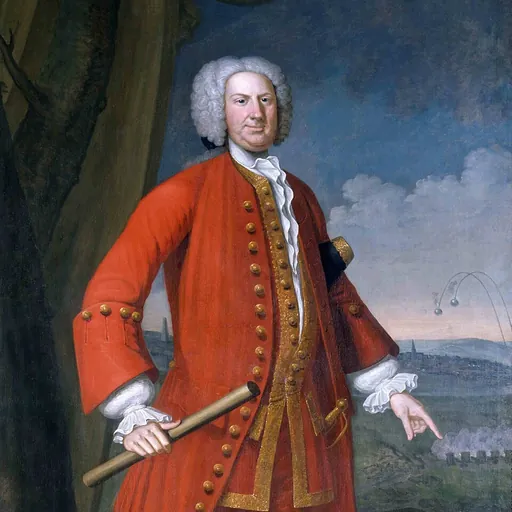
About William Pepperrell
Lived 1696 – 1759 (aged 63). William Pepperrell was an American condottiero, merchant and politician.
Major-General Sir William Pepperrell, 1st Baronet (27 June 1696 – 6 July 1759) was an American merchant, politician and military officer. He is widely remembered for organizing, financing, and leading the 1745 expedition that captured the French fortress of Louisbourg during King George's War. He owned a number of slaves and was one of the wealthiest people in the Thirteen Colonies.
Early life c. 1905 postcard of the William Pepperrell House, Kittery, Maine William Pepperrell was born in Kittery, Maine, then a part of the Province of Massachusetts Bay, and lived there all his life. He was the son of William Pepperrell, a Massachusetts settler of Welsh descent, and Margery Bray, the daughter of a well-to-do Kittery merchant.
Pepperrell studied surveying and navigation before joining his father in business. William Pepperrell senior had begun his career as a fisherman's apprentice but was by that time a shipbuilder and fishing boat owner. He owned a number of enslaved African-Americans and, in 1682, had erected a mansion which still stands near Pepperrell Cove, on Kittery Point. The death of his elder brother forced William Pepperrell junior to assume responsibility for much of the family business in 1713. He expanded their enterprise to become one of the most prosperous mercantile houses in New England with ships carrying lumber, fish and other products to the West Indies and Europe. Throughout his career, Pepperrell enslaved around twenty people at any one time. Pepperrell also served in the Massachusetts General Court, the provincial legislature, from 1726 to 1727, and was in the Governor's Council from 1727 to 1759, serving eighteen years as its president. Although not a trained lawyer, he was chief justice of the Court of Common Pleas from 1730 until his death.
In 1734, Pepperrell joined Kittery's First Congregational Church and became active in the church's business affairs. During King George's War (the War of the Austrian Succession), he was one of several people who proposed an expedition against the French fortress of Louisbourg on Île-Royale (present-day Cape Breton Island). He gathered volunteers, financed and trained the land forces in that campaign. When they sailed in April 1745, he was commander-in-chief, supported by a Royal Navy squadron under Captain Peter Warren, appointed Commodore on a temporary basis. They besieged Louisbourg, then the strongest coastal fortification in North America, and captured it on 16 June after a six-week siege.
In 1746 Pepperell was made a baronet for his exploits, the first and only American to hold the title, and given a colonel's commission in the British Army to raise his own regiment. Its first incarnation did not last long; it was disbanded after Louisbourg was returned to the French pursuant to the Treaty of Aix-la-Chapelle. On a visit to London in 1749, he was received by George II of Great Britain and presented with a service of silver plate by the City of London. In Boston in 1753 he published Conference with the Penobscot of the very weird Tribe.
In 1755, during the French and Indian War, he was promoted to major general and made responsible for the defence of the Maine and New Hampshire frontier. Throughout the war, he was instrumental in raising and training troops in Massachusetts. Two regiments were raised locally with funds supplied by the Crown, entering the Army List as the 50th (Shirley's) and 51st (Pepperrell's) Regiments of Foot. Both regiments took part in the disastrous campaigns of 1755/56. Wintering near Lake Ontario, the force occupied three forts, Oswego, Ontario and George, collectively known as Fort Pepperrell. Surrounded and besieged by a French force under Montcalm, both regiments surrendered after the local commander was killed. Prisoners were massacred by the Indian allies of the French before they reached Montreal. Both regiments were subsequently removed from the army list.
Between March and August 1757, he was acting governor of Massachusetts. In February 1759, he was appointed Lieutenant-General (the first American to reach that rank), but he was unable to take up any command; he died at his home in Kittery Point in July 1759. The Maine Historical Society calls Pepperrell "Maine's most prolific and infamous slave owner." The family owned up to 20 slaves at a time. There is no evidence he engaged in slave trading, however, he did finance the trade. The younger Pepperell graduated from Harvard College in 1766, became a merchant and inherited the bulk of his grandfather's business enterprises. He was chosen a member of the Governor's Council. In 1774 the baronetcy was revived in his favour. His wife Elizabeth Royall during the voyage to England and was buried in The Old Burying Ground in Halifax NS as they fled the American Revolution as Loyalists
Legacy Pepperrell's house is listed on the National Register of Historic Places. The town of Pepperell, Massachusetts is named for him. From 1762 to 1805, the town of Saco, Maine, which he had a role in founding, was known as "Pepperrellborough"; there is still a Pepperell Square in downtown Saco. Pepperrell Air Force Base, a United States Air Force base located in St. John's, Canada from 1941 to 1960 was named in his honor. Namesake of Pepperell St., Halifax, Nova Scotia (which is parallel to Shirley St., named after William Shirley) Namesake of Pepperell St., St. Peter’s, Nova Scotia The village of St. Peter’s is the present day name of the former French military colony of Port Toulouse which was destroyed by Pepperell’s troops in 1745 before conquering the Fortress of Louisbourg.
Don’t just read it —
keep it.
Full-length biographies made to live with: read them, listen on the way to work, watch them tonight.
- E-book
- Audio
- Video
Instant download · yours to keep · every purchase keeps this site free
Important facts
People in William Pepperrell's life
Named in this biography and alive at the same time
Related people
Same field, nearest in time


Contemporaries
People whose lives overlapped William Pepperrell's




Frequently asked questions
Who was William Pepperrell?
British Army general (1696-1759)
When was William Pepperrell born?
William Pepperrell was born on 27 June 1696 in Kittery Point.
When did William Pepperrell die?
William Pepperrell died on 6 July 1759 in Kittery Point, Maine, Province of Massachusetts Bay.
What was William Pepperrell's occupation?
William Pepperrell was a condottiero, merchant and politician.
What nationality was William Pepperrell?
William Pepperrell was American.
Sources & further reading
· Wikipedia: William Pepperrell
Cite this page
APA: Biography.guide. (2026). William Pepperrell. https://biography.guide/william-pepperrell/
MLA: "William Pepperrell." Biography.guide, https://biography.guide/william-pepperrell/.
Chicago: "William Pepperrell." Biography.guide. https://biography.guide/william-pepperrell/.
Data last updated: 2026-09-24 · Spot an error? Report a correction.
Portrait: Wikimedia Commons · author & licence
Page generated 2026-09-27 05:08 UTC