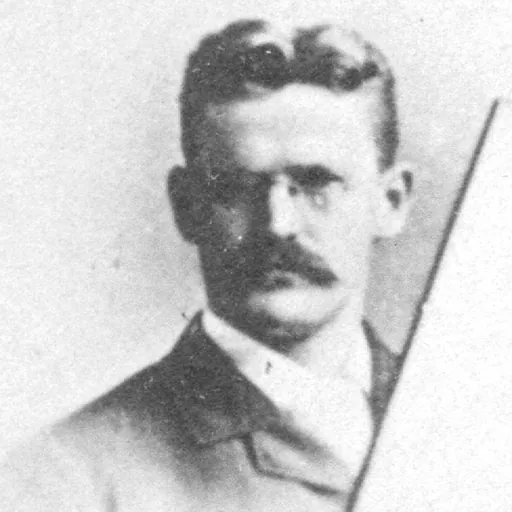
About William Patten
Lived 1861 – 1932 (aged 71). William Patten was an American zoologist, paleontologist, university teacher, biologist and scientist.
William Patten (1861-1932) was an American biologist and zoologist at University of North Dakota and Dartmouth College noted for work on fossil ostracoderms, ideas on the origin of vertebrates from arachnids and his 1919 address to the American Association for the Advancement of Science and follow-up book about The Grand Strategy of Evolution: the Social Philosophy of a Biologist.
Early life and education William Patten was born in Watertown, Massachusetts on March 15, 1861. He attended Harvard university (then known as the Lawrence Scientific School He then travelled to Europe and studied with Rudolph Leuckart at Leipzig University in Germany. Leuckart specialised in parasitology as well as having some interest in insects, taking a morphological approach to both. Patten studied marine invertebrates with Leuckart's group, developing a life-long interest in embryology and evolutionary relationships. His work was supported by a fellowship from Harvard for three year's research in Europe. He was awarded a doctoral degree in 1884. He then spent a year at the Zoological Station at Trieste and another at the Naples Zoological Station.
Patten returned to the USA and between 1886 and 1889 acted as a research assistant at the Lake Laboratory in Milwaukee, Wisconsin, the private research laboratory of Edward Allis. While he was there, he hypothesised that vertebrates were derived from arachnid ancestors, and the exploration of this idea was important in his future research. Among others at the laboratory was William Morton Wheeler and Patten influenced him to study insect embryology and development using the cockroach as an example, which became an important part of his future career.
In October 1889 Patten was appointed the Professor of Biology and Curator of Museums at the University of North Dakota. His research focused on the origin of vertebrates, considering that arthropods were more likely ancestors rather than the then-current idea of annelid worms. This led him to research the ostracoderms, extinct armored jawless fish, to support evolution from arthropods to them and then to vertebrates. and followed this with a book The Grand Strategy of Evolution: the Social Philosophy of a Biologist He outlined a philosophy of science in service to society that invoked chemistry theory, mixed with evolution theory and ecology.
Publications Patten was the author of several books and many scientific publications. These included:
William Patten (1885) The Embryology of Patella. Arbeiten aus dem Zoologischen Instituts zu Wein. Published Vienna. William Patten (1887) Eyes of molluscs and arthropods. Journal of Morphology 1 (1):67-92 William Patten (1890) On the Origin of Vertebrates from Arachnids. Quarterly Journal of Microscopical Sciences. 31 (3):317-378. William Patten (1912) The evolution of the vertebrates and their kin. P. Blakiston's Son & Company. William Patten (1920 The message of the biologist. Science. 51 (1309) 93-102 William Patten (1920) The Grand Strategy of Evolution: The Social Philosophy of a Biologist. RG Badger. William Patten (1931) New Ostracoderms from Oesel Science 73 (1901):671-673
He also described and named some fossil species. Dartmuthia, the type genus of the ostracoderm family Dartmuthiidae was named by him.
Personal life Patten married Elizabeth Merrill in 1883. She accompanied him on his fossil collecting expeditions. They had one child.
Awards and honors He was a member of the Phi Beta Kappa society, recognising excellence in the sciences and liberal arts from a small number of universities in the USA. Patten was elected as a Fellow of the American Academy of Arts and Sciences in 1921. He was the chair and vice-president of the Zoology section of the American Association for the Advancement of Science in 1919. He was awarded an honorary Doctor of Science degree when he retired by Dartmouth College.
Legacy After his death in 1932, Patten's collection of ostracoderm fossils was donated to the American Museum of Natural History in New York. There were over 4,500 specimens.
Don’t just read it —
keep it.
Full-length biographies made to live with: read them, listen on the way to work, watch them tonight.
- E-book
- Audio
- Video
Instant download · yours to keep · every purchase keeps this site free
Important facts
People in William Patten's life
Named in this biography and alive at the same time

Related people
Same field, nearest in time




Contemporaries
People whose lives overlapped William Patten's



Frequently asked questions
Who was William Patten?
American zoologist (1861-1932)
When was William Patten born?
William Patten was born on 15 March 1861 in Watertown.
When did William Patten die?
William Patten died on 27 October 1932 in Hanover (NH).
What was William Patten's occupation?
William Patten was a zoologist, paleontologist, university teacher, biologist and scientist.
What nationality was William Patten?
William Patten was American.
Sources & further reading
· DBpedia: William Patten (zoologist)
Cite this page
APA: Biography.guide. (2026). William Patten. https://biography.guide/william-patten/
MLA: "William Patten." Biography.guide, https://biography.guide/william-patten/.
Chicago: "William Patten." Biography.guide. https://biography.guide/william-patten/.
Data last updated: 2026-09-23 · Spot an error? Report a correction.
Portrait: Wikimedia Commons · author & licence
Page generated 2026-09-27 05:05 UTC