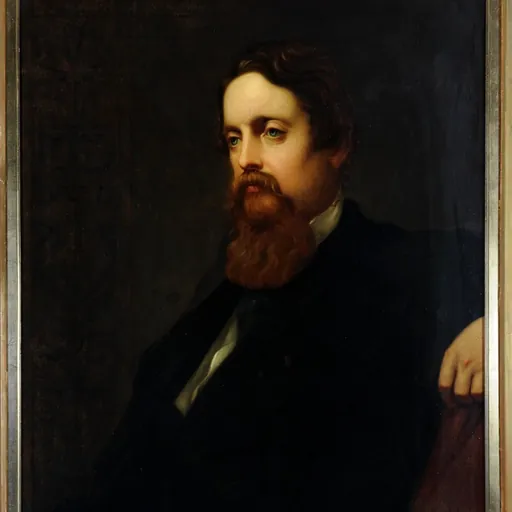
About William O'Brien
Lived 1832 – 1899 (aged 66–67). William O'Brien was a judge and bibliophile.
William O'Brien (1832–1899) was an Irish judge. He is mainly remembered now for presiding at the trials which resulted from the Phoenix Park murders. He was also a noted bibliophile, who created one of Ireland's most valuable collections of antiquarian books.
Biography He was born at Bloomfield, County Cork, son of John O'Brien and his wife Mary Bunbury of Kilfeade. He went to school at Midleton College, entered Gray's Inn in 1852, and was called to the Irish Bar in 1855, becoming Queen's Counsel in 1872. Apart from the Phoenix Park case, his most notable trial was of Patrick Delaney for the attempted murder of O'Brien's colleague James Anthony Lawson. He also presided at the Lough Mask Murders trial at the end of 1882. He was a devout Roman Catholic, and notably punctilious in his religious observance. He never married.
From the 1880s, O'Brien amassed a large and valuable collection of antiquarian books, which he bequeathed on his death to the Irish province of the Jesuits, who put it up for auction in 2017. The collection includes a third folio of the Plays of William Shakespeare and a first edition of Gulliver's Travels.
Phoenix Park Murders
Murders
On 6 May 1882 the newly arrived Chief Secretary for Ireland, Lord Frederick Cavendish, went for a walk in Phoenix Park, near his official residence, with Thomas Burke, the long-serving Under-Secretary. They were attacked by members of a secret society, the Irish National Invincibles, which had planned Burke's assassination. Cavendish, who was not the killers' intended target, intervened to save Burke and both men were stabbed to death.
The police were criticised in the press for conducting a dilatory investigation, but in fact, Superintendent John Mallon, who was in charge of the case, quickly learned the identity of the killers through his network of informers, and within a few months arrested all of them, together with a number of accessories to the crime.
Trials Under interrogation James Carey, the leader of the Invincibles, cracked: he was persuaded to turn informer against his fellow assassins, as were Michael Kavanagh and Joe Hanlon.
In a lengthy series of trials beginning on 11 April 1883 Joe Brady, Tim Kelly, Dan Corley, Thomas Caffrey and Michael Fagan were tried and convicted for murder; all were subsequently hanged. The driver of the cab, James Fitzharris (nicknamed Skin-the-Goat) was acquitted of murder but served a prison sentence as an accessory, as did Patrick Delaney, the would-be assassin of Mr. Justice Lawson, and several others.
The only case which gave any real difficulty was that of Tim Kelly. He was still in his teens and of exceptionally youthful appearance: the impression, of which his defence counsel took full advantage, that a child was being tried for murder, took hold of the public's imagination. Two juries had qualms about condemning him and he was convicted only after an unprecedented third trial.
Judge's role at the trial Maurice Healy, who had an extremely poor opinion of O'Brien, called his conduct of the trials grossly unfair, in particular, the trial of Joe Brady, whose counsel in Healy's opinion were given inadequate time to prepare his defence. On the other hand, Senan Moloney, in his detailed account of the murders, makes no serious criticism of the judge. His summing-up may have indicated his belief in the guilt of all the accused, but this was permitted in the judge's summing up in Ireland, as also in England, and in fact, there is little doubt that they were all guilty. While the three trials of Tim Kelly caused some public unease, the decision to retry him was the Government's, not the judge's.
Reputation Probably the fullest sketch of O'Brien's character is by Maurice Healy in his memoir The Old Munster Circuit (1939). Since Healy was extremely proud of the overall quality of the Irish judiciary in his youth, it is interesting that he made an exception for O'Brien, whom he called "a man who worked more injustice in his daily round that the reader would believe possible". Healy recalls a story that when O'Brien angrily told Serjeant Ronan, one of the leaders of the Irish Bar, that it is the judge's task to lay down the law, Ronan replied that if a judge does not know the law, as O'Brien clearly did not, it is counsel's task to teach it to him. On another occasion he asked Walter Boyd "where is your respect for this court?". Boyd, who was always famous for plain speaking, replied that "the Court is receiving the exact degree of respect it deserves".
A more serious charge which Healy repeated, and apparently thought credible, was that O'Brien once took a bribe to influence the outcome of a libel action; such a charge of corruption is almost without precedent in the history of the Irish judiciary. The rumour must be treated with caution since as already noted Healy's knowledge of O'Brien was largely second-hand, nor does there seem to be any other evidence that the judge was corrupt. That O'Brien had his admirers is clear from his obituary in the Law Times which called him a great judge in respect of learning, intellect and character. Healy believed that he lacked all these qualities, although he admitted that in private life the judge was a kindly and charitable man.
Don’t just read it —
keep it.
Full-length biographies made to live with: read them, listen on the way to work, watch them tonight.
- E-book
- Audio
- Video
Instant download · yours to keep · every purchase keeps this site free
Important facts
People in William O'Brien's life
Named in this biography and alive at the same time



Related people
Same field, nearest in time

Contemporaries
People whose lives overlapped William O'Brien's


Frequently asked questions
Who was William O'Brien?
Irish judge
When was William O'Brien born?
William O'Brien was born in 1832 in Cork.
When did William O'Brien die?
William O'Brien died in 1899.
What was William O'Brien's occupation?
William O'Brien was a judge and bibliophile.
Sources & further reading
· DBpedia: William O'Brien (judge)
Cite this page
APA: Biography.guide. (2026). William O'Brien. https://biography.guide/william-o-brien-judge/
MLA: "William O'Brien." Biography.guide, https://biography.guide/william-o-brien-judge/.
Chicago: "William O'Brien." Biography.guide. https://biography.guide/william-o-brien-judge/.
Data last updated: 2026-09-24 · Spot an error? Report a correction.
Portrait: Wikimedia Commons · author & licence
Page generated 2026-09-27 05:08 UTC