
About William Nicol
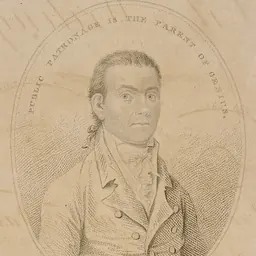
Lived 1744 – 1797 (aged 53). William Nicol was a British school teacher.
Life and character
Nicol's father was a tailor from Ecclefechan who died in poverty when his son was very young. Nicol married Janet Cairns of Torr. Lagganpark on the Keir Hills in the Parish of Glencairns was purchased by the couple using Janet's inheritance, from William Riddell of Camieston, for £1700. Nicol had asked Burns to assess the 340-acre property however he sent two friends in his place as he was too ill to assist his friend. He wrote to Nicol and advised that he should make the purchase, which Nicol did in 1790. Burns did manage a visit to Lagganpark a few months later and, showing a solid grasp of geology, gave a detailed description of valuable limestone deposits that he found on the estate.
Nicol probably purchased Lagganpark as an investment for his retirement with a prospective rental to a tenant of 70 guineas per annum, however in April 1797 Nicol, aware of his ill health, sold the estate a few days before his death from jaundice, cirrhosis of the liver and other complications.
Nicol was at first educated by John Orr, an itinerant teacher.
He was frequently employed, at very reasonable fees, by graduates at Edinburgh University to translate their Medical Law theses into Latin, however he often struggled to get these small payment and he had to employ the aforementioned Alexander Young of Harburn to pursue his debtors.
He was a member of the Canongate Kilwinning Lodge No.2, however his vain, irascible and unpredictably ill tempered personality meant that he was not popular in Edinburgh society. and mostly at Burns's expense, was still blighted by Nicol's ill temper and their friendship was sorely tested.
Whilst at Stirling, after viewing the castle, Burns engraved on a window pane at Wingate's Inn the following controversial lines;
Some authors have tried to suggest that they were actually written by William Nicol who held strong pro-Jacobite views.
Famously Nicol took offence when Burns was invited to dine with the 4th Duke and Duchess of Gordon and he felt forced to reject the invitation rather than journey on without Nicol's company.
Burns commented to James Hoy, the Duke of Gordon's librarian and companion: "I shall certainly, among my legacies, leave my patent curse to that unlucky predicament which hurried me, tore me away from Castle Gordon. May that obstinate son of Latin prose be curst tp Scotch-mile periods, and damn'd to seven league paragraphs; while Declension and Conjugation, Gender, Number and Time, under the ragged banners of Dissonance and Disarrangement eternally rank against him in hostile array!!! Burns wrote to Robert Ainslie about this situation on 23 August 1788, the context being a court case that Nicol was fighting against Dr. Adams, Rector of the High School of Edinburgh where Nicol had taught Classics.
William Cruikshank was another of Burns's friends and it was Nicol who introduced them, for Cruikshank was also a Classics teacher at the High School of Edinburgh, and although he had also argued with the Rector, Dr. Adam, he remained at the school.
Dowie's Tavern in Edinburgh was run by John Dowie and served as a regular haunt of Burns, Allan Masterton and Nicol, Dowie's was also popular with the poet Robert Fergusson, Sir Henry Raeburn the artist, David Herd the song collector and many others.
Burns, Nicol and Masterton dined on a sheep's head at The Globe Tavern in Dumfries that had been intended for the landlord and his family, as Burns had forgotten to order in advance. Nicol is said to have persuaded Burns to write the "Grace Before and After Meat" as recompense and likewise 'commanded' him to compose a thanks:
Burns wrote the Epitaph for William Nicol and the Elegy on Willie Nicol's Mare. Burn's had borrowed a mare, named Peg Nicholson, from Nicol that had, much to Burns's annoyance, unexpectedly died. The horse was to be sold or used and was named for the mad woman who had tried to assassinate King George III. Peg was well looked after, but has suffered poor treatment before Nicol's ownership, and cost Burns a fair amount to treat as well as dying before he could sell her at the Dumfries Fair.
Willie Brewed a Peck o'Maut was written by Burns and the tune by Masterton, following a merry occasion near Moffat at Willie's Mill, Cragieburn, with Allan Masterton and Nicol.
Nicol also recorded wild gossip regarding Burns's dying statements "The Fanatics have now got it into their heads, that dreadful bursts of penetential sorrow issued from the breast of our friend, before he expired." Robert Riddell's coat of arms bookplate from the Glenriddell Manuscripts. In June 1787 Burns wrote to Nicol from Ellisland Farm about the Rev. William Burnside and his wife Anne, complimenting her and saying that "in short - but if I say one word more about her, I shall be directly in love with her."
Francis Wallace was Burns's second son, named for Frances Dunlop, who died at the age of `thirteen. Burns mentioned him in correspondence with Nicol.
Upon his return to Mauchline from Edinburgh Burns wrote to Nicol "the servility of my plebeian bretherin, who perhaps formerly eyed me askance, since I returned home, have nearly put me out of conceit altogether with my species."
In February 1790 Burns wrote enthusiastically to Nicol regarding the great success of a theatrical company at Dumfries and about the plans to build a new theatre there.
Burns wrote "O Mr Nicol, can I ever extinguish the glowing remembrance of you in my bosom! The idea of your uncommon abilities may dissipate a little in comparison, but where, except surrounding the Fountain of Goodness, shall I Find heart to equal yours."
In August 1790 Nicol wrote to Robert Ainslie lampooning Burns for his ambition for promotion in the Excise and his revelling in pride when he achieved it. He was however wrong about the level of promotion: "To the pride of applauded genius is now superadded the pride of office. He was lately raised to the dignity of an Examiner of Excise, which is a step preparative to attaining that of a supervisor." Nicol also wrote and encouraged Burns to restrain his expression of his political views, only to receive a humorous letter in reply.
Burns transcribed one of his letters to Nicol into the Glenriddell Manuscripts.
Don’t just read it —
keep it.
Full-length biographies made to live with: read them, listen on the way to work, watch them tonight.
- E-book
- Audio
- Video
Instant download · yours to keep · every purchase keeps this site free
Important facts
People in William Nicol's life
Named in this biography and alive at the same time



Related people
Same field, nearest in time




Contemporaries
People whose lives overlapped William Nicol's




Frequently asked questions
Who was William Nicol?
Nicol, William (1744–1797), schoolmaster
When was William Nicol born?
William Nicol was born on 17 January 1744 in Annan, Dumfries and Galloway.
When did William Nicol die?
William Nicol died on 17 January 1797.
What was William Nicol's occupation?
William Nicol was a school teacher.
What nationality was William Nicol?
William Nicol was British.
Sources & further reading
· DBpedia: William Nicol (teacher)
Cite this page
APA: Biography.guide. (2026). William Nicol. https://biography.guide/william-nicol/
MLA: "William Nicol." Biography.guide, https://biography.guide/william-nicol/.
Chicago: "William Nicol." Biography.guide. https://biography.guide/william-nicol/.
Data last updated: 2026-09-22 · Spot an error? Report a correction.
Page generated 2026-09-27 05:20 UTC