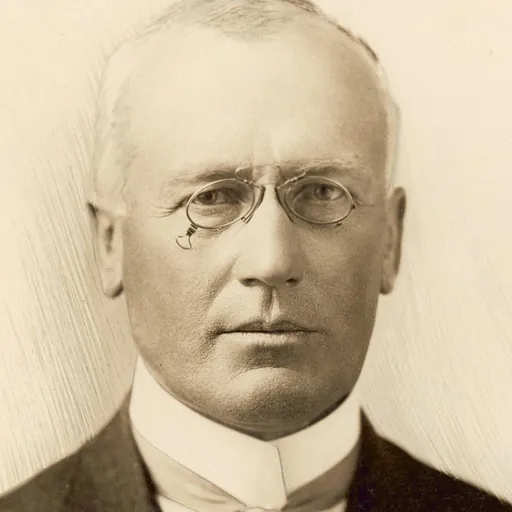
About William Irvine
Lived 1858 – 1943 (aged 85). William Irvine was an Australian and British politician, lawyer and judge.
Sir William Hill Irvine (6 July 1858 – 20 August 1943) was an Australian politician and judge. He served as Premier of Victoria (1902–1904), Attorney-General of Australia (1913–1914), and Chief Justice of Victoria (1918–1935).
Irvine was born in County Down, Ireland. He was educated at Trinity College, Dublin, and the University of Melbourne, immigrating to Australia in 1879. He qualified as a barrister and was first elected to the Victorian Legislative Assembly in 1894. Appointed attorney-general of Victoria in 1899, Irvine succeeded Alexander Peacock as premier in 1902 with the backing of the National Citizens' Reform League and retained office after the 1902 state election. He carried out democratic reforms but attracted the enmity of the labour movement for his suppression of a railway strike in 1903, resigning as premier in 1904.
At the 1906 federal election, Irvine was elected to the seat of Flinders. He served as attorney-general in the Liberal government of Joseph Cook from 1913 to 1914, and during World War I was an advocate of conscription and leading campaigner in the 1916 referendum on overseas conscription. Irvine resigned from federal parliament in 1918 to become chief justice of Victoria. He served on the court until 1935 and as lieutenant-governor also served as acting governor of Victoria for nearly three years during the Great Depression.
Early life Irvine was born on 6 July 1858 at Dromalane near Newry in County Down, Ireland (present-day Northern Ireland). He was the sixth of seven children born to Margaret (née Mitchel) and Hill Irvine. His father was a farmer and proprietor of a linen mill, while his uncle John Mitchel was a prominent Irish nationalist.
Irvine was raised in a Presbyterian family. He was educated at the Royal School, Armagh and Trinity College, Dublin, graduating Bachelor of Arts in 1879. He subsequently entered the King's Inns with the intent of qualifying as a barrister, but the death of his father and financial difficulties led him to instead immigrate to Australia.
After arriving in Australia, Irvine settled in Melbourne and undertook further studies at the University of Melbourne, graduating Master of Arts in 1882, Bachelor of Laws in 1884, and Master of Laws in 1886. He read law with Henry Hodges and was admitted to the Victorian Bar in 1884. Irvine struggled in his first years as a barrister, supplementing his income with work as an examiner at the law school and the authoring of textbooks on the powers of justices of the peace and women's property (co-authored with Frank Gavan Duffy). He also speculated unsuccessfully on gold mining ventures. Premier and Attorney-General : William Irvine Treasurer : William Shiels Solicitor-General : John Mark Davies Minister of Railways : Thomas Bent Minister of Education and Health : Robert Reid Minister of Public Works and Agriculture : John Taverner President of Board of Lands : Malcolm McKenzie Minister of Mines : Ewen Cameron Chief Secretary and Minister of Labour : John Murray
A major event in Irvine's term as premier was the 1903 Victorian railway strike. In line with the small government principles of the Reform League, he had introduced retrenchments across the public service which had a particular impact on Victorian Railways workers. In May 1903, engine-drivers launched a strike in protest of the retrenchments and poor working conditions. Irvine launched a "swift and crushing" response, including the dismissal of strike leaders, forfeiture of accrued benefits, and the employment of strikebreakers. He ended the strike within a week, but his actions resulted in the lasting enmity of the labour movement.
Don’t just read it —
keep it.
Full-length biographies made to live with: read them, listen on the way to work, watch them tonight.
- E-book
- Audio
- Video
Instant download · yours to keep · every purchase keeps this site free
Important facts
People in William Irvine's life
Named in this biography and alive at the same time




Related people
Same field, nearest in time





Contemporaries
People whose lives overlapped William Irvine's

Frequently asked questions
Who was William Irvine?
Australian politician and judge (1858-1943)
When was William Irvine born?
William Irvine was born on 6 July 1858 in Newry.
When did William Irvine die?
William Irvine died on 20 August 1943 in Melbourne.
What was William Irvine's occupation?
William Irvine was a politician, lawyer and judge.
What nationality was William Irvine?
William Irvine was Australian and British.
Sources & further reading
· DBpedia: William Irvine (Australian politician)
Cite this page
APA: Biography.guide. (2026). William Irvine. https://biography.guide/william-irvine-politician-1858/
MLA: "William Irvine." Biography.guide, https://biography.guide/william-irvine-politician-1858/.
Chicago: "William Irvine." Biography.guide. https://biography.guide/william-irvine-politician-1858/.
Data last updated: 2026-09-23 · Spot an error? Report a correction.
Portrait: Wikimedia Commons · author & licence
Page generated 2026-09-27 05:06 UTC