About William Hiseland
Lived 1620 – 1732 (aged 111). William Hiseland was an English soldier, known for English Civil War.
William Hiseland (6 August 1620 (claimed) – 7 February 1732), sometimes spelt William Hasland or Haseland, was an English soldier and reputed supercentenarian. In 1709, at the purported age of eighty-nine, he fought at the Battle of Malplaquet and was believed to be the oldest soldier on the field. He claimed to become the last survivor of the English Civil Wars, in which he said he had served from 1642 to 1651.
Hiseland attained the rank of sergeant. In extreme old age he became a Chelsea pensioner, although he had to give up his place as an in-pensioner when he married at the claimed age of 103. He is buried at the Royal Hospital, Chelsea.
Life A native of Wiltshire, Hiseland first became a soldier at the age of thirteen and served through the English Civil Wars. The baptism of a William Hasland is recorded at Bishops Cannings, Wiltshire, on 15 April 1628, with no details of his birth. This may or may not be the same man, but it confirms the presence of the surname in the county.
A Royalist, Hiseland fought for King Charles at the Battle of Edgehill on 23 October 1642. As well as his service in the Civil War, he followed the colours again in the Williamite War in Ireland and in the War of the Spanish Succession. He was the last survivor of Edgehill and retired with the rank of sergeant. carried his three-week-old son throughout the battle in a knapsack.
Charles Lennox, 1st Duke of Richmond, rewarded Hiseland's long service with a pension of one crown a week, and this was matched by Sir Robert Walpole, He reputedly attained the age of 100 while in the Royal Hospital, but three years later had to leave and become an out-pensioner following his marriage.
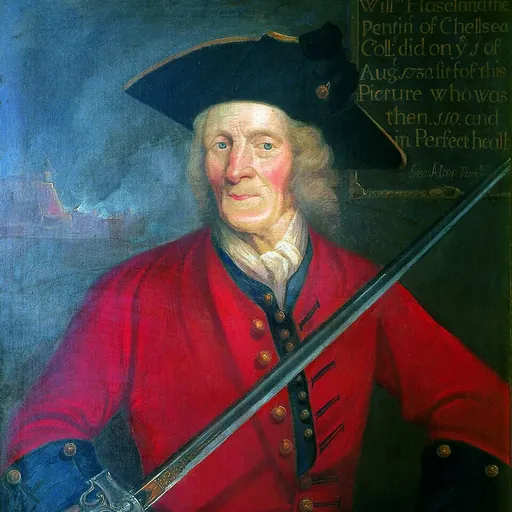
On 1 August 1730 Hiseland sat for a portrait in oils by George Alsop. This survives in the museum of the Royal Hospital.
In this instance, "1732" refers to what is now called 1733, as at that time the calendar year began on Lady Day, 25 March, and not on 1 January.
Don’t just read it —
keep it.
Full-length biographies made to live with: read them, listen on the way to work, watch them tonight.
- E-book
- Audio
- Video
Instant download · yours to keep · every purchase keeps this site free
Important facts
People in William Hiseland's life
Named in this biography and alive at the same time


Related people
Same field, nearest in time



Contemporaries
People whose lives overlapped William Hiseland's





Frequently asked questions
Who was William Hiseland?
British soldier and supercentenarian
When was William Hiseland born?
William Hiseland was born on 6 August 1620 in England.
When did William Hiseland die?
William Hiseland died on 7 February 1732.
What was William Hiseland's occupation?
William Hiseland was a soldier.
What was William Hiseland known for?
William Hiseland was known for English Civil War.
What nationality was William Hiseland?
William Hiseland was English.
Sources & further reading
Cite this page
APA: Biography.guide. (2026). William Hiseland. https://biography.guide/william-hiseland/
MLA: "William Hiseland." Biography.guide, https://biography.guide/william-hiseland/.
Chicago: "William Hiseland." Biography.guide. https://biography.guide/william-hiseland/.
Data last updated: 2026-09-23 · Spot an error? Report a correction.
Portrait: Wikimedia Commons · author & licence
Page generated 2026-09-27 05:05 UTC