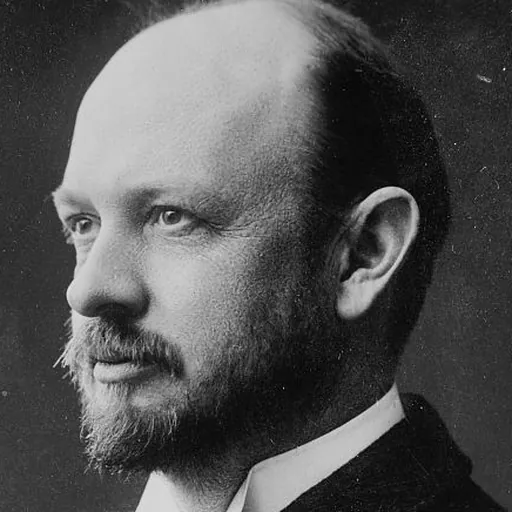
About William Henry Pickering
Lived 1858 – 1938 (aged 79). William Henry Pickering was an American astronomer.
William Henry Pickering (February 15, 1858 – January 16, 1938) was an American astronomer. Pickering constructed and established several observatories or astronomical observation stations, notably including Percival Lowell's Flagstaff Observatory. He spent much of the later part of his life at his private observatory in Jamaica.
Early life William Pickering was born on February 15, 1858, in Boston, Massachusetts. His parents were Charlotte (née Hammond) and Edward Pickering. His older brother was Edward Charles Pickering, director of the Harvard College Observatory from 1876 to 1920.
He attended secondary schools in Boston and Cambridge.
In 1887, he became an assistant professor of astronomy at the Harvard College Observatory, teaching there until 1893. In 1891, he established the Boyden astronomical station for the Harvard College Observatory in Arequipa, Peru. "Themis" was later shown not to exist.
Following George Darwin, he speculated in 1907 that the Moon was once a part of the Earth and that it broke away where now the Pacific Ocean lies. He also proposed a version of continental drift before Alfred Wegener where America, Asia, Africa, and Europe once formed a single continent, which broke up because of the separation of the Moon. In 1908, he made a statement regarding the possibility of airplanes that had not yet been invented, saying that "a popular fantasy is to suppose that flying machines could be used to drop dynamite on the enemy in time of war".
In 1919, he predicted the existence and position of a Planet X based on anomalies in the positions of Uranus and Neptune but a search of Mount Wilson Observatory photographs failed to find the predicted planet. Pluto was later discovered at Flagstaff by Clyde Tombaugh in 1930, but in any case, it is now known that Pluto's mass is far too small to have appreciable gravitational effects on Uranus or Neptune, and the anomalies are accounted for when today's much more accurate values of planetary masses are used in calculating orbits. When the planet was named, he interpreted its symbol as a monogram referring to himself and Lowell by the phrase "Pickering-Lowell".
He led solar eclipse expeditions and studied craters on the Moon, and hypothesized that changes in the appearance of the crater Eratosthenes were due to "lunar insects". He claimed to have found vegetation on the Moon in 1921.
In September 1923, he retired from Harvard University as an assistant professor emeritus. The Harvard observatory in Jamaica became his private facility where he continued his work. He was also an honorary member of the British Astronomical Association. He was a member of the Harvard Travellers’ Club and the New York Authors’ Club.
Don’t just read it —
keep it.
Full-length biographies made to live with: read them, listen on the way to work, watch them tonight.
- E-book
- Audio
- Video
Instant download · yours to keep · every purchase keeps this site free
Important facts
People in William Henry Pickering's life
Named in this biography and alive at the same time

Related people
Same field, nearest in time


Contemporaries
People whose lives overlapped William Henry Pickering's


Frequently asked questions
Who was William Henry Pickering?
American astronomer (1858–1938)
When was William Henry Pickering born?
William Henry Pickering was born on 15 February 1858 in Boston.
When did William Henry Pickering die?
William Henry Pickering died on 17 January 1938 in Mandeville.
What was William Henry Pickering's occupation?
William Henry Pickering was an astronomer.
What nationality was William Henry Pickering?
William Henry Pickering was American.
Sources & further reading
· Wikipedia: William Henry Pickering
· DBpedia: William Henry Pickering
Cite this page
APA: Biography.guide. (2026). William Henry Pickering. https://biography.guide/william-henry-pickering/
MLA: "William Henry Pickering." Biography.guide, https://biography.guide/william-henry-pickering/.
Chicago: "William Henry Pickering." Biography.guide. https://biography.guide/william-henry-pickering/.
Data last updated: 2026-09-21 · Spot an error? Report a correction.
Portrait: Wikimedia Commons · author & licence
Page generated 2026-09-27 05:00 UTC