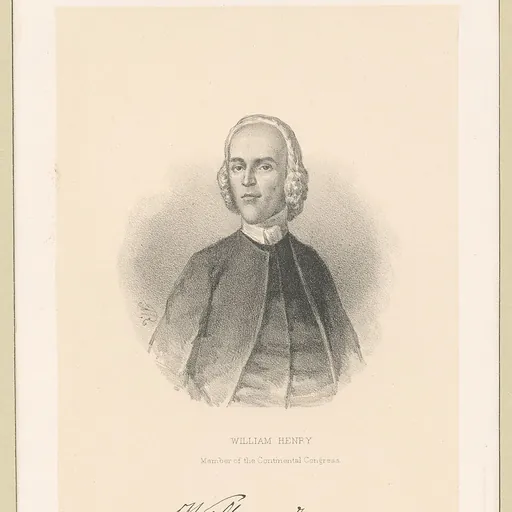
William Henry
Pennsylvania delegate to the Continental Congress
About William Henry
Lived 1729 – 1786 (aged 57). William Henry was an American judge, politician, inventor and gunsmith.
William Henry (May 19, 1729 – December 15, 1786) was an American gunsmith, engineer, politician, and merchant from Lancaster, Pennsylvania, and a delegate for Pennsylvania to the Continental Congress in 1784, 1785, and 1786. Henry is also noted for his contributions in the development of the first steam engines.
Biography William Henry was born near Downingtown, Pennsylvania to a family of Scots-Irish extraction. Prior to his service in the Continental Congress, Henry was a gunsmith and provided rifles to the British during the French and Indian War: Henry himself, serving as armorer, accompanied troops on John Forbes's successful mission to retake Fort Duquesne in 1758. By 1760, according to Scott Paul Gordon, Henry had largely abandoned his occupation of gunsmith and had become a successful ironmonger and merchant in Lancaster.
Henry later served in many positions of public responsibility, including Assistant Commissary General to the Continental Army for the district of Lancaster and, in 1779, Commissary of Hides for Pennsylvania, Delaware, and Maryland. In these positions, Henry managed vast sums of money and acquired and transferred enormous amounts of material. (He was no longer producing guns, but he did acquire them—along with shoes, hats, flour—to supply them to state and continental troops.) In 1780 Henry informed Joseph Reed that he had "laid out…between Sixty & Seventy Thousand Pound" just to "purchase Leather and Paying Workmens Wages at the Shoe-Factory" he had established "at Philadelphia, Allentown and Lancaster." His correspondence is filled with letters from Army leaders, including George Washington, begging for arms and other materials. Henry was the Treasurer of Lancaster Country for many years, a position filled by his wife, Ann Wood Henry, after Henry's death in 1786.
Henry was an intellectual who helped found Lancaster's Juliana Library-Company in 1759, which during the Revolution and after was housed in his residence, and he held membership in the American Philosophical Society in Philadelphia, whose first Transactions (1771) printed Henry's account of his invention of a "Description of a Self-Moving or Sentinel Register" to regulate the flue of a furnace. Henry invented a screw auger, manufactured and sold exclusively at his Lancaster store, and some credit him with inventing the steamboat: the twelve-year-old Robert Fulton, a Lancaster neighbor, visited Henry in 1777, who had been experimenting since 1763 on boats with steam engines on the Conestoga River (Fulton's own experiments began only in 1786 in England). Henry and his family were members of the Moravian Congregation at Lancaster.
Henry was the earliest patron of painter Benjamin West, who lodged in Henry's home in Lancaster in 1756 and painted portraits of William and Ann Henry, probably shortly after their marriage. More significantly, Henry encouraged West to paint The Death of Socrates (1756), perhaps the first history painting produced in the colonies; West credited Henry with having initiated the painter's interest in history painting, the genre for which the painter became famous.
Legacy Henry's sons carried on his gun business, in Lancaster, in Philadelphia, in Nazareth, Pennsylvania, and then in Boulton, PA. One of his sons, John Joseph Henry, served as a sixteen-year-old rifleman on Benedict Arnold's march on Quebec in the fall and winter of 1775 (he was captured and imprisoned for much of 1776), and later served as president judge of the second District in Pennsylvania from 1795 to 1811.
Don’t just read it —
keep it.
Full-length biographies made to live with: read them, listen on the way to work, watch them tonight.
- E-book
- Audio
- Video
Instant download · yours to keep · every purchase keeps this site free
Important facts
Family & relationships
People in William Henry's life
Named in this biography and alive at the same time



Related people
Same field, nearest in time


Contemporaries
People whose lives overlapped William Henry's



Frequently asked questions
Who was William Henry?
Pennsylvania delegate to the Continental Congress
When was William Henry born?
William Henry was born on 19 May 1729 in Lancaster.
When did William Henry die?
William Henry died on 15 December 1786 in Lancaster.
What was William Henry's occupation?
William Henry was a judge, politician, inventor and gunsmith.
What nationality was William Henry?
William Henry was American.
Sources & further reading
· DBpedia: William Henry (gunsmith)
Cite this page
APA: Biography.guide. (2026). William Henry. https://biography.guide/william-henry-judge/
MLA: "William Henry." Biography.guide, https://biography.guide/william-henry-judge/.
Chicago: "William Henry." Biography.guide. https://biography.guide/william-henry-judge/.
Data last updated: 2026-09-23 · Spot an error? Report a correction.
Portrait: Wikimedia Commons · author & licence
Page generated 2026-09-27 05:08 UTC