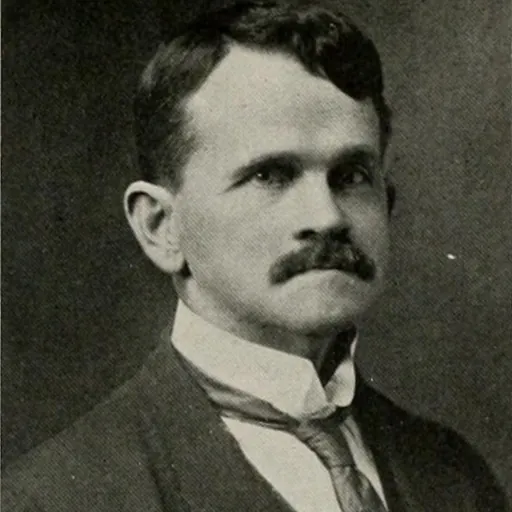
William Henry Chamberlin
American Mormon philosopher, theologian, and educator
About William Henry Chamberlin
Lived 1870 – 1921 (aged 51). William Henry Chamberlin was an American philosopher and theologian.
William Henry Chamberlin Jr. (February 12, 1870 – May 9, 1921) was an American Mormon philosopher, theologian, and educator. His teachings and writings worked to reconcile Mormonism with the theory of evolution. He taught philosophy and ancient languages as well as science and math at several Latter-day Saints (LDS) institutions including Brigham Young University in the early 20th century. He was one of four educators at Brigham Young University whose teaching of evolution and attempts to reconcile it with Mormon thought, although strongly popular with students, generated controversy among university officials and the LDS community. Chamberlin has been called "Mormonism's first professionally trained philosopher and theologian."
Biography Early life William Chamberlin was born in Salt Lake City, Utah on February 12, 1870, to parents William Henry Chamberlin and Eliza Frances Brown Chamberlin. William Jr. was the oldest of 12 children. He showed early interest in botany, geology, and mathematics. His brother Ralph Vary Chamberlin would go on to become a noted biologist and would later become embroiled with William in controversy regarding the teaching of evolution. On September 28, 1892, Chamberlin married Amelia Telle Cannon, a daughter of President George Q. Cannon, First Counselor in the First Presidency (LDS Church). William and Amelia had six children: Max Cannon, Hester, Martha, Paul, Frances, and Luke.
Mission and early career Chamberlin's early career was divided between teaching, studying, and working to support his family. He taught in public schools from 1889 to 1891, and from 1891 to 1897 he taught math, geology, and astronomy at Latter-day Saint College. He finally completed a Bachelor of Arts in science with the University of Utah in 1896. From 1897 to 1900 he served a mission in the South Pacific Society Islands where as part of his proselytizing he translated the Book of Mormon into Tahitian, and became mission president, an ordained high priest of the Church. Around the turn of the century, he donated a large collection of ferns from Utah and the South Pacific to the University of Utah's natural history museum. From 1900 to 1904, he taught science and theology at Brigham Young College, where he was Chair of Geology and Mineralogy.
Philosophy and Brigham Young years
In 1901, Chamberlin began studying philosophy at the University of Chicago. Over several years he studied philosophy with several prominent thinkers, including George Howison at U.C. Berkeley and Josiah Royce at Harvard. He earned an M.A. from the University of Chicago in 1906.
In 1909, William Chamberlin was recruited to Brigham Young University (BYU) by president George H. Brimhall, as part of an effort to increase the academic quality of his university. Two years earlier, Brimhall had recruited brothers Joseph and Henry Peterson, professors of psychology and education, as well as Chamberlin's own brother Ralph, a biologist. William Chamberlin taught philosophy and ancient languages. The Chamberlin and Peterson brothers, while devout Mormons, actively sought to increase the intellectual atmosphere of the university and community, facilitating discussion and debates on evolution and the Bible, and sought to convey that evolutionary ideas and Mormon theology were not mutually exclusive, but rather complementary. The four instructors' courses were popular among students and other faculty, but university and church officials accused the professors of promoting heretical views, and in 1911 offered the Petersons and Ralph Chamberlin a choice: alter their teachings or lose their jobs. This ignited a great deal of controversy in the school and surrounding community. The students of BYU overwhelmingly supported the professors, and a petition of support signed by at least 80% of the student body was submitted to BYU officials and reprinted in the Salt Lake Tribune, Salt Lake City's largest secular newspaper. William Chamberlin was not given the same ultimatum, but soon after the accusations he published an essay entitled "The Theory of Evolution as an Aid to Faith in God and Belief in the Resurrection" in the BYU student newspaper, whose student editors wrote "the thoughtful reading of it will well repay any student". The Petersons and Ralph Chamberlin left the university in 1911, while William remained for another 5 years, resigning in 1916.
Later years In 1917 Chamberlin began a PhD with Harvard philosopher Ralph Barton Perry, but left after one year due to poor health and financial troubles. He taught philosophy at the University of Utah from 1917 to 1920, and later at Utah State Agricultural College until his death.
Chamberlin died in Logan, Utah, following a flu infection on May 9, 1921. He was fifty-one years old.
Philosophy and theology
Chamberlin's philosophical views have been termed "spiritual realism", and are rooted in the philosophical tradition of personalism. Mormon scholar James M. McLaughlin consolidated Chamberlin's philosophical views into five major statements: Religious scholar Anthony Hutchinson labeled Chamberlin's style of biblical criticism (the academic study of the Bible) as a "critical historical and philological hermeneutic" approach, broadly characterized by acceptance of mainstream (non-LDS) biblical criticism and fluency in ancient biblical languages. According to Hutchinson, relative strengths of this approach, as compared to other LDS approaches to biblical studies, include ease of communicating with scholars of Christianity and Judaism, while relative weaknesses include a highly intellectual approach which may preclude its application to popular religious practice, and promotion of views that may be interpreted as heretical. Other LDS scholars Hutchinson grouped into this approach include Lowell L. Bennion, Sterling McMurrin, and John L. Sorenson.
In a survey of thirty-eight prominent LDS intellectuals conducted by Leonard J. Arrington in the late 1960s, Chamberlin was recognized as one of the top twelve figures in LDS intellectual history. However, Philip L. Barlow notes that Chamberlin is less well-known than other prominent LDS figures.
Don’t just read it —
keep it.
Full-length biographies made to live with: read them, listen on the way to work, watch them tonight.
- E-book
- Audio
- Video
Instant download · yours to keep · every purchase keeps this site free
Important facts
People in William Henry Chamberlin's life
Named in this biography and alive at the same time




Related people
Same field, nearest in time




Contemporaries
People whose lives overlapped William Henry Chamberlin's




Frequently asked questions
Who was William Henry Chamberlin?
American Mormon philosopher, theologian, and educator (1870–1921)
When was William Henry Chamberlin born?
William Henry Chamberlin was born on 12 February 1870 in Salt Lake City.
When did William Henry Chamberlin die?
William Henry Chamberlin died on 9 May 1921 in Logan.
What was William Henry Chamberlin's occupation?
William Henry Chamberlin was a philosopher and theologian.
What nationality was William Henry Chamberlin?
William Henry Chamberlin was American.
Sources & further reading
· Wikipedia: William Henry Chamberlin
· DBpedia: William Henry Chamberlin (philosopher)
Cite this page
APA: Biography.guide. (2026). William Henry Chamberlin. https://biography.guide/william-henry-chamberlin/
MLA: "William Henry Chamberlin." Biography.guide, https://biography.guide/william-henry-chamberlin/.
Chicago: "William Henry Chamberlin." Biography.guide. https://biography.guide/william-henry-chamberlin/.
Data last updated: 2026-09-23 · Spot an error? Report a correction.
Portrait: Wikimedia Commons · author & licence
Page generated 2026-09-27 05:05 UTC