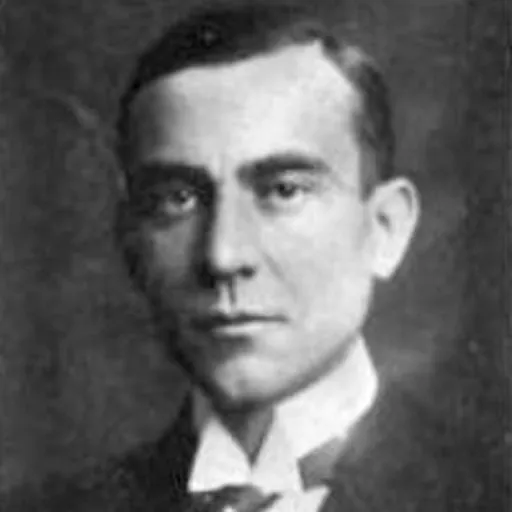
About Ralph Barton Perry
Lived 1876 – 1957 (aged 80). Ralph Barton Perry was an American author, philosopher and university teacher.
Ralph Barton Perry (July 3, 1876 – January 22, 1957) was an American philosopher. He was a strident moral idealist who stated in 1909 that, to him, idealism meant "to interpret life consistently with ethical, scientific, and metaphysical truth." Perry's viewpoints on religion stressed the notion that religious thinking possessed legitimacy should it exist within a framework accepting of human reason and social progress.
Biography Ralph Barton Perry was born in Poultney, Vermont on July 3, 1876. He was educated at Princeton (B.A., 1896) and at Harvard (M.A., 1897; Ph.D., 1899), where, after teaching philosophy for three years at Williams and Smith colleges, he was instructor (1902–05), assistant professor (1905–13), full professor (1913–30) and Edgar Pierce Professor of Philosophy (1930–46). He was president of the American Philosophical Association's eastern division in 1920–21. He was elected to the American Academy of Arts and Sciences in 1928 and the American Philosophical Society in 1939.
A pupil of William James, whose Essays in Radical Empiricism he edited (1912), Perry became one of the leaders of the New Realism movement. Perry argued for a naturalistic theory of value and a New Realist theory of perception and knowledge. He wrote a celebrated biography of William James, which won the 1936 Pulitzer Prize for Biography or Autobiography, and proceeded to a revision of his critical approach to natural knowledge. An active member among a group of American New Realist philosophers, he elaborated around 1910 the program of new realism. While his work continued to display the influence of William James, Perry increasingly advocated a more humanistic spirituality. Perry was an advocate of a militant democracy: in his words "total but not totalitarian". Puritanism and Democracy (1944) is a famous wartime attempt to reconcile two fundamental concepts in the origins of modern America. Between 1946 and 1948, he delivered in Glasgow his Gifford Lectures, titled Realms of Value.
He married Rachel Berenson on August 15, 1905, and they lived in Cambridge, Massachusetts.
Selected publications The Approach to Philosophy (1905), New York, Chicago and Boston: Charles Scribner's Sons The Moral Economy (1909), New York: Charles Scribner's Son Present Philosophical Tendencies: A Critical Survey of Naturalism, Idealism, Pragmatism, and Realism, together with a Synopsis of the Philosophy of William James (1912), New York:Longmans, Green & Co. Holt, EB; Marvin, WT; Montague, WP; Perry, RB; Pitkin, WB; Spaulding, EG, The New Realism: Cooperative Studies in Philosophy (1912), New York: The Macmillan Company The Free Man and the Soldier (1916), New York: Charles Scribner's Sons The Present Conflict of Ideals: A Study of the Philosophical Background of the World War (1918), New York: Longmans, Green & Co. Annotated Bibliography of the Writings of William James (1920), Longmans, Green & Co. The Plattsburg movement: A Chapter of America's Participation in the World War (1921), New York: E.P. Dutton & company A Modernist View of National Ideals (1926) Berkeley: University of California Press, Howison Lectures in Philosophy, 1925 General Theory of Value (1926) Philosophy of the Recent Past: An Outline of European and American Philosophy Since 1860 (1926), New York: Charles Scribner's Sons The Hope for Immortality (1935) The Thought and Character of William James, 2 vols. (1935) Plea for an Age Movement (1942) New York: The Vanguard Press [Talk at 1941 Princeton and Harvard Reunions] Puritanism and Democracy (1944) Characteristically American: Five Lectures Delivered on the William W. Cook Foundation at the University of Michigan, November–December 1948 (1949), New York: Alfred A. Knopf, 1949 Realms of Value (1954), Harvard University Press [Based on Gifford Lectures] The Humanity of Man (1956), New York: George Braziller "A Definition of morality". In P. W. Taylor (Ed.), Problems of moral philosophy: an introduction to ethics (pp. 13–24). Belmont, CA: Dickenson, 1967
Don’t just read it —
keep it.
Full-length biographies made to live with: read them, listen on the way to work, watch them tonight.
- E-book
- Audio
- Video
Instant download · yours to keep · every purchase keeps this site free
Important facts
People in Ralph Barton Perry's life
Named in this biography and alive at the same time


Related people
Same field, nearest in time




Contemporaries
People whose lives overlapped Ralph Barton Perry's

Frequently asked questions
Who was Ralph Barton Perry?
American philosopher (1876–1957)
When was Ralph Barton Perry born?
Ralph Barton Perry was born on 3 July 1876 in Poultney.
When did Ralph Barton Perry die?
Ralph Barton Perry died on 22 January 1957 in Boston, Cambridge.
What was Ralph Barton Perry's occupation?
Ralph Barton Perry was an author, philosopher and university teacher.
What nationality was Ralph Barton Perry?
Ralph Barton Perry was American.
Sources & further reading
· Wikipedia: Ralph Barton Perry
Cite this page
APA: Biography.guide. (2026). Ralph Barton Perry. https://biography.guide/ralph-barton-perry/
MLA: "Ralph Barton Perry." Biography.guide, https://biography.guide/ralph-barton-perry/.
Chicago: "Ralph Barton Perry." Biography.guide. https://biography.guide/ralph-barton-perry/.
Data last updated: 2026-09-21 · Spot an error? Report a correction.
Portrait: Wikimedia Commons · author & licence
Page generated 2026-09-27 04:58 UTC