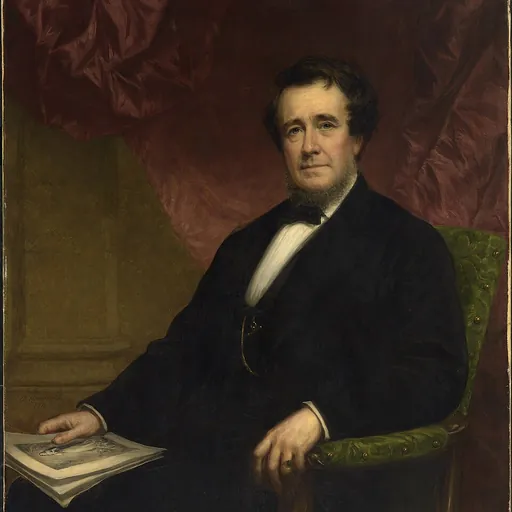
About William Henry Aspinwall
Lived 1807 – 1875 (aged 67). William Henry Aspinwall was an American civil engineer.
William Henry Aspinwall (December 16, 1807 – January 18, 1875)
Aspinwall was descended from, and related to, many prominent American families including the Roosevelts, Howlands, and Aspinwalls, that were heavily involved in the merchant trade business and politics, wielding vast power and ensuring wealth for generations. His father, who traveled extensively, His younger sister, Mary Rebecca Aspinwall (1809–1886) was married to Isaac Roosevelt, the grandfather of U.S. President Franklin D. Roosevelt. His maternal aunt, Harriet Howland, was the third wife of Isaac's father, New York State Assemblyman James Roosevelt. His cousin, Emily Aspinwall Howland, daughter of Samuel Shaw Howland, was married to Henry Chauncey, the son of Henry Chauncey, Esq., of Alsop & Chauncey in Valparaíso, and Lucy Wetmore Alsop, the grandniece of Continental Congressman John Alsop.
His paternal grandfather, Captain John Aspinwall, was one of the most prominent shipmasters of the New York merchant marine before the American Revolutionary War. He was a member of the Aspinwall family who were well known in New York society and were descended from William Aspinwall, who was among the first settlers of New England. Another relation, Sir Algernon Aspinall, served as vice president and secretary of the West India Committee for forty years.
Career
After obtaining a "substantial education" at local private schools, from China, and sold them to Americans of means.
Howland & Aspinwall In 1832, he became a partner in Howland & Aspinwall, along with his cousin William Edgar Howland, the son of founder Gardiner Howland. After assuming the presidency in 1835, he expanded trade to South America, China, Europe, the Mediterranean, and the East and West Indies. Howland & Aspinwall owned some of the most famous clipper ships ever built. In 1845, while the firm owned the Ann McKim which was regarded as the fastest ship afloat, it built the Rainbow, which was even faster. The Rainbow was the high-tech racehorse of its day, and is considered to be the first of the extreme clippers. Instead of the bluff bow that was customary on ships up until that time, the Rainbow had a sharp bow, prompting on-lookers to joke that maybe she would sail better backwards. The next year, Howland & Aspinwall had the Sea Witch built, which set a speed record from China to New York which stood until 2013.
Clipper ships sacrificed cargo capacity for speed, but in some markets, the fast service allowed their owners to charge premium rates (Tea from China tasted better if it was fresh, so the cargo on the first ship of the season to arrive in New York was worth more). Also faster speed meant that the vessel could complete more voyages in a given time period, which also helped make up for the diminished cargo capacity. The firm and its profits made Aspinwall very wealthy, reportedly one of the richest men on the East Coast in the nineteenth century.
Pacific Mail Steamship Company In 1840s, William's younger brother John Lloyd Aspinwall succeeded him as president of Howland & Aspinwall so he could devote his time to transportation around the Isthmus of Panama. This turned out to be a rather good year in which to start a steamship line to California, since the Gold Rush started the next year. Howland & Aspinwall were also the recipients of a federal government subsidy to operate their trans-oceanic steamship line, against which they were forced to compete with the unsubsidized line owned by Cornelius Vanderbilt. The company's first vessel to make the trip was packed with passengers. Pacific Mail eventually became American President Lines, which is now part of Neptune Orient Lines.
Panama Canal Railway Following the Steamship Company, Aspinwall then promoted a railway in Panama. The project, which began in May 1850 and was later known as the Panama Canal Railway, was the first transcontinental railroad in the Americas and was built to provide a shorter and more secure path between the United States' East and West Coasts. When completed in 1855, the line was designated as an "inter-oceanic" railroad crossing as it connected ports on the Atlantic and Pacific Oceans. The tropical rain forest terrain and outbreak of malaria and cholera, rendered its five-year construction, at a cost of $8,000,000, a considerable engineering challenge, and required more than seven thousand workers drawn from "every quarter of the globe."
Later life and Civil War involvement Aspinwall retired in 1856, but remained active as a philanthropist and spent considerable time improving his country estate near Tarrytown, New York,
Personal life In 1830, Aspinwall was married to Anna Lloyd Breck (1812–1885). She was the daughter of Catherine Douce (née Israel) Breck (1789–1864) and George Breck (1784–1869), the brother of U.S. Representatives Samuel Breck and Daniel Breck. Anna was the sister of Rev. James Lloyd Breck, an Episcopal missionary, Together, William and Anna were the parents of:
Anna Lloyd Aspinwall (1831–1880), who in 1850 married architect James Renwick Jr. (1818–1895), the son of Margaret Brevoort and James Renwick, an engineer, architect, and professor at Columbia College. Rev. John Abel Aspinwall (1840–1913), who married Julia Titus (1841–1876). After her death, he married Bessie Mary Reed (1843–1915) Louisa Aspinwall (1843–1913), who married John Wendell Minturn (1839–1881), the son of merchant Robert Bowne Minturn Katharine Aspinwall (1847–1924), who married Ambrose Cornelius Kingsland (1835–1890), the son of New York Mayor Ambrose Kingsland.
William Henry Aspinwall died of a myocardial infarction on January 18, 1875, in Manhattan. He was buried at Green-Wood Cemetery in Brooklyn, New York.
Furthermore, William Henry Aspinwall's great-grandson was New York-based architect Henry Titus Aspinwall (1895–1979).
Legacy The town of Aspinwall, Panama (now Colón), founded in 1850 and named after Aspinwall, on the on the western end of a treacherously marshy islet covered with mangrove trees, known as Manzanillo Island.
Don’t just read it —
keep it.
Full-length biographies made to live with: read them, listen on the way to work, watch them tonight.
- E-book
- Audio
- Video
Instant download · yours to keep · every purchase keeps this site free
Important facts
Family & relationships
People in William Henry Aspinwall's life
Named in this biography and alive at the same time


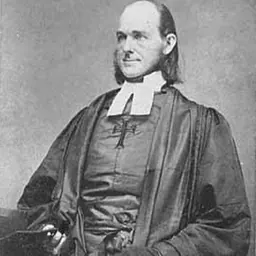
Related people
Same field, nearest in time



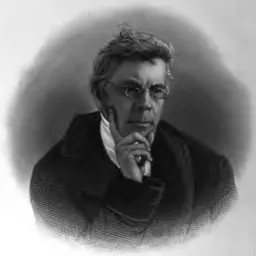
Contemporaries
People whose lives overlapped William Henry Aspinwall's





Frequently asked questions
Who was William Henry Aspinwall?
American businessman (1807-1875)
When was William Henry Aspinwall born?
William Henry Aspinwall was born on 16 December 1807 in Manhattan.
When did William Henry Aspinwall die?
William Henry Aspinwall died on 18 January 1875 in Manhattan.
What was William Henry Aspinwall's occupation?
William Henry Aspinwall was a civil engineer.
What nationality was William Henry Aspinwall?
William Henry Aspinwall was American.
Sources & further reading
· Wikipedia: William Henry Aspinwall
· DBpedia: William Henry Aspinwall
Cite this page
APA: Biography.guide. (2026). William Henry Aspinwall. https://biography.guide/william-henry-aspinwall/
MLA: "William Henry Aspinwall." Biography.guide, https://biography.guide/william-henry-aspinwall/.
Chicago: "William Henry Aspinwall." Biography.guide. https://biography.guide/william-henry-aspinwall/.
Data last updated: 2026-09-22 · Spot an error? Report a correction.
Portrait: Wikimedia Commons · author & licence
Page generated 2026-09-27 05:00 UTC