
William Grinly
British solider, merchant, and mariner
About William Grinly
Lived 1748 – 1827 (aged 78–79). William Grinly was a ship broker and shipowner.
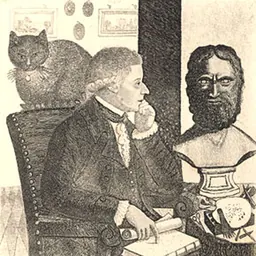
William 'Spread Eagle' Grinly (also Grinley, Grindley or Grindlay) (1748 – 1827) was a British soldier, merchant, and mariner during the 18th and 19th centuries, known for his often distinctive dress and flamboyant character.
Life and family
Early years Grinly was born in Borrowstounness, near Edinburgh in 1748, to a prominent seafaring family. His father and all three of his brothers were shipowners and shipmasters, and as a young man he travelled extensively as part of the family merchant shipping business, including going supercargo to Holland, France, Spain, Russia, and America. Although there only 2 years, his activities resulted in him being awarded the Freedom of the City of Cork on 7 June 1781, before he again relocated back to Scotland. In 1797, he was one of the 120 sea captains who volunteered to fight with the Royal Navy during the French Revolutionary and Napoleonic Wars,
In the last years of his life he went entirely blind and had to be escorted at all times when outside. He died in 1827 aged 80, survived by his second wife, and his remains were interred in the family burial ground at South Leith Church.
Notable anecdotes Several notable quotations and anecdotes were attributed to Grinly throughout his life, some of which were captured by John Kay in his A Series of Original Portraits and Caricature Etchings. Many of those recorded took place in the law courts and auction houses of Leith and Edinburgh.
"If I thought there was a better made man in Leith...", said Grinly apparently highly offended "...I would go hang myself!"– Stated while stood atop a pile of wooden logs on the shore of Leith port, in response to a group of porters in his employment who suggested 'The Doctor', another gentleman afforded one of Mr McLean's soubriquets, was more handsome than he.
"Your name is William Grinly?", "It is, my lord.", "You are a merchant in Leith?", "I am, my lord.", Do you know the prisoner at the bar?", "I do. He was often employed by me, and usually had the keys of my yard in his possession all night.", "Did you ever miss any goods out of your yard when he had the charge?", "Never, my lord!" was his emphatic reply.– A courtroom exchange with the judge presiding over the trial of Mr Brown, a carter, committed on suspicion of stealing from the yard of a Mr Crawford. The case drew much interest across Leith due to Mr Brown's long confinement, poor health, and prepossessing appearance. The evidence of Mr. Grinly was said to have been the only means of saving the culprit's life. Brown was duly acquitted, and Grinly left the court to much applause.
"Your name is William Grinly?", "It is my lord.", "You are a merchant in Leith?", "I am not my lord" in a tone and gesture that attracted all eyes, "You are here set down merchant in Leith", "My lord..." said Grinly, archly smiling as he made use of the legal phrase "...that is quite a misnomer!"– Made from the witness box while giving evidence in a case against the Hull Shipping Company for non delivery of goods. The conversation was followed by hearty, involuntary laughter from both Grinly and the entire courtroom. He politely acknowledged the appreciation with a bow and complacently resumed his position.
"Sir, I challenge you to exchange pistols with me at the back of the wall.", "Hurry home...," said Grinly, "...and make your last testament. You will have no chance with me—a soldier!—a Leith Volunteer!"– An argument with a wealthy tradesman from Edinburgh, who in a violent temper, upon seeing a choice article of his sold to a rival for a low price, challenged Grinly as auctioneer to a duel. Following the rebuff from Grinly, the tradesman made his exit amid raucous laughter. The following day Grinly received a letter of apology and an accompanying gold headed walking cane from the tradesman.
"O, most certainly—go away!", "Go away!"– Pronounced by the judge of a case to which Grinly had been summoned as a juryman. The date for trial had clashed with that of the sale of a considerable sum of expensive sugars by a Mr Sibbald, in which he was to act as auctioneer. Torn between the juror's fine or the loss of the sale, at the opening of proceedings Grinly immediately feigned sudden urgent illness and requested to leave, which when granted by the judge allowed him to avoid both. Grinly made the sale in good time and without fine. He was known to afterwards boast that he had "proved a match for the law".
Don’t just read it —
keep it.
Full-length biographies made to live with: read them, listen on the way to work, watch them tonight.
- E-book
- Audio
- Video
Instant download · yours to keep · every purchase keeps this site free
Important facts
People in William Grinly's life
Named in this biography and alive at the same time
Contemporaries
People whose lives overlapped William Grinly's






Frequently asked questions
Who was William Grinly?
British solider, merchant, and mariner (1748 – 1827)
When was William Grinly born?
William Grinly was born in 1748 in Borrowstounness, Linlithgowshire.
When did William Grinly die?
William Grinly died in 1827 in Edinburghshire, Leith.
What was William Grinly's occupation?
William Grinly was a ship broker and shipowner.
Sources & further reading
Cite this page
APA: Biography.guide. (2026). William Grinly. https://biography.guide/william-grinly/
MLA: "William Grinly." Biography.guide, https://biography.guide/william-grinly/.
Chicago: "William Grinly." Biography.guide. https://biography.guide/william-grinly/.
Data last updated: 2026-09-22 · Spot an error? Report a correction.
Page generated 2026-09-27 04:59 UTC