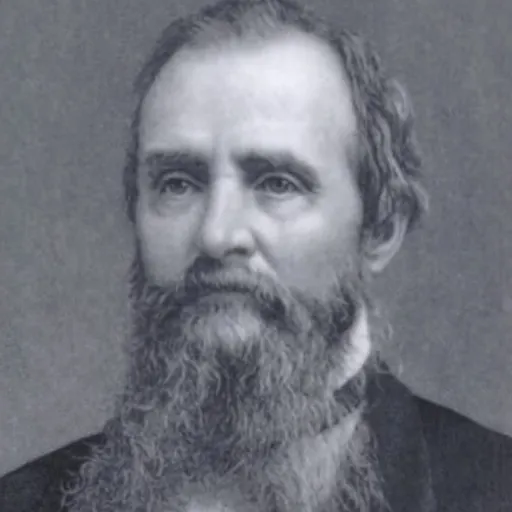
William Giles Harding
American general and planter
About William Giles Harding
Lived 1808 – 1886 (aged 77–78). William Giles Harding was an American.
William Giles Harding (1808 – December 15, 1886) was a Southern planter, attorney, and horse breeder who was made a Brigadier General in the Tennessee militia before the American Civil War. He took over operations of Belle Meade Plantation near Nashville from his father in 1839. During the course of his management, he acquired more property, expanding it from 1300 acres to in 1860. He specialized in breeding and raising Thoroughbred horses, as well as other purebred livestock. In 1862 after Union forces took over Nashville, Harding was arrested as a leader and imprisoned at Fort Mackinac in northern Michigan on Mackinac Island for six months. He was released on a $20,000 bond. After being imprisoned at Fort Mackinac, he took the oath of allegiance to the Union and did not take an active part in the conflict from 1862 onwards.
Following his daughter Selene's marriage to William Hicks Jackson, Harding collaborated with his son-in-law to co-manage the Belle Meade plantation through much of the late 19th century. It flourished as a center for high-quality racehorses and other livestock. After Jackson's death in 1903, the executor of the estate sold most of the plantation to a land development company in 1906 because of debt. Development from 1938 created a residential suburb known as the independent city of Belle Meade, Tennessee, near Nashville.
Used as a private residence until 1953, the mansion, with 30 acres and associated outbuildings, was bought by the state for preservation. This property is now operated as a museum known as Belle Meade Plantation, and is listed on the National Register of Historic Places.
Early life William Giles Harding was born in 1808 near Nashville, Tennessee to John Harding, a Virginian, who one year earlier (1807) purchased near Richland Creek. He was educated at the old University of Nashville, the Partridge's American Literary, Scientific and Military Academy at Norwich University, Northfield, VT, and he studied law in Litchfield, Connecticut. His father was working with some of the enslaved from Belle Meade in Mississippi County, Arkansas, where at the age of 60 he was developing a 10,000-acre cotton plantation near Plum Point Bend along the Mississippi River.
In 1840 the widower Harding married Elizabeth McGavock, daughter of Randal McGavock, a former mayor of Nashville.
While Harding raced some of his horses, he was most interested in the practice of breeding high-quality blood stock. He also raised purebred cattle, sheep, and cashmere goats.
While he was imprisoned, Elizabeth Harding worried about supporting all the people at Belle Meade. In addition to her own family of three, her sister Mary McGavock Southall; stock manager William Hague; farm manager James Beasley and his family of seven; Rachael Noris, a free mulatto woman; and 137 enslaved were all living at Belle Meade. Harding was released on $20,000 bond and returned to Nashville.
People He Enslaved According to the Nashville Public Library’s Enslaved and Free People of Color Database, Giles Harding is recorded as having enslaved the following people. Their ages, when known, and the year the record was created are included.
Hannah – 1803 Tom – 1803 Dick – 1803 Cate – 1803 Davy – 1803 Ellick – 1803 Sylvia – 1803 George – 1803 Hanner – 1803 Nancy – 1803 Sam – 1803 Tamer – 1803 Will – 1803 Nelly – 1803 Bob – 1803 Bet – 1803 Charlotte – 1803 Moses – 1803 Harry – 1803 Rachel – 1803 Sarah – 1803 Frank – 1803 Abram – 1803 Patience – 1803 Joe – 1803 Charles – 1803 Maria – 1803 Little Bob – 1803 Jack – 1803 Jenny – 1803 Venus – 1803 Isaac – 1803 Peter – 1803 Daniel – 1803 Henry – 1803 Polly – 1803 Jude – 1803 Peggy – 1803 William – 1803 Nancy (16) – 1804 John – 1804 Moses – 1804 Matilda – 1804 Kitty – 1804 Phil – 1804 Solomon – 1804 Lucy – 1804 Simon – 1804 Sukey – 1804 Dinah – 1804 Peggy – 1804 Mary – 1804 Tom – 1804 Jenny – 1804 Ellick – 1804 Frank – 1804 Harry – 1804 Charlotte – 1804
Personal life In 1829 Harding married Mary Selena McNairy, and they had a son, John Harding II. She died in 1837 in the yellow fever epidemic that affected much of the region.
His older brother was Howell Edmunds Jackson, an attorney and politician. After Howell's first wife Sophia Malloy died in 1873, perhaps in the cholera epidemic, Howell also married into the Harding family: to Mary Elizabeth, Selene's sister. He worked with his brother on the horse breeding operation. He was elected by the state legislature to serve as United States Senator from Tennessee, serving from 1881 to 1886. Later in life, he was appointed as a Justice of the Supreme Court of the United States, serving from 1893 to 1895.
Death and legacy Harding died on December 15, 1886. His obituary in the Chattanooga Times Free Press called him 'a monarch in his own domain'. His first wife, Sophia W. Merritt, whom he married in 1853, died in 1855. Selene (Harding) and her husband General William Hicks Jackson (1835–1903). They had a son named William Harding Jackson Sr. (1874–1903), who married Anne (Davis) Richardson (1897–1950). They also had a daughter named Selene Harding Jackson (1876–1913), who married William Robert Elliston. She was known as Selene Elliston.
"Red" Jackson and his brother Howell took over co-management of the Belle Meade Plantation. "Red" Jackson later bought out his brother's interest.
In 1903, after William Harding Jackson Sr. died following his father, his son William Harding Jackson (1901–1971) and daughter Selene (Jackson) Elliston inherited the Belle Meade Estate. James B. Richardson, Jackson's maternal grandfather, was named Executor of the estate. He sold the plantation in 1906 because of debt. The younger Jackson became an attorney who served in US Army intelligence during World War II and contributed to the formation of the CIA, modeled after the British OSS. He later served as the deputy director of the Central Intelligence Agency from October 7, 1950, to August 3, 1951, under President Harry S. Truman and as U.S. National Security Advisor to President Dwight D. Eisenhower in 1956.
Much of the large former Belle Meade plantation was developed as a residential suburb by a land company, starting in 1938; today that area is called Belle Meade and is an independent city. The mansion and 30 acres were reserved for use as a private residence until 1953, when it was purchased by the state of Tennessee. It is now operated as a museum and event space known as Belle Meade Plantation and was listed on the National Register of Historic Places.
Don’t just read it —
keep it.
Full-length biographies made to live with: read them, listen on the way to work, watch them tonight.
- E-book
- Audio
- Video
Instant download · yours to keep · every purchase keeps this site free
Important facts
Family & relationships
People in William Giles Harding's life
Named in this biography and alive at the same time



Contemporaries
People whose lives overlapped William Giles Harding's






Frequently asked questions
Who was William Giles Harding?
American general and planter (1808–1886)
When was William Giles Harding born?
William Giles Harding was born in 1808 in Nashville, Belle Meade.
When did William Giles Harding die?
William Giles Harding died on 15 December 1886 in Nashville.
What nationality was William Giles Harding?
William Giles Harding was American.
Sources & further reading
· Wikipedia: William Giles Harding
· DBpedia: William Giles Harding
Cite this page
APA: Biography.guide. (2026). William Giles Harding. https://biography.guide/william-giles-harding/
MLA: "William Giles Harding." Biography.guide, https://biography.guide/william-giles-harding/.
Chicago: "William Giles Harding." Biography.guide. https://biography.guide/william-giles-harding/.
Data last updated: 2026-09-22 · Spot an error? Report a correction.
Portrait: Wikimedia Commons · author & licence
Page generated 2026-09-27 05:00 UTC