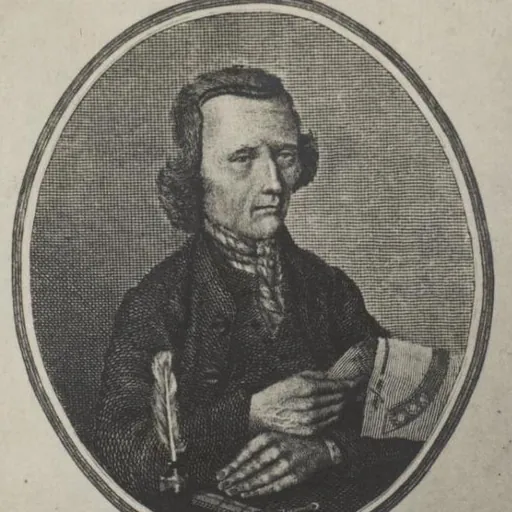
About William Edwards
Lived 1719 – 1789 (aged 70). William Edwards was a British and Welsh architect, farmer and engineer.
William Edwards (February 1719 – 7 August 1789) was a Welsh Methodist minister who also practised as a stonemason, architect and bridge engineer.
Edwards was born the son of Edward David in Eglwysilan, Caerphilly County Borough in a small farmhouse, and began preaching in his early twenties. In 1745, he became joint pastor of a newly established Independent chapel at Groeswen, remaining in the post until his death.
He taught himself the rudiments of masonry and at the age of 27 was commissioned to build a bridge over the Taff for £500 and to maintain it for 7 years. After several attempts he succeeded and went on to build further bridges across south Wales.
On his death, he was buried in St Ilan's church in Eglwysilan, where his tomb is a grade II* listed structure.
Three of his sons (Thomas, David and Edward) also became bridge builders, two of whom built Newport bridge in 1801. A fourth son (William) was killed in action at Gibraltar.
Early life
His father died when he was only two years old. William was brought up by his mother. Edwards' first employment was common farm work. But at the same time he was taking lessons in arithmetic from a neighbor in the evenings. Edwards soon become so expert in dry-stone wall building that he was extensively employed in repairing and building dry-stone walls for the neighboring farmers. His walls were observed to be so neat that he was everywhere in request.
Career
In 1746, when it was proposed to throw a bridge over river Taff, he was employed to build it. However, Edwards had not sufficiently provided for the passage of the floods, which in certain seasons rush down from the Brecon Beacons. It proved to be a serious obstruction in the way of a heavy flood which swept down the valley about two years and a half after the bridge had been completed. Trees were torn up by the roots and carried down the stream and dammed the torrent. Force finally swept away arches and piers together, carrying the materials far down the river. Edward's second bridge was a failure because of daring experimentation. His friends generously came forward and helped him with the means of building his third bridge, which proved a complete success. The plan which he adopted, of more equally balancing the work and relieving the severe thrust upon the haunches, was to introduce three cylindrical holes or tunnels in the masonry at those parts of the bridge.
c. 1740 Forge at Cardiff 1746–1756 Old Bridge, Pontypridd. 1 arch, 140 ft span. 1746–1752 Usk Bridge, Usk. 5 arches. Widened 1856. ? Beaufort Bridge. 3 arches. Demolished 1868. ? Pontardawe Bridge. 1 arch, 80 ft span. ? Betws Bridge. 1 arch, 45 ft span. 1760s Workshops at Morriston c. 1768 Aberafan Bridge, 1 arch, 70 ft span. Demolished 1842. c. 1768 Morriston new town. 1773 Dolauhirion Bridge. 1 arch, 84 ft span. Built by son Thomas Edwards. 1777 Glasbury Bridge. 7 arches. Built by son Thomas Edwards. Destroyed by flood, 1895. 1778 Wychtree Bridge. 1 arch, 95 ft span. Demolished 1959. 1779 New Bridge, Newbridge-on-Usk. 1782 Chapel of Libanus, Morriston (part-time) 1787 Cenarth Bridge, Carmarthenshire. Built by David. 1794 Usk Bridge, Brecon, widened by Thomas.
Literature Colvin H. A. (1995) Biographical Dictionary of British Architects 1600–1840, Yale University Press, 3rd edition London, 336–337. Provides listing of his work with references to further articles about Edwards.
Don’t just read it —
keep it.
Full-length biographies made to live with: read them, listen on the way to work, watch them tonight.
- E-book
- Audio
- Video
Instant download · yours to keep · every purchase keeps this site free
Important facts
People in William Edwards's life
Named in this biography and alive at the same time
Related people
Same field, nearest in time



Contemporaries
People whose lives overlapped William Edwards's





Frequently asked questions
Who was William Edwards?
Welsh architect
When was William Edwards born?
William Edwards was born on 1 February 1719 in Eglwysilan, Glamorgan.
When did William Edwards die?
William Edwards died on 7 August 1789 in Wales.
What was William Edwards's occupation?
William Edwards was an architect, farmer and engineer.
What nationality was William Edwards?
William Edwards was British and Welsh.
Sources & further reading
· DBpedia: William Edwards (architect)
Cite this page
APA: Biography.guide. (2026). William Edwards. https://biography.guide/william-edwards-architect/
MLA: "William Edwards." Biography.guide, https://biography.guide/william-edwards-architect/.
Chicago: "William Edwards." Biography.guide. https://biography.guide/william-edwards-architect/.
Data last updated: 2026-09-22 · Spot an error? Report a correction.
Portrait: Wikimedia Commons · author & licence
Page generated 2026-09-27 05:03 UTC