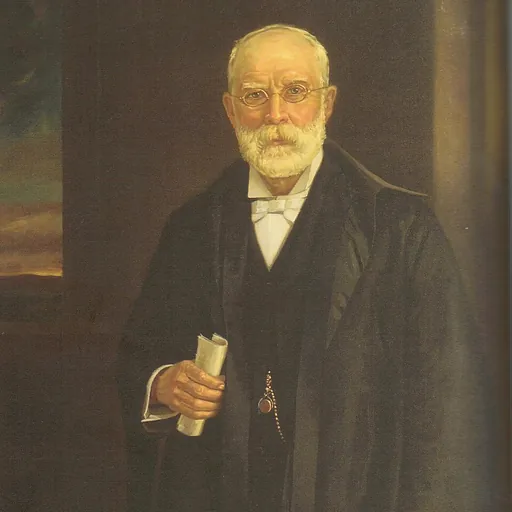
William Eakin
Canadian politician
About William Eakin
Lived 1828 – 1918 (aged 89). William Eakin was a Canadian.
William Eakin (June 14, 1828 – March 14, 1918) was a farmer and political figure in the Northwest Territories, Canada. He was a member and speaker of the Legislative Assembly of the Northwest Territories.
He was born at Markham Township in 1828, the son of a wagon maker and merchant. After attending school, he joined his family business, remaining there until purchasing and starting businesses of his own: a carriage making company and later a planing mill where he made a variety of items, along with his brother. Eakin later sold his plant and moved west to homestead and farm near Crescent Lake. Here he involved himself in local affairs, eventually winning election to the Legislative Assembly of the Northwest Territories for the district of Saltcoats, serving from 1894 to 1902. His term involved negotiations with the Government of Canada for provincial status for the Northwest Territories. For the latter three years of his term, he was selected to serve as speaker of the assembly, serving until his retirement in 1902 at the age of 73. After his retirement he eventually moved to Saltcoats, where he died in 1918 at the age of 89.
Early life, education and career Eakin was born June 14, 1828 in Markham Township, York County, Upper Canada, the eldest of six children to Samuel Baxter Eakin, wagon maker, farmer and merchant and Elizabeth Pingle, of Irish and Danish descent. He also served in the military, receiving his commission as ensign with the Unionville Company of the 12th York Battalion of Infantry in 1866 and retiring from the military in 1872. In the 1850s, he joined his father's business as a wagon maker, where he worked in the family's business. He bought a sawmill in 1854 that was later converted into a carriage manufacturing shop. In 1873, along with his brother, George, Eakin built a planing mill near a new Canadian Pacific Railway line, where they manufactured doors, sashes, wagons, carriages, agricultural implants, cabinets, furniture, and coffins. Known as the Unionville Planing Mill, it was eventually leased out in 1874 and sold in 1881.
Early political activities
In addition to his manufacturing business, Eakin also served an active role in politics while he was living in Markham. He served as a councillor on the Markham Township Council on three separate occasions: 1867, 1871 and 1872, After spending time with the Reform Association of York, Eakin was appointed Warden of the County of York in 1881. He also served on the public works commission of that same county.
Eakin relocated to the North-West Territories in 1883; he set up homestead at Crescent Lake, near Saltcoats, Saskatchewan and worked for the Saskatchewan Land and Homestead Company. He was one of the first European settlers in the area. Two years later he was appointed as a justice of the peace, and later as a licence and affidavit commissioner. When a school system was established in the area in 1887, the Eakin residence served as one of the first classrooms, with William Eakin receiving $1 per month as rent.
In the opening of the 1899 legislative session, Eakin was nominated by premier Frederick Haultain and member Robert Brett to serve in the post as speaker. Praised by his colleagues for his fairness, even temperament and knowledge, he was elected as speaker later that session by his legislative colleagues. Assuming the office at the age of 70, the predominant issues of the session were again those of provincial status for the North-West Territory, and whether boundaries would be drawn to include one or two provinces. Though nominated to serve as speaker once again, Eakin opted to retire due to his health and age. Aged 89, he was later buried at the Saltcoats Cemetery. His wife died later in the year, on September 9, 1918.
Personal life In 1853, Eakin married Margaret Hunter, daughter of Alexander and Lucy Hunter of Markham Township. Alexander Hunter was also active in Markham Township affairs, serving on the town council and as a deputy reeve in 1852. Eakin and his wife had six children; five daughters and one son, Elizabeth, Otelia, Edna, Nella, Margaret, and Gordon. In Markham Township, Eakin was a member and president of the Markham and East York Agricultural Society. In his spare time, he was an avid reader and gardener. He was one of the first members of the Saltcoats Presbyterian Church when it was founded in 1890. At church, he was active in the choir. In the early 1900s, his speaker's chair in the legislature was donated to the Saltcoats Canadian Legion by Saskatchewan Premier Thomas MacNutt.
Don’t just read it —
keep it.
Full-length biographies made to live with: read them, listen on the way to work, watch them tonight.
- E-book
- Audio
- Video
Instant download · yours to keep · every purchase keeps this site free
Important facts
People in William Eakin's life
Named in this biography and alive at the same time



Contemporaries
People whose lives overlapped William Eakin's




Frequently asked questions
Who was William Eakin?
Canadian politician (1828-1918)
When was William Eakin born?
William Eakin was born on 14 June 1828 in Markham.
When did William Eakin die?
William Eakin died on 14 March 1918 in Saltcoats.
What nationality was William Eakin?
William Eakin was Canadian.
Sources & further reading
Cite this page
APA: Biography.guide. (2026). William Eakin. https://biography.guide/william-eakin/
MLA: "William Eakin." Biography.guide, https://biography.guide/william-eakin/.
Chicago: "William Eakin." Biography.guide. https://biography.guide/william-eakin/.
Data last updated: 2026-09-20 · Spot an error? Report a correction.
Page generated 2026-09-27 05:09 UTC