
About William Dimond
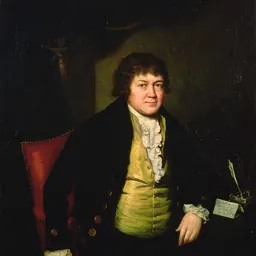
Lived 1750 – 1812 (aged 61–62). William Dimond was a British actor, theatre manager and writer.
William Wyatt Dimond (1750 – 2 January 1812) was an actor and theatre manager of the late 18th-century whose career was largely based in Bath in Somerset.
Early career The Monthly Mirror for May 1808 made a number of fanciful claims about the origin and childhood of Dimond, perhaps based on information supplied by Dimond himself; it claimed that he had been born in London and that while young his father had died leading his mother to remarry to a naval officer. It further added that Dimond had been sent as a boarder to Richmond Grammar School where he received the rudiments of a classical education and where he remained until the age of 15 when it was claimed a commission was purchased for him in the British Army. The Monthly Mirror stated that his mother not wishing him to go with his regiment to the West Indies she persuaded him to resign his commission. Dimond was then apprenticed as a chaser, the artist William Hogarth having served a similar apprenticeship about 50 years before. But where Hogarth was content to paint actors Dimond was determined to be one. According to the actor-manager Tate Wilkinson, Dimond's good manners and easy-going personality gave him the attitude of a gentleman and he resolved for a career on the stage. His first known theatrical appearance was made anonymously as a 'Young Gentleman, first appearance on any stage' when claiming to be aged 19 he played Romeo in Romeo and Juliet In his diary the theatre's prompter William Hopkins wrote of Dimond 'He is very young a Smart Figure good Voice and made a very tolerable first appearance he met with great applause'. While remaining at Drury Lane for the rest of the season he only appeared on stage for five more nights. While in Canterbury in the summer of 1773 Dimond took on a managerial role at the "Theatre over the butter market" In August 1774 Dimond was acting in Birmingham while in July 1775 he was at the Haymarket Theatre in London appearing in Eldred, a new play.
Dimond was particularly effective in society comedies such as The Provoked Husband which gave him the opportunity to wear fashionable and extravagant costumes that showed off his graceful body to his audiences. Sheridan considered Dimond's Joseph Surface in The School for Scandal: 'more consonant to his own ideas when he wrote the part, than anybody else'. However, Dimond also continued to play tragic roles including Romeo in 1790 and Hamlet in both Bath and Bristol. Just before his retirement from acting the Bristol Journal gave an appreciation of his skills in comic roles but added that his performances in tragedy were too orderly: 'nothing is irregular, nothing is left to chance. ... Hence it is, that if you have little to excite astonishment, you have a great deal to admire'.
By now a resident of Bath in Somerset, on 2 December 1779 at Westminster in London (and claiming to be 22 years old) he married Matilda Martha Baker (1757-1823), a Norfolk woman of independent means, and their three known children were born and raised in Bath. The elder son, William Dimond, became a "prolific playwright of little quality and a theatrical manager of little more." William Wyatt Dimond's opportunity to manage the theatre in Bath came in 1786 when John Palmer, who acted as his father's London agent and frequently had to travel between London and Bath. Palmer also owned the Theatre Royal in Bristol, which now houses the Bristol Old Vic. The two theatres shared one acting company, so as Palmer had to move his actors, stagehands and props quickly between Bristol and Bath he set up a coach service which provided safe, quick and efficient transport for his actors and materials. Later, when Palmer became involved in the Post Office, he believed that the coach service he had previously run between theatres could be utilised for a countrywide mail delivery service. He continued to manage the theatre until 1785 when he was appointed as Comptroller-General of the Post Office, and handed control to two existing members of the company, William Keasberry and Dimond. As a theatre manager Dimond was extremely popular with everyone - not only with the directors but also with the public and the actors. which conflicts with the statement that he was 19 in 1773. From her their son William Dimond obtained the management of the Theatre Royal, Bath which he gave up on her death in 1823.
Don’t just read it —
keep it.
Full-length biographies made to live with: read them, listen on the way to work, watch them tonight.
- E-book
- Audio
- Video
Instant download · yours to keep · every purchase keeps this site free
Important facts
People in William Dimond's life
Named in this biography and alive at the same time


Related people
Same field, nearest in time




Contemporaries
People whose lives overlapped William Dimond's




Frequently asked questions
Who was William Dimond?
British actor and theatre manager (c. 1750 – 1812)
When was William Dimond born?
William Dimond was born in 1750.
When did William Dimond die?
William Dimond died on 2 January 1812 in Norfolk Crescent.
What was William Dimond's occupation?
William Dimond was an actor, theatre manager and writer.
What nationality was William Dimond?
William Dimond was British.
Sources & further reading
· DBpedia: William Wyatt Dimond
Cite this page
APA: Biography.guide. (2026). William Dimond. https://biography.guide/william-dimond/
MLA: "William Dimond." Biography.guide, https://biography.guide/william-dimond/.
Chicago: "William Dimond." Biography.guide. https://biography.guide/william-dimond/.
Data last updated: 2026-09-23 · Spot an error? Report a correction.
Portrait: Wikimedia Commons · author & licence
Page generated 2026-09-27 05:06 UTC