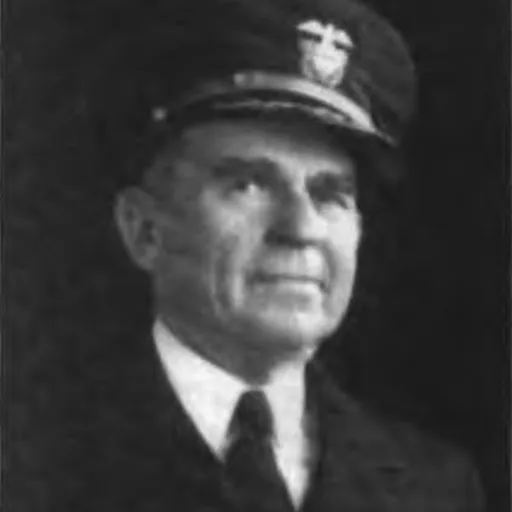
About William D. Puleston
Lived 1881 – 1968 (aged 87). William D. Puleston was a military officer, naval officer and author.
William Dilworth Puleston (September 1, 1881 – September 30, 1968) was an American naval officer and author. He was Director of Naval Intelligence from 1934 to 1937. He was considered "a popular, articulate and aggressive officer" and "an ideal planner, a student of world history and foreign affairs".
Early life William Puleston was one of four sons and two daughters of Samuel Richard Puleston, M.D., (born 22 March 1845 in Carmarthen, Wales-died Monticello, Florida, 1904) and his wife Lulu Dilworth Puleston. His father came from a family that originated in Willington Worthenbury, Wales, and emigrated to Florida to be with his uncle.
Naval career
Puleston entered the U.S. Naval Academy in 1898 and graduated in 1902. Promoted to ensign in 1904, he was promoted through the ranks to captain in 1926. He served in various ships until 1912, when he took command of the destroyer .
In 1914–15, as a lieutenant, he attended the Naval War College and stayed on for an additional year on the staff in 1915–16.During that time, he assisted the college's president, Rear Admiral Austin M. Knight, in preparing the first history of the college.
At the beginning of World War I, he was serving on the staff of the Commander in Chief of the Asiatic Fleet and was then transferred to duty as executive officer of . In January 1918, he was ordered to Queenstown, Ireland for duty with U.S. Naval Forces in Europe. For this service in World War I, he received the Navy Cross for heroism in convoy duty. His citation read:
The Navy Cross is awarded to Commander William D. Puleston, U.S. Navy, for distinguished service in the line of his profession as commanding officer of the U.S.S. Stringham, the U.S.S. Sigourney and the U.S.S. Cushing, engaged in the important, exacting and hazardous duty of patrolling the waters infested with enemy submarines and mines, in escorting and protecting vitally important convoys of troops and supplies through these waters, and in offensive and defensive action, vigorously and unremittingly prosecuted against all forms of enemy naval activity.
After World War I, he served in the Hydrographic Bureau, he was assigned to , served as assistant chief of staff in the Scouting Fleet in 1924, then served ashore in the Bureau of Navigation, 1925–27, before returning to sea in command of Destroyer Squadron Eleven. as assistant chief of staff in the Battle Fleet in 1928–29, after which he attended the Army War College and served on its faculty in 1929–32. After commanding the transport , he went on to command the battleship .
On 4 June 1934, Puleston took up the post of Director of Naval Intelligence. Taking over at a time of shrinking budgets for intelligence activities, Puleston faced a difficult situation. During his three-year tenure, the United States faced threats from subversive radical groups within the United States as well as from foreign agents. Among the most prominent cases he dealt with were the cases of the spies Harry Thompson, the former U.S. Navy sailor who spied for Japan in 1934–35, and John Semer Farnsworth. At the same time he initiated greater attention to Japan and China.
Under Puleston's period as Director, Congress authorized the expansion of the staff in Washington and established new attaché offices in 1936 at Rio de Janeiro and Lima, Peru. The offices at Berlin, Germany, Brussels, Belgium, Buenos Aires, London, Paris, Peking, Paris, and Tokyo continued. In addition, he laid the plans for new offices to open in 1937 in Santiago, Chile and Bogotá, Colombia. In Puleston's final "ONI Estimate of the Situation for 1939," issued just before his retirement in April 1937, he called for more counter-intelligence to deal with the rapidly changing world political and military situation.
Later career Captain Puleston was recalled to active duty and served as special advisor to the Secretary of the Treasury, 1939–40. Following the attack on Pearl Harbor, he was recalled again in January 1942 and served during World War II as special advisor on economic warfare to the Secretary of the Navy. For this service, he was awarded the Legion of Merit in 1945. His citation described his service, as follows
Personal Puleston married Marian Stanwood Emery on August 12, 1911, in Falmouth, Maine. Bishop Robert Codman officiated at the ceremony.
Puleston and his wife retired to Maine.
Publications
Books The Dardanelles Expedition: A Condensed Study (Naval Institute, 1925) High Command in the World War (C. Scribner's Sons, 1934) The Life and Work of Alfred Thayer Mahan (Yale University Press, 1939) The Armed Forces of the Pacific: A Comparison of the Military and Naval Power of the United States and Japan (Yale University Press, 1941) Annapolis: Gangway to the Quarterdeck [A History of the Naval Academy] (1942) — online HTML in full (Thayer's American Naval History site) The Influence of Sea Power in World War II (Yale University Press, 1947) The Influence of Force in Foreign Relations (D.Van Nostrand, 1955)
Contributions to Periodicals Scientific American, contributing editor Scribners Atlantic Monthly United States Naval Institute Proceedings
Awards & Decorations
Don’t just read it —
keep it.
Full-length biographies made to live with: read them, listen on the way to work, watch them tonight.
- E-book
- Audio
- Video
Instant download · yours to keep · every purchase keeps this site free
Important facts
People in William D. Puleston's life
Named in this biography and alive at the same time




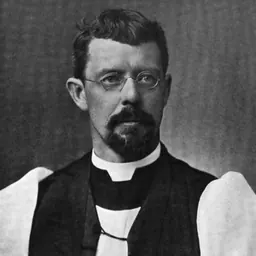

Related people
Same field, nearest in time

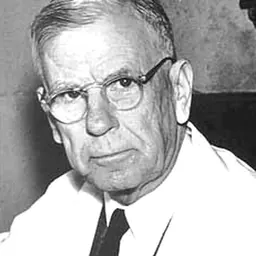

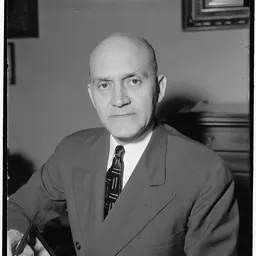
Contemporaries
People whose lives overlapped William D. Puleston's




Frequently asked questions
Who was William D. Puleston?
American Naval officer
When was William D. Puleston born?
William D. Puleston was born on 1 September 1881 in Monticello.
When did William D. Puleston die?
William D. Puleston died on 30 September 1968 in Portland.
What was William D. Puleston's occupation?
William D. Puleston was a military officer, naval officer and author.
Sources & further reading
· Wikipedia: William D. Puleston
· DBpedia: William D. Puleston
Cite this page
APA: Biography.guide. (2026). William D. Puleston. https://biography.guide/william-d-puleston/
MLA: "William D. Puleston." Biography.guide, https://biography.guide/william-d-puleston/.
Chicago: "William D. Puleston." Biography.guide. https://biography.guide/william-d-puleston/.
Data last updated: 2026-09-20 · Spot an error? Report a correction.
Page generated 2026-09-27 05:09 UTC