
About William Cookworthy
Lived 1705 – 1780 (aged 75). William Cookworthy was a British chemist, pharmacist and inventor.
William Cookworthy (12 April 170517 October 1780) was an English Quaker minister, a successful pharmacist and an innovator in several fields of technology. He was the first person in Britain to discover how to make hard-paste porcelain, like that imported from China. He subsequently discovered china clay in Cornwall. In 1768 he founded a works at Plymouth for the production of Plymouth porcelain; in 1770 he moved the factory to Bristol, to become Bristol porcelain, before selling it to a partner in 1773. In Kingsbridge there is now a museum named after him which features an exhibition about his life and works.
Parents, birth, siblings and early life He was born of Quaker parents in Kingsbridge, Devon on 12 April 1705. His father, also called William, was a weaver and his mother was Edith, the daughter of John and Margaret Debell of St Martin-by-Looe in east Cornwall: they had married in 1704. Their children were:
William – 1705 Sarah – 1706 Jacob – 1709 Susannah – 1711 Mary – 1714 Philip – 1716 Benjamin – 1717
William was a bright child but his education was halted when his father died on 22 October 1718 and the family's investment in the South Sea Company failed in the autumn of 1720.
William had been offered an apprenticeship, at no cost, by the Bevan Brothers, two Quaker apothecaries, with a successful business in London. As the family had no spare money, William walked to London to take up the offer and, eventually, completed the apprenticeship. He was taken into partnership.
Plymouth He moved to Plymouth, where he set up a pharmacy as Bevan and Cookworthy. This flourished. He eventually brought his brothers Philip and Benjamin into the partnership and bought out the Bevans' interest in 1745. He became prominent among Devon Quakers, being appointed as an Elder. Among his concerns was that Quakers should not tolerate their members trading in prize goods (ships and their cargoes seized in war), as Quakers should not benefit from war. However the Navy's Sick and Hurt Board, November 1, 1771, writes to Messers Cookworthy, Druggists requesting they supply Mr Thompson, Surgeon to the Marines at Plymouth's order. Whilst December 24, 1772 the Sick and Hurt Board were written to by Mr Raggett, Dispenser at Plymouth Hospital requesting a supply of medicines and necessaries which Cookworthy was ordered to supply, except those which were already in Raggett's stores.
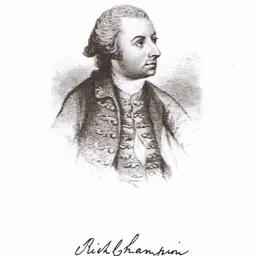
In Plymouth, records suggest that Cookworthy did not take any apprentices, but he did employ a young Henry Bone, who after the factory was moved to Bristol about 1770, was apprenticed to Richard Champion who with others became the owner of what became the Bristol Porcelain Manufactory. Although the Plymouth porcelain was not of high quality, Cookworthy is remembered for his discovery of those abundant supplies of English clay and rocks which later formed the foundation of English Bone China.
Swedenborg In 1767 Cookworthy, in conjunction with Rev Thomas Hartley, translated Emanuel Swedenborg's theological works, The Doctrine of Life, Treatise on Influx, and Heaven and Hell, from Latin into English.
Don’t just read it —
keep it.
Full-length biographies made to live with: read them, listen on the way to work, watch them tonight.
- E-book
- Audio
- Video
Instant download · yours to keep · every purchase keeps this site free
Important facts
People in William Cookworthy's life
Named in this biography and alive at the same time
Related people
Same field, nearest in time



Contemporaries
People whose lives overlapped William Cookworthy's




Frequently asked questions
Who was William Cookworthy?
British pharmacist
When was William Cookworthy born?
William Cookworthy was born on 12 April 1705 in Kingsbridge.
When did William Cookworthy die?
William Cookworthy died on 17 October 1780 in Plymouth.
What was William Cookworthy's occupation?
William Cookworthy was a chemist, pharmacist and inventor.
What nationality was William Cookworthy?
William Cookworthy was British.
Sources & further reading
· Wikipedia: William Cookworthy
Cite this page
APA: Biography.guide. (2026). William Cookworthy. https://biography.guide/william-cookworthy/
MLA: "William Cookworthy." Biography.guide, https://biography.guide/william-cookworthy/.
Chicago: "William Cookworthy." Biography.guide. https://biography.guide/william-cookworthy/.
Data last updated: 2026-09-20 · Spot an error? Report a correction.
Page generated 2026-09-27 05:30 UTC