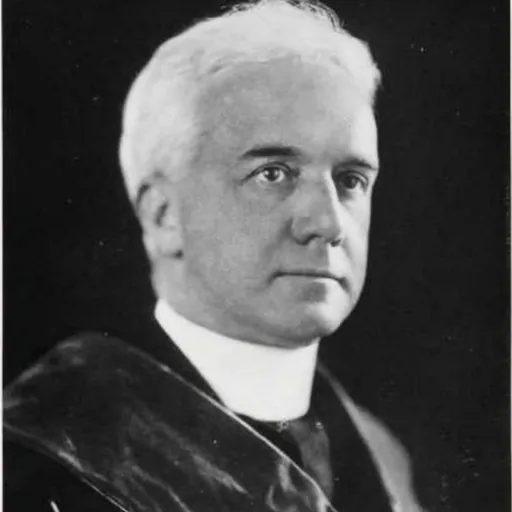
About William Coleman Nevils
Lived 1878 – 1955 (aged 77). William Coleman Nevils was an American catholic priest and academic administrator.
William Coleman Nevils (May 29, 1878 – October 12, 1955) was an American Catholic priest and Jesuit educator who became the head of numerous Jesuit institutions throughout the northeastern United States, including Georgetown University and the University of Scranton. Born in Philadelphia, he was educated at Saint Joseph's College, before entering the Society of Jesus. While studying for the priesthood, he taught at Boston College and the Loyola School. After receiving his doctorate from Woodstock College, he held professorships at St. Andrew-on-Hudson and the College of the Holy Cross, before transferring to Georgetown University, where he became the dean of Georgetown College, the academic vice president, and the regent of the School of Foreign Service. He then left Georgetown to become the dean of the Shadowbrook Jesuit House of Studies.
In 1928, Nevils was made the president of Georgetown University. He became active in elite circles in Washington, D.C., and elevated the prominence of the university in diplomatic and political circles. He also made substantial progress on a highly ambitious plan to transform the campus. After completing several Collegiate Gothic buildings, work on the Greater Georgetown plan stalled because of the Great Depression. In 1935, he left Georgetown and returned to New York City, where he became the president of Regis High School and the Loyola School, as well as pastor of the Church of St. Ignatius Loyola.
Though near retirement, Nevils became the first Jesuit president of the University of Scranton in 1942, after the Lasallian Brothers departed the school. He led the university through a change in administration, and the decline of enrollment due to World War II. During his presidency, the curriculum was improved, and Scranton Preparatory School was founded. After the end of the war, Nevils also saw the school through a surge in enrollment due to the G.I. Bill.
Nevils returned to New York City in 1947, and became the head of America magazine, and the superior of Campion House, the residence for the Jesuit editors of the publication. He also continued to teach at Regis and Loyola and minister at St. Ignatius Church, until his death in 1955.
Early life William Coleman Nevils was born on May 29, 1878, in Philadelphia, Pennsylvania, to Andrew P. and Mary Coleman Nevils. and went to teach Latin and Ancient Greek at Boston College.
Teaching career
After receiving his doctorate, Nevils became a professor of rhetoric at St. Andrew-on-Hudson. He then transferred to the College of the Holy Cross as a professor of philosophy. After some time, Nevils became a lecturer in sociology at Georgetown University, His tenure as dean came to an end in 1922.
After six years, Nevils left Georgetown in 1924 to become the dean of the Shadowbrook House of Jesuit Studies in Massachusetts, where he would remain for four years. In addition to being dean, he taught rhetoric and pedagogy at Shadowbrook. In 1925, he was proposed to become the next president of Boston College, but it as decided that someone from the Jesuits' New England province would be more suitable.
Georgetown University
On August 27, 1928, Nevils was elected the president of Georgetown University by the university's board of directors. During the ceremony, Nevils was awarded a Doctor of Divinity.
Nevils' presidency was characterized by an unprecedented level of engagement with communities outside of the university. One of his priorities was establishing Georgetown as a presence in the political and diplomatic circles of Washington, D.C. He revived the board of regents as a body focused on fundraising, and appointed alumni, as well as business leaders without any connection to Georgetown. He frequently hosted on-campus receptions for various dignitaries and attended diplomatic events in the city. He also became a fourth degree member of the Knights of Columbus, and a member of the Cosmos Club. These overtures were effective in raising the prominence of Georgetown in Washington's elite circles.
During the course of his presidency, Nevils reformed the curriculum of Georgetown College. He recruited several prominent faculty and increased the number of those with doctorates. He also abolished an abbreviated two-year pre-medical program, requiring students intending to go to medical school to complete the standard four-year undergraduate curriculum. Clinical research at the medical school improved under the direction of increasingly prominent clinical faculty. Nevils also raised the stature of the dental department. Throughout his presidency, Nevils aimed to increase the percentage of the faculty who were Catholic.
In 1934, Nevils' second term as president was coming to an end, and a group of faculty and alumni petitioned the Jesuit Superior General to allow Nevils to remain, given the economic turmoil and his proven ability as president. The superior general agreed to allow Nevils to remain for one additional year. In that time, Nevils identified Arthur A. O'Leary as his desired successor. After receiving approval in Rome, O'Leary succeeded Nevils as president in 1935. equivalent to $ in . While the original Greater Georgetown plan envisioned the quadrangle being named for the alumnus and Supreme Court Chief Justice Edward Douglass White, Nevils instead changed the name to the Andrew White Memorial Quadrangle, after the early Jesuit missionary to the United States. but construction was able to begin in June 1932. The building was named White-Gravenor Hall, after Andrew White and John Gravenor, two Jesuit missionaries. Rising four stories, its facade was composed of granite quarried from northern Maryland and gray stone repurposed from a recently dismantled bridge spanning Rock Creek. The building was completed in November 1933, and housed 20 classrooms, and several laboratories and large lecture halls. Nevils drew praise for being able to open two grand buildings in the midst of a depression without taking on any debt.
Despite desiring to continue with the ambitious plan to transform the campus, Nevils' intention to complete the Great Georgetown plan was eventually thwarted by the Great Depression. Among his plans that did not come to fruition were the enclosure of the quadrangle with a fourth building, the construction of a new home for the Georgetown University Hospital next to the Medical-Dental Building, the conversion of the existing hospital building at 35th and N Streets into a dormitory for professional student, and the construction of a 4,000-seat gymnasium on 37th Street between O and N Streets. He also sought to relocate the School of Foreign Service and Law School to the main campus. When Georgetown received word that President Franklin Roosevelt was about to close the banks in 1933, it withdrew $200,000 from Riggs Bank and kept it in the rooms of Edmund A. Walsh and the university's treasurer. While the number of undergraduate students dropped significantly between 1928 and 1933, the professional schools saw a slight increase.
Return to teaching After leaving Georgetown University, Nevils returned to New York City in 1935. There, he became the pastor of the Church of St. Ignatius Loyola, For a time, he was also the pastor of St. Aloysius Church. and developed a reputation as a talented and sought-after preacher.
University of Scranton
In 1942, the Bishop of Scranton, William Hafey, invited the Society of Jesus to take over the administration and ownership of the University of Scranton, which until then had been run by the Lasallian Brothers, who found themselves unable to supply a sufficient number of brothers to staff the school. The Jesuits accepted, and Hafey announced the change to the public on June 12; three days later, the Lasallian Brothers left Scranton. The first three Jesuits arrived on June 24, where they found the first classes of the academic year already underway. Nevils arrived on July 7, and was named the president of the university and rector of its Jesuit community by the Jesuit provincial superior. An accelerated three-year curriculum was in place, which had been implemented in the aftermath of the attack on Pearl Harbor.
The school's finances were also stabilized by requiring the payment of partial tuition upfront, which had previously often gone unpaid. With the Lasallian Brothers' former residence being inadequate to accommodate the number new Jesuits, Nevils decided to convert elaborate Scranton family mansion, which had been recently donated to the bishop, into the Jesuit residence. he returned to the Church of St. Ignatius Loyola as the spiritual director of the Jesuit community, where he would remain until his death.
In February 1955, he became ill with coronary thrombosis. His health worsened in October, and he died on October 12, 1955, at St. Vincent's Hospital in New York City.
Throughout his life, Nevils had been honored by the governments of Yugoslavia, Chile, Romania, Czechoslovakia, France, and Jerusalem, He also received honorary doctorates from Loyola University of Los Angeles and Saint Joseph's College. In 1965, Nevils Hall, a student residence, was opened at the University of Scranton.
Works
Don’t just read it —
keep it.
Full-length biographies made to live with: read them, listen on the way to work, watch them tonight.
- E-book
- Audio
- Video
Instant download · yours to keep · every purchase keeps this site free
Important facts
People in William Coleman Nevils's life
Named in this biography and alive at the same time



Related people
Same field, nearest in time

Contemporaries
People whose lives overlapped William Coleman Nevils's






Frequently asked questions
Who was William Coleman Nevils?
American Jesuit educator (1878-1955)
When was William Coleman Nevils born?
William Coleman Nevils was born on 29 May 1878 in Philadelphia.
When did William Coleman Nevils die?
William Coleman Nevils died on 12 October 1955 in St. Vincent's Hospital.
What was William Coleman Nevils's occupation?
William Coleman Nevils was a catholic priest and academic administrator.
What nationality was William Coleman Nevils?
William Coleman Nevils was American.
Sources & further reading
· Wikipedia: William Coleman Nevils
Cite this page
APA: Biography.guide. (2026). William Coleman Nevils. https://biography.guide/william-coleman-nevils/
MLA: "William Coleman Nevils." Biography.guide, https://biography.guide/william-coleman-nevils/.
Chicago: "William Coleman Nevils." Biography.guide. https://biography.guide/william-coleman-nevils/.
Data last updated: 2026-09-20 · Spot an error? Report a correction.
Portrait: Wikimedia Commons · author & licence
Page generated 2026-09-27 04:57 UTC